Have you ever caught yourself staring in the mirror, wondering why your teeth don’t line up like a perfectly stacked row of bricks? Or perhaps you have noticed that chewing a tough piece of food feels more like a jaw workout than a meal. If your teeth feel crowded, crooked, or your upper and lower jaws do not quite meet comfortably, you are likely experiencing a malocclusion of teeth. In plain English, malocclusion meaning translates to a “bad bite.” At Nipissing Dental, we see patients every week who believe a misaligned bite is purely an aesthetic issue. But dental occlusion — the technical term for occlusion in dentistry that describes how your upper and lower teeth interact — is the foundation of your entire oral health ecosystem. A poorly aligned bite changes how you chew, how you speak, how easily you can clean your teeth, and it can even trigger chronic jaw pain. Let’s take a deep, hype-free look at what is malocclusion of teeth, the common causes of malocclusion of the teeth, how dentists classify it, and the modern orthodontic solutions for bite problems.
What Is Malocclusion of Teeth in Dentistry?
To fully grasp what is malocclusion of teeth, we first need to look at proper, resting teeth in occlusion. In an ideal mouth, your upper teeth sit slightly outside your lower teeth. The points (cusps) of your upper molars should fit perfectly into the grooves of your lower molars. This natural design distributes the massive pressure of chewing evenly across your entire skull and jaw structure.
- Proper Dental Occlusion: Upper teeth overlap lower teeth slightly; forces distribute evenly across the jaw and skull.
- Malocclusion of the Teeth: Teeth are crowded, twisted, or jaws are misaligned; forces distribute unevenly, causing premature wear and strain.
When you have a malocclusion, this harmony is disrupted. Your teeth may be crowded, rotated, or your jaws might be physically disproportionate. This structural misalignment forces your jaw muscles to work twice as hard to perform basic functions, leading to premature tooth wear and significant occlusal issues. If left untreated, these issues can become serious enough to require advanced care such as crowns and bridges in Milton or even dental implants in Milton.
How Do Dentists Classify Your Bite? (Angle’s Classification)
Dentists do not just look at a malocclusion of teeth and say, “Yep, that’s crooked.” We use a standardized diagnostic framework called Angle’s classification in dentistry, developed by Dr. Edward Angle to organize different dental occlusion classes and types of malocclusion of the teeth.
Understanding what are dental occlusion classes helps our clinical team at Nipissing Dental Clinic chart a highly predictable, effective treatment plan. If you are looking for a beginner guide to malocclusion, this system splits bites into 3 types of malocclusion:
Class I Dental Occlusion Explained
A Class I dental occlusion is actually the most common relationship between the jaws. In a malocclusion Class 1 (or dental occlusion Class 1), your overall bite line is normal — meaning your upper and lower jaws meet exactly where they should — but individual teeth are crowded, spaced out, overlapping, or rotated. When explaining a dental occlusion Class 1 to a patient, think of it as having a perfectly sized garage, but the cars inside are parked completely sideways.
Class II Malocclusion (The Overbite)
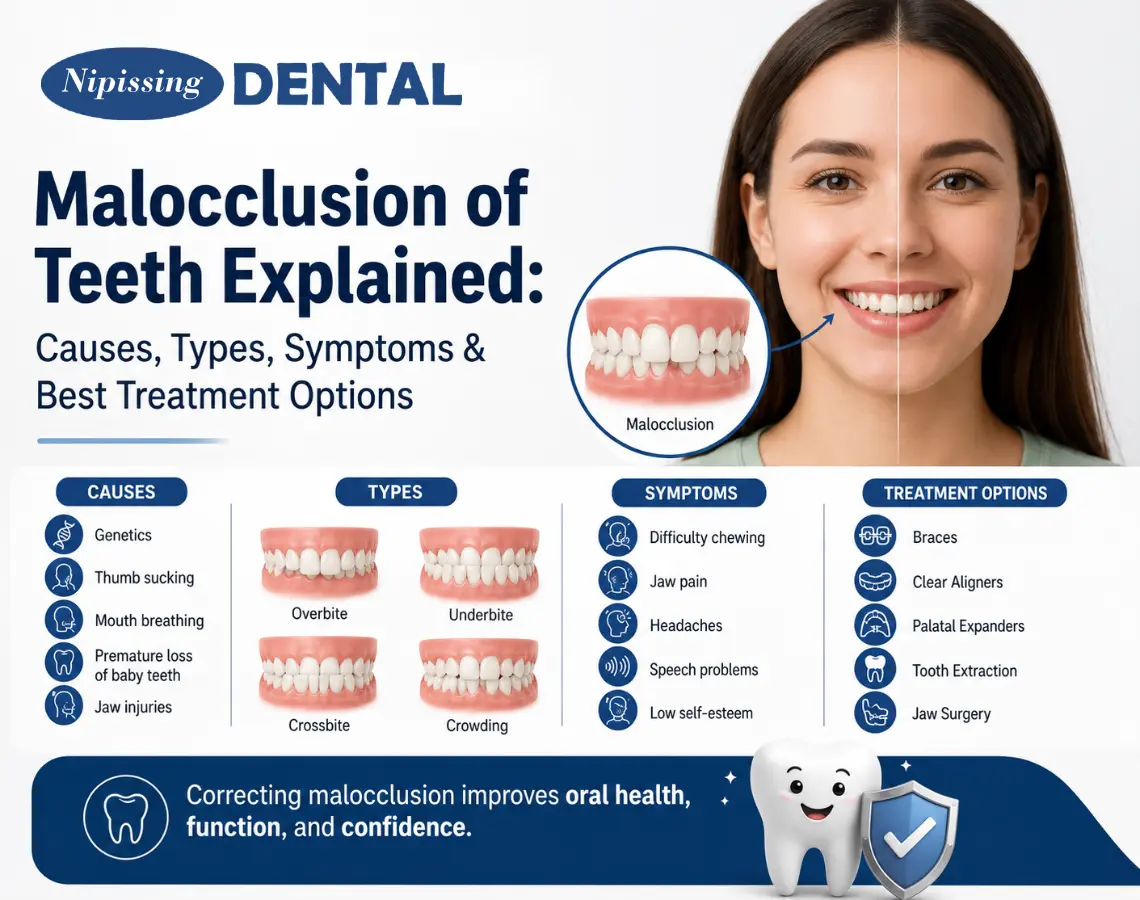
In a Class II relationship, the upper jaw and teeth severely overlap the lower jaw and teeth. This is often driven by a retrognathic mandible, meaning the lower jaw is structurally smaller or set further back than the upper jaw. It frequently results in a pronounced overbite smile. Our team provides targeted overbite treatment through Invisalign clear aligners in Milton or traditional braces, depending on severity.
Class III Malocclusion (The Underbite)
A malocclusion Class 3 occurs when the lower jaw protrudes forward, causing the lower front teeth to sit entirely in front of the upper front teeth when the mouth is closed. Commonly referred to as a Class 3 bite or Class 3 underbite, this structural imbalance can severely restrict normal chewing and noticeably alter a patient’s facial profile.
Beyond the Big Three: Other Types of Bites
While the occlusion classification system covers the structural foundation, we also classify specific variations in how individual teeth meet. Here is a breakdown of what are the different types of malocclusions and dental bite problems patients encounter:
- Crossbite: This happens when your upper teeth close inside your lower teeth. A crossbite can happen on one side of your mouth (posterior) or right at the front (anterior), causing the jaw to shift to one side when chewing.
- Open Bite: If your back molars touch but your front teeth cannot meet when you close your mouth fully, you have an open bite. This makes tearing into food like apples or pizza incredibly frustrating.
- Overcrowding: The most frequent culprit behind a malocclusion Class 1. The dental arch simply lacks the physical real estate required to hold all your adult teeth in a straight line, forcing them to twist or erupt out of place, leading to crooked teeth. Invisalign clear aligners in Milton are a highly effective and discreet solution for mild to moderate overcrowding.
Overbite vs. Overjet Explained
Many people use these terms interchangeably, but looking at the difference between overbite vs overjet reveals they describe entirely different dimensions of a smile:
| Feature | Overbite | Overjet |
|---|---|---|
| Dimension | Vertical overlap | Horizontal gap |
| Description | How far the top teeth hang down over the bottom teeth. | The distance your top front teeth stick out past the lower teeth (often called “buck teeth”). |
| Visual Indicator | A deep overbite smile may hide the lower teeth completely. | A noticeable horizontal space between the front and bottom teeth. |
Causes of Malocclusion of Teeth
For the vast majority of people, malocclusion of teeth is a genetic hand-me-down. You inherit the physical size of your jaw from one parent and the physical size of your teeth from the other. If you inherit a narrow jaw but wide teeth, severe overcrowding and jaw misalignment are practically guaranteed.
However, specific environmental factors and childhood habits can also physically alter the shape of a developing jawbone, leading to what causes bite misalignment:
- Prolonged Childhood Habits: Sucking thumbs, fingers, or pacifiers past the age of three places constant upward and outward pressure on the developing palate, often causing a severe overjet or an open bite. Our children’s dentist in Milton can monitor developing jaw alignment and advise parents early on.
- Tongue Thrusting: Swallowing by pushing the tongue forward against the teeth rather than upward against the roof of the mouth can gradually push front teeth out of alignment.
- Early Tooth Loss: Losing primary (baby) teeth too early due to decay or injury allows neighboring teeth to drift into the empty space, blocking the permanent adult teeth waiting to erupt below. Timely dental fillings in Milton can help preserve baby teeth and prevent this from happening.
- Physical Trauma: A severe jaw fracture or facial injury can alter how the upper and lower jaws align during the healing process. If you’ve experienced trauma, our emergency dentist in Milton can assess your bite and recommend prompt intervention.
Signs and Symptoms of Malocclusion of Teeth
How do you know if your malocclusion of teeth is genuinely problematic or just unique? The symptoms of malocclusion of teeth range from obvious cosmetic concerns to subtle, painful structural issues:
- Visible misalignment, crowding, or large gaps between teeth.
- Biting the insides of your cheeks or your tongue frequently while eating.
- Difficulty pronouncing certain sounds, resulting in a slight lisp or speech impediment.
- Breathing habitually through your mouth rather than your nose, especially during sleep.
- Discomfort or fatigue in your jaw muscles after eating standard meals. Custom night guards and sports guards in Milton can provide relief from jaw strain caused by bite imbalances.
- Frequent, unexplained tension headaches or pain centered around your temporomandibular joint (TMJ).
What Happens if Malocclusion of Teeth Is Untreated?
It is tempting to think that minor malocclusion of teeth is harmless. However, leaving moderate to severe types of malocclusions in dentistry uncorrected acts as a slow-motion catalyst for larger systemic oral problems.
When teeth overlap severely, they create tight, hard-to-reach nooks where plaque and tartar accumulate undisturbed. Because traditional brushing and flossing cannot reach these areas, patients with crowded teeth exhibit significantly higher rates of localized gum disease and tooth decay — eventually requiring specialized treatment like dental cleanings and periodontal therapy in Milton.
Furthermore, an uncorrected jaw misalignment forces specific teeth to absorb the brunt of your chewing forces. This concentrated, uneven structural stress leads to premature enamel erosion, micro-fractures in the teeth, and chronic jaw joint strain — sometimes requiring root canals in Milton or crowns and bridges in Milton to restore damaged teeth. Over time, this imbalances the entire oral complex.
How Dentists Diagnose Malocclusion of Teeth
Identifying malocclusion of teeth requires a systematic clinical assessment. When you visit a local dental clinic for malocclusion like Nipissing Dental Care, the process of how dentists diagnose malocclusion involves three foundational steps:
- Comprehensive Visual Exam: The dentist checks how your jaw moves, looks for signs of uneven enamel wear, and evaluates how your teeth meet during relaxed and active biting.
- Digital Diagnostics: Specialized panoramic and cephalometric (side-profile) X-rays are taken to look directly at the roots of your teeth and the precise relationship between your jawbones and skull. Our advanced dental technology in Milton ensures the highest diagnostic precision. According to the American Dental Association (ADA), thorough diagnostic imaging before orthodontic therapy significantly improves clinical outcomes.
- Digital Impressions: Modern practices utilize advanced intraoral scanners to build a highly accurate 3D digital model of your mouth. This replaces the messy, uncomfortable putty impressions of the past and allows for highly precise treatment planning. The Canadian Dental Association (CDA) endorses the use of digital diagnostics as a leading-edge standard of care in modern orthodontic assessment.
Modern Malocclusion of Teeth Treatment Options
Fixing malocclusion of teeth is no longer a one-size-fits-all journey involving a mouth full of metal brackets for two to three years. Today, orthodontic treatment for malocclusion is highly customized, discrete, and adapted to adult lifestyles. While patients often search online for how to fix malocclusion naturally, true structural alignment requires professional biomedical guidance. The right bite alignment treatment choice depends heavily on your specific classification, age, and clinical needs.
1. Clear Aligners (Invisalign)
For mild to moderate cases of crowding, spacing, and minor occlusal issues, clear aligners have revolutionized dental care. These clear, removable medical-grade plastic trays apply precise, incremental forces to move teeth into position. If you are wondering can Invisalign treat malocclusion or can Invisalign correct overbite, the answer is a resounding yes for most adolescent and adult cases. They are highly sought after by working professionals because they are nearly invisible and can be taken out to eat, brush, and floss normally. Book a consultation for Invisalign clear aligners in Milton to find out if this option is right for you.
2. Traditional and Ceramic Braces
For complex structural movements — such as correcting a severe Class 3 underbite or an extreme overjet — traditional braces for malocclusion remain the gold standard. Modern brackets are smaller and more streamlined than ever before. For patients seeking a subtle look, tooth-colored ceramic braces blend beautifully with your natural enamel while providing the structural strength needed to guide complex tooth roots into place. Our cosmetic dentistry team in Milton can discuss which braces option suits your aesthetic and functional needs best.
3. Palatal Expanders
Most effective in children and young teenagers whose jawbones haven’t fully fused, a palatal expander gently widens a narrow upper jaw. By creating more physical space across the roof of the mouth, this appliance naturally resolves severe crowding issues and can prevent the need for tooth extractions later in life. Our children’s dentist in Milton identifies candidates for early interceptive orthodontics at routine checkups. According to Health Canada, early dental intervention in children significantly reduces the complexity and cost of orthodontic treatment in adolescence and adulthood.
4. Surgical Interventions (Orthognathic Surgery)
For adult patients dealing with a severe structural jaw bite correction — such as an extreme skeletal Class II or Class III discrepancy — orthodontic movement alone may not suffice. In these advanced cases, an orthodontist works alongside a maxillofacial surgeon to physically reposition the jaw bones, restoring balance, function, and comfort to the entire facial profile. After surgical correction, restorative work such as crowns and bridges in Milton may be recommended to rebuild teeth affected by years of misalignment stress.
The Oral-Systemic Connection: Why a Healthy Bite Matters
Many people treat their bite as an isolated cosmetic issue. In reality, malocclusion of teeth is a structural problem that can ripple through your entire systemic health.
Chronic malocclusion leads to gum disease and tooth decay — and medical research from institutions like the Mayo Clinic and Harvard Medical School has repeatedly confirmed that chronic gum disease correlates with several serious full-body health conditions:
Cardiovascular Disease
Oral bacteria from inflamed, overcrowded teeth can enter the bloodstream and attach to fatty plaques in your arteries, contributing to inflammation, blood clots, and an increased risk of heart attacks and strokes. This is documented science, not a scare tactic. The American Dental Association (ADA) consistently highlights the relationship between poor oral health and cardiovascular risk in its clinical guidelines.
Diabetes Management
Chronic oral infections raise systemic inflammation, making it significantly harder to control blood sugar levels. Conversely, poorly managed diabetes reduces your body’s ability to fight off oral infections. Health Canada acknowledges the strong bidirectional link between oral health and systemic conditions including diabetes.
Respiratory Infections
High volumes of bacterial plaque — especially in hard-to-clean crowded teeth — can be accidentally aspirated into the lungs, potentially leading to conditions like aspiration pneumonia or worsening chronic obstructive pulmonary disease (COPD). The Canadian Dental Association (CDA) emphasizes that preventive oral care and timely correction of malocclusion directly supports better respiratory health outcomes.
By treating malocclusion proactively, you are not just straightening your smile — you are protecting your entire body. Our family dentistry team in Milton takes a whole-health approach to every patient’s dental care plan.
The Benefits of Treating Malocclusion of Teeth: A Quick Overview
| Benefit | Clinical Outcome | Why It Matters |
|---|---|---|
| Stops Premature Tooth Wear | Eliminates uneven chewing pressure across specific teeth. | Prevents micro-fractures, enamel erosion, and the need for restorations. |
| Improves Oral Hygiene Access | Eliminates crowded, overlapping surfaces where plaque hides. | Reduces risk of cavities, gum disease, and need for deep cleaning. |
| Eliminates Jaw Pain and Headaches | Relieves chronic muscle strain in the jaw and TMJ joint. | Reduces tension headaches and jaw fatigue associated with bite problems. |
| Protects Systemic Health | Lowers overall systemic inflammation by preventing oral infections. | Reduces risks associated with heart disease, diabetes, and stroke. |
| Enhances Aesthetic Confidence | Straightens crowded, rotated, or protruding teeth. | Restores a balanced, healthy, and confident smile. |
Looking for Bite Correction? Connect with Nipissing Dental Care in Milton
If you are tired of dealing with crooked teeth, jaw discomfort, or a smile that just doesn’t feel right, you don’t have to navigate it alone. Seeking malocclusion treatment is one of the most proactive steps you can take to preserve your natural smile for decades to come.
At Nipissing Dental Milton, our experienced clinical team — led by Dr. Disha Hans (DMD, Boston University)— provides personalized, comprehensive evaluations to determine the exact root cause of your bite irregularities. We proudly serve patients in English, Hindi, Urdu, and Punjabi. Whether you are looking for an overbite treatment Milton, an underbite correction Milton, or simply a dental occlusion treatment near me, we focus on creating healthy, functional smiles that last.
Our team specializes in customized care, ranging from Invisalign for malocclusion in Milton to traditional braces for malocclusion Milton. We provide top-tier orthodontic care in a warm, welcoming environment designed around your peace of mind.
Ready to discover what a balanced bite alignment can do for your comfort and confidence? Contact our clinic today to book your orthodontic consultation in Milton. If you have experienced a sudden change in your bite due to trauma or dental shifting, we also offer an emergency dental consultation in Milton to restore your alignment quickly. Let us be your trusted bite correction dentist Milton and your go-to dentist for malocclusion in Milton.
Frequently Asked Questions (FAQ)
Protect Your Smile at Nipissing Dental Milton
A malocclusion of teeth is a quiet but progressive condition that can affect everything from your tooth enamel to your jaw joints to your overall health. Ignoring it only allows the structural imbalance to deepen over time. Whether you need a simple crowding correction or a comprehensive bite realignment, our team is here to guide you every step of the way.
At Nipissing Dental, our dedicated team combines advanced dental technologies with a patient-first approach to make sure your treatment is thoroughly comfortable and highly successful.
Do not let a bad bite put your smile or your systemic health at risk. Contact Nipissing Dental Clinic today to schedule your comprehensive orthodontic evaluation and take the first step toward lifelong oral health.
Explore our related services:
- Invisalign Clear Aligners in Milton — Discreet, removable aligners for mild to moderate bite correction
- Cosmetic Dentistry in Milton — Restoring the aesthetic appearance of your smile after bite correction
- Family Dentistry in Milton — Comprehensive oral health care for every member of your household
- Children’s Dentist in Milton — Early interceptive orthodontics and jaw growth monitoring for kids
- Dental Cleanings in Milton — Preventive care to protect teeth against gum disease caused by crowding
- Crowns and Bridges in Milton — Rebuilding and protecting teeth damaged by years of bite misalignment
- Dental Implants in Milton — Restorative solutions when malocclusion has caused severe tooth loss
- Root Canals in Milton — Advanced care when bite stress has led to deep internal tooth damage
- Emergency Dentist in Milton — Fast care for sudden bite changes, jaw pain, or dental trauma
- Extractions and Wisdom Teeth Removal in Milton — When overcrowding cannot be resolved without tooth removal
- Night Guards and Sports Guards in Milton — Protection against jaw clenching and grinding worsened by bite misalignment
- Dental Fillings in Milton — Restoring decay caused by plaque buildup in hard-to-clean crowded teeth
Book Your Orthodontic Consultation at Nipissing Dental, Milton ON
Don’t let a misaligned bite steal your comfort and confidence. At Nipissing Dental, our friendly team provides fast, comfortable, and effective bite correction and orthodontic treatment in Milton — with no surprises and no unnecessary waiting.
References & Trusted Sources
This article was developed using expert dental knowledge and validated against the following trusted health and dental authorities:
- American Dental Association (ADA) — Clinical guidelines on orthodontic treatment, malocclusion classification, diagnostic imaging, and patient care protocols
- Canadian Dental Association (CDA) — Canadian clinical standards for orthodontic assessment, bite correction, and adult and pediatric treatment planning
- Health Canada — Oral health guidance, early intervention recommendations, and systemic connections to untreated dental conditions