If you’ve spent years hiding your smile because of an underbite, you’re probably wondering whether Invisalign is finally your answer — or just another overpromised solution. I get it. Patients at Nipissing Dental come to me all the time asking, “Can Invisalign fix underbite?” and honestly, the answer is more nuanced than a simple yes or no.
Let me walk you through what you really need to know — clearly, honestly, and without the dental jargon overload. Whether you’ve been searching for Invisalign near me or wondering whether can Invisalign fix underbite cases like yours, this guide covers everything. To get a full picture of your current oral health, we always recommend starting with a comprehensive dental cleaning and exam before beginning any orthodontic treatment.
What Is an Underbite and Why Does It Happen?
An underbite — technically called a Class III malocclusion — occurs when your lower teeth sit in front of your upper teeth when you close your mouth. It can range from barely noticeable to quite pronounced, and it is rarely just a cosmetic concern.
According to the American Dental Association (ADA), bite misalignments left untreated can contribute to jaw discomfort, uneven tooth wear, and difficulties with chewing and speech over time.
Common causes include:
- Genetics — Underbites often run in families. If one or both parents had jaw alignment issues, there is a good chance you might too.
- Childhood habits — Prolonged pacifier use, thumb-sucking, or tongue thrusting can influence jaw development over time.
- Jaw bone discrepancy — In some cases, the lower jaw simply grows more than the upper, creating a skeletal misalignment.
- Missing upper teeth — Tooth loss can gradually shift the bite. If a tooth was recently lost or extracted, our dental implants in Milton and extractions and wisdom teeth services can help restore stability before orthodontic treatment begins. Our family dentistry in Milton team can also assess overall bite stability during your regular visits.
Understanding the root cause matters — because how does Invisalign work for underbites really depends on whether the problem is dental (tooth position) or skeletal (jaw structure).
Does Invisalign Work for Underbites? Here’s the Honest Answer
Yes — but with important caveats.
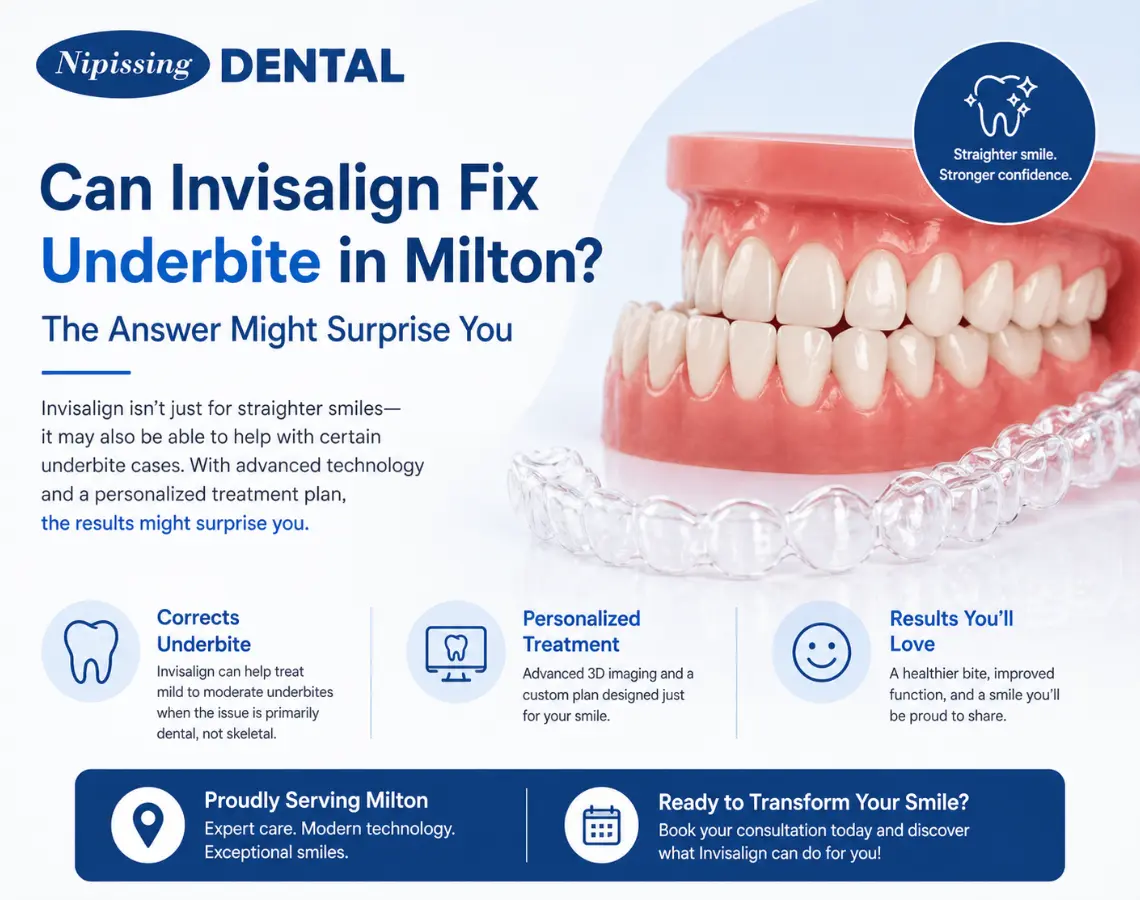
Invisalign aligners can effectively fix underbites that are dental in nature, meaning the misalignment comes from the position of your teeth rather than your jaw bones. In these cases, the clear aligners gently guide teeth into proper alignment over time. The results can be genuinely impressive, especially when you review Invisalign before and after photos from comparable cases.
However, if your underbite is skeletal — caused by a misaligned jaw structure — Invisalign alone may not be sufficient. In those situations, orthodontic treatment may need to be combined with jaw surgery (orthognathic surgery) or other interventions. This is why a thorough professional evaluation is absolutely essential before you begin.
The good news? Many mild to moderate underbites are dental in origin, and our Invisalign in Milton service has helped patients achieve successful, non-surgical corrections. Does Invisalign work for your specific case? That can only be confirmed after a proper clinical assessment.
Important note on dental health before starting: Before any orthodontic treatment, your teeth and gums must be in good health. Issues like cavities may require dental fillings in Milton, and gum health is verified through dental cleanings before aligners begin.
How Do Invisalign Aligners Fix Underbite Issues?
Here is the process in plain terms. Invisalign uses a series of custom-made, removable clear trays that apply gentle, consistent pressure to move your teeth gradually. Each set of aligners shifts your teeth slightly — and you swap to a new set roughly every one to two weeks.
For underbite correction specifically, your dentist may also use:
- Attachments — Small tooth-coloured bumps bonded to certain teeth that give the aligners better grip and more precise directional control.
- Elastics (rubber bands) — These hook between upper and lower aligners to help guide the jaw relationship into proper positioning.
- Precision cuts — Custom slots in the aligner trays that allow for elastic attachment, greatly improving bite correction efficiency.
This combination approach is what makes can Invisalign fix underbite a realistic option for many patients in Milton who previously assumed they would need traditional braces or surgery.
It is also worth knowing that crowns and bridges in Milton are sometimes needed to restore damaged teeth before or after Invisalign treatment, depending on your individual oral health profile. Similarly, patients wearing custom night guards and sports guards should discuss timing with their dentist, as guards and aligners may overlap during treatment.
If you are also considering aesthetic improvements alongside bite correction, our cosmetic dentistry in Milton services can be planned in coordination with your aligner treatment for a complete smile transformation.
How Long Does Invisalign Take to Fix an Underbite?
This is one of the most common questions I hear — and understandably so. How long does Invisalign take is often the deciding factor for busy adults.
Typical Invisalign treatment for an underbite ranges from 12 to 24 months, depending on the severity of the misalignment, how consistently you wear your aligners, and your individual biology.
| Underbite Severity | Estimated Treatment Time |
|---|---|
| Mild (dental only) | 6–12 months |
| Moderate | 12–18 months |
| Severe (dental component) | 18–24+ months |
| Skeletal (with surgery) | Varies — consult required |
One thing that directly affects how long will Invisalign take in your case: compliance. The aligners must be worn 20 to 22 hours per day to stay on schedule. Skipping wear time does not just slow things down — it can compromise your results entirely. This is something the Canadian Dental Association (CDA) consistently emphasises in patient care guidelines: treatment outcomes depend heavily on patient adherence to prescribed protocols.
Research published by the National Institutes of Health (NIH) further supports that clear aligner therapy achieves optimal results when combined with regular professional monitoring — which is exactly what our check-in schedule at Nipissing Dental is designed to provide.
What to Expect: Discomfort, Pain, and the First Few Weeks
Let me be straightforward with you — does Invisalign hurt? Not exactly, but it is not entirely comfortable either, especially in the early stages.
Most patients describe the sensation as pressure rather than pain, particularly in the first few days of wearing a new set of aligners. This is completely normal and signals that the aligners are doing their job moving your teeth.
Here is what to typically expect:
- Days 1–3 of each new tray: Mild pressure, slight soreness when biting down
- Week 1–2: An adjustment period; speaking may feel slightly different
- Ongoing: Discomfort usually becomes minimal as your mouth adapts to each new tray
If you are already dealing with dental anxiety on top of this, know that you are not alone. Our team has dedicated resources for dental anxiety support in Milton to make your entire treatment journey as comfortable as possible.
If you experience sharp, stabbing, or persistent pain that does not improve after a few days, do not delay — contact our emergency dentist in Milton promptly. Unusual or sustained pain is not a typical Invisalign response and warrants an immediate check-in.
Step-by-Step: Getting Invisalign for an Underbite in Milton
Here is what the process generally looks like at Nipissing Dental:
- Step 1 — Initial Consultation: We assess whether your underbite is dental or skeletal and confirm whether Invisalign is the right treatment path for you. We also review your full oral health, including any need for prior dental cleanings or fillings.
- Step 2 — Digital Scans and Treatment Planning: 3D imaging maps out your teeth and shows you a projected Invisalign before and after simulation so you can visualise your future smile.
- Step 3 — Aligner Fabrication: Your custom trays are manufactured to precise specifications and delivered to our clinic.
- Step 4 — Aligner Fitting: You receive your first few sets and detailed instructions on wear and care routines.
- Step 5 — Regular Check-Ins: Every 6 to 10 weeks, you will visit us to monitor progress and collect new trays.
- Step 6 — Refinements (if needed): Additional aligner sets are sometimes required to fine-tune the bite correction.
- Step 7 — Retainers: After treatment ends, retainers are essential to maintaining your new bite permanently. This step is non-negotiable. If you grind your teeth at night, pairing your retainer with one of our custom night guards is strongly recommended to protect your results.
How to Clean Invisalign Trays (and Why It Matters)
Proper hygiene is a significant part of making your treatment both successful and comfortable. Here is how to clean Invisalign trays correctly:
- Rinse them every time you remove them — Saliva dries on the trays and creates a film where bacteria thrive rapidly.
- Brush them gently — Use a soft toothbrush and lukewarm water. Avoid hot water — it can warp the plastic and ruin the fit.
- Use Invisalign cleaning crystals or a denture cleaner — These are formulated specifically for aligner trays.
- Never soak in mouthwash — Many mouthwashes contain dyes that permanently stain the trays.
- Keep your teeth clean before reinserting — Always brush and floss before putting aligners back in to avoid trapping food and bacteria.
Good oral hygiene throughout Invisalign treatment is not optional — it is how you protect your teeth from cavities and gum irritation. Health Canada recognises oral hygiene maintenance as a foundational component of overall health, and this applies especially during active orthodontic treatment. Scheduling regular dental cleanings in Milton throughout your Invisalign journey helps ensure your gums and enamel stay healthy from start to finish.
Does Invisalign Fix Overbite Too?
Yes — does Invisalign fix overbite is another very common question, and the answer is also yes in most cases. Invisalign is commonly used to correct overbites, where the upper teeth protrude significantly over the lower teeth. The treatment mechanics are similar: a combination of aligner pressure, attachments, and sometimes elastics helps reposition teeth and gradually improve jaw relationship.
Whether you are dealing with an underbite, overbite, crossbite, or crowding, the first step is always the same — a professional evaluation. Our cosmetic dentistry in Milton page covers the full range of smile correction options available at our clinic. You may also be a candidate for teeth whitening in Milton at the end of your treatment, which many patients combine with Invisalign for a full smile transformation.
For younger patients: If your child is showing early signs of bite misalignment, our children’s dentist in Milton team can evaluate jaw development and recommend the right timing for orthodontic intervention. Early detection through our family dentistry in Milton check-ups can prevent more complex corrections later.
I Know This Can Feel Overwhelming — But You’re Not Alone
I understand how daunting it can be to consider orthodontic treatment — especially when something like your bite affects how you speak, eat, and feel about your smile every single day. Patients often arrive with a mix of hope and hesitation, and I completely understand that.
Here is the reassuring truth: underbite correction with Invisalign is one of the most manageable orthodontic treatments we offer. The right aligner plan, combined with a few consistent habits, can genuinely transform your smile for decades. The key is acting sooner rather than later.
If you have been hiding your smile, struggling with jaw discomfort, or someone has pointed out your bite alignment, please do not put this off. An early intervention today can save you considerable pain — and significant cost — down the road. The Canadian Dental Association (CDA) consistently emphasises that early orthodontic assessment leads to significantly better long-term outcomes. Additionally, the Mayo Clinic notes that patient consistency is one of the strongest predictors of orthodontic success regardless of treatment type.
If a tooth develops an infection or requires endodontic care during your treatment, it can typically be addressed without abandoning your aligner plan. Our root canals in Milton team coordinates closely with your Invisalign provider to minimise disruption to your treatment timeline.
Conclusion
So, can Invisalign fix underbite? For most patients with dental-origin misalignment — absolutely yes. It protects your jaw, realigns your teeth, improves function, and restores confidence in your smile. With the right treatment plan, consistent wear, and professional monitoring, the results can be life-changing.
Whether you are in Milton or anywhere else, the message is the same: if you suspect an underbite is affecting your quality of life, do not wait. Book an appointment with your dentist, discuss your symptoms honestly, and ask about getting a customised Invisalign plan. Health Canada’s oral health guidelines reinforce that preventive and early corrective dental care is a cornerstone of long-term wellness.
Your future self — and your smile — will thank you. The team at Nipissing Dental is here to guide you through every step with care and expertise. Book your appointment today.
References & Trusted Sources
-
- American Dental Association (ADA) – Clinical Guidelines on Orthodontic Treatment
- Canadian Dental Association (CDA) – Patient Care Standards
- Health Canada – Dental Care Guidelines
- National Institutes of Health (NIH) – Research on Clear Aligner Therapy
- Mayo Clinic – Malocclusion and Orthodontic Options
Frequently Asked Questions
Can Invisalign fix underbite?
Yes — Invisalign can effectively correct underbites that are dental in origin, meaning the misalignment is caused by tooth positioning rather than jaw structure. Using custom clear aligners, elastics, and precision attachments, Invisalign gradually shifts the teeth into proper alignment. Skeletal underbites may require surgical intervention alongside aligner therapy.
How long does it take Invisalign to work?
You may begin to notice subtle shifts in your tooth positioning within the first two to three months, but significant visible change typically becomes apparent around the six-month mark. Full underbite correction generally takes 12–24 months depending on severity and daily compliance with wear time.
Does Invisalign hurt?
Most patients experience mild pressure rather than outright pain, especially during the first few days of wearing a new set of trays. This sensation is normal and indicates that the aligners are actively moving your teeth. Discomfort typically becomes minimal as your mouth adjusts to each new tray.
What is the 30-minute rule with Invisalign?
After eating or drinking anything other than plain water, it is recommended that you wait approximately 30 minutes before reinserting your aligners. This allows your saliva to neutralise mouth acids and reduces the risk of trapping harmful bacteria against your teeth under the tray.
Does Invisalign fix overbite?
Yes — Invisalign is also commonly used to correct overbites, where the upper teeth significantly overlap the lower teeth. The treatment approach uses a similar combination of aligner pressure, attachments, and elastics to gradually reposition the teeth and improve the jaw relationship. A professional evaluation at Nipissing Dental in Milton will confirm the best approach for your bite.
Can Invisalign fix underbite in adults?
Absolutely. While treatment may take slightly longer in adults than in teenagers or children (whose jaws are still actively developing), many adults in Milton achieve excellent underbite correction with Invisalign — particularly when the misalignment is dental rather than skeletal. Age is not a barrier to a straighter, healthier bite.
Can I chew gum with Invisalign?
No — chewing gum with Invisalign in is strongly discouraged. Gum sticks to the aligner material, can distort the tray shape, and may pull attachments off your teeth. Always remove your aligners before eating or chewing anything at all.
Ready to Correct Your Bite and Transform Your Smile?
Our team at Nipissing Dental is here to assess your underbite, confirm whether Invisalign is right for you, and guide you through every step of the process. Take the first step toward better oral health today.