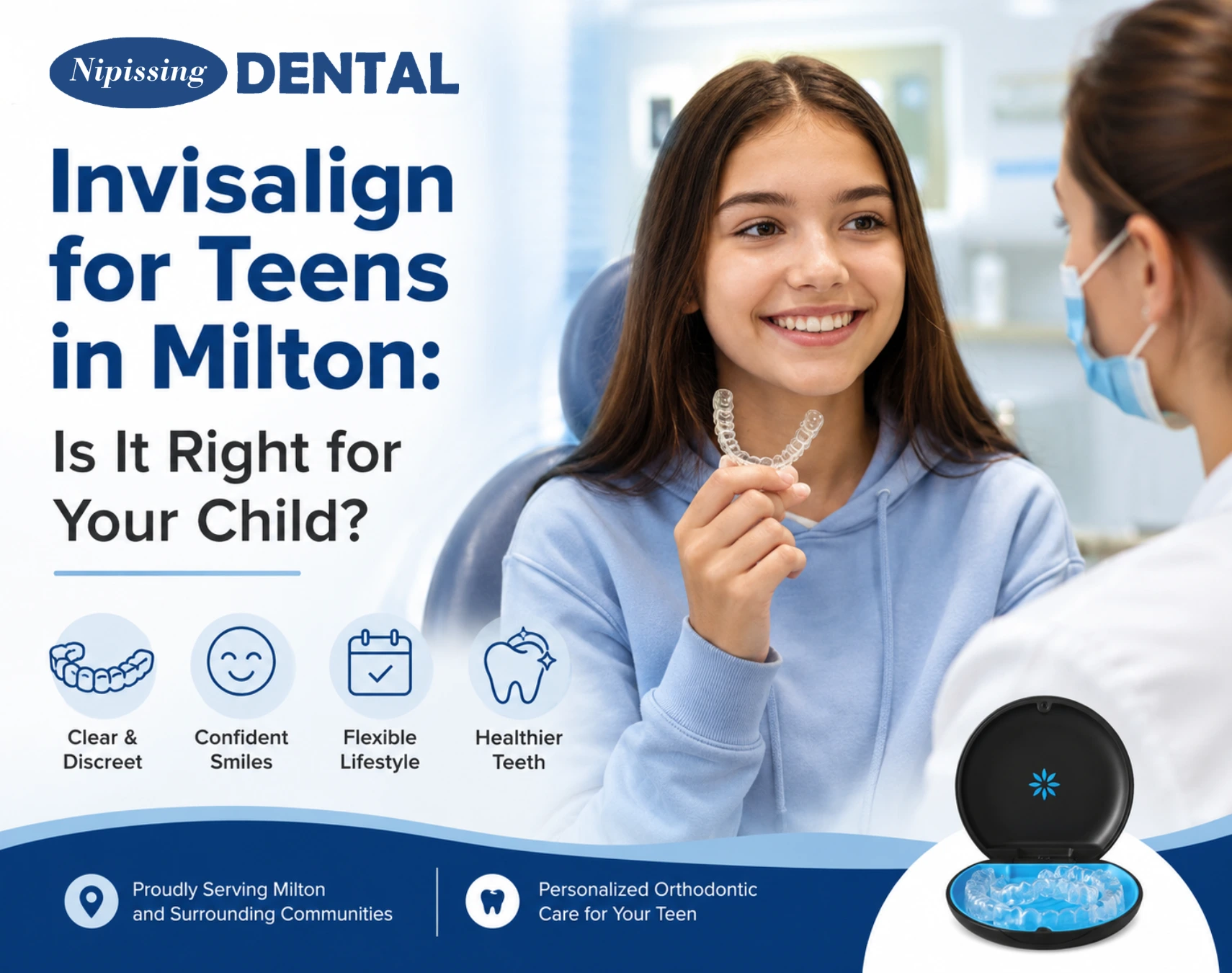
If your teenager needs orthodontic treatment, you may be wondering whether clear aligners are a practical alternative to traditional braces. Invisalign for teens can offer a discreet, removable approach to orthodontic treatment, but it is not automatically the best choice for every teenager.
The right option depends on several factors, including your teen’s teeth and bite, the complexity of the orthodontic problem, their daily habits, and—perhaps most importantly—their ability to consistently follow treatment instructions.
For parents considering Invisalign in Milton, the key question is not simply, “Is Invisalign better than braces?” Instead, it is:
Is Invisalign appropriate for my teenager’s specific orthodontic needs and lifestyle?
Let’s look at what parents should know before making that decision.
Key Takeaways
- Invisalign for teens can be a discreet, removable orthodontic option, but candidacy depends on the individual patient, not age alone.
- Responsibility is one of the biggest factors — teens must wear aligners 20–22 hours per day and handle them carefully.
- Crowded teeth may respond to clear aligners, but the amount and cause of crowding need a professional assessment first.
- Braces may be a better fit when the orthodontic problem is complex or consistent aligner wear is unlikely.
- An in-person orthodontic assessment is always more reliable than judging candidacy from photos or an online quiz.
Can Teenagers Get Invisalign?
Yes. Clear aligner treatment is available for teenagers, and Invisalign has treatment options specifically designed for younger patients. Invisalign describes its aligners as removable orthodontic appliances that gradually move teeth into planned positions.
The Canadian Dental Association explains that orthodontic treatment can address problems involving tooth alignment and bite, including crowded or overlapped teeth, crossbites and other malocclusions. Depending on the situation, treatment may involve braces, removable appliances, aligners or referral to an orthodontist.
However, being a teenager does not automatically make someone a candidate for clear aligners.
A dental professional needs to assess the teeth, bite, growth and overall orthodontic needs before recommending a treatment approach.
What Makes a Teen a Good Candidate for Invisalign?
One of the biggest differences between clear aligners and braces is that aligners are removable.
That can be a major advantage—but it also creates an important responsibility.
A teenager considering Invisalign should be able to:
- Wear the aligners according to the treatment instructions
- Remember to put them back in after eating or brushing
- Keep the aligners clean
- Maintain good brushing and flossing habits
- Store the aligners safely when they are removed
- Attend recommended dental or orthodontic appointments
- Tell their dental team if an aligner is lost, damaged or no longer fitting properly
Invisalign states that most people are expected to wear their aligners for approximately 20–22 hours per day.
This means parental involvement can be helpful, particularly during the early stages of treatment.
If your teenager frequently forgets belongings, removes dental appliances for long periods or struggles to follow routines, fixed braces may sometimes be easier to manage.
The decision should be based on the individual patient rather than age alone.
Can Invisalign Help With Crowded Teeth?
Crowded teeth occur when there is not enough space for teeth to align normally. They may overlap, rotate or appear out of position.
Orthodontic treatment can address different types of tooth and bite irregularities, but the appropriate treatment depends on what is causing the crowding and how complex the movement needs to be. The Canadian Dental Association identifies crowded or overlapped teeth as one of the conditions considered in orthodontic care.
Clear aligners may be an option for some teenagers with crowded teeth.
However, a simple description such as “crowding” does not tell you whether Invisalign will be appropriate. Your dental professional may need to assess:
- The amount and location of crowding
- Tooth position and rotation
- The relationship between the upper and lower teeth
- Jaw development
- The presence of bite problems
- The overall orthodontic treatment objectives
This is why an in-person assessment is more useful than trying to determine candidacy from photographs or an online quiz.
Invisalign vs. Braces for Teenagers
Parents often search for braces vs Invisalign because both treatments can move teeth but work differently.
| Consideration | Invisalign | Traditional Braces |
|---|---|---|
| Appearance | Clear and relatively discreet | Brackets and wires are visible |
| Removable | Yes | No |
| Eating | Aligners are removed for meals | Certain foods may need to be avoided |
| Oral hygiene | Aligners can be removed for brushing and flossing | Cleaning around brackets and wires requires additional care |
| Responsibility | Requires consistent wear and care | Appliance remains attached to the teeth |
| Treatment suitability | Depends on the individual’s orthodontic needs | Can be suitable for many types of orthodontic problems |
| Daily routine | Requires remembering to replace aligners | Requires care around fixed appliances |
The American Association of Orthodontists notes that orthodontic treatment options include both fixed appliances such as braces and removable appliances such as clear aligners. The appropriate option depends on factors such as age, jaw relationships, tooth size and the nature of the orthodontic problem.
So, is Invisalign better than braces?
There is no universal answer.
For one teenager, the ability to remove aligners for meals and oral hygiene may be particularly valuable. For another, fixed braces may be more practical because they do not depend on remembering to wear a removable appliance.
What Are the Benefits of Invisalign for Teens?
When clear aligners are clinically appropriate and worn as instructed, they can offer several practical advantages for teenagers.
1. A More Discreet Appearance
Clear aligners are designed to be less noticeable than traditional metal braces.
This may appeal to teenagers who are concerned about how orthodontic appliances look at school, during social activities or in photographs.
Appearance is not the most important clinical consideration, but it can influence how comfortable a teenager feels about beginning treatment.
2. Removable for Eating
Unlike fixed braces, clear aligners can be removed for meals.
That means teenagers do not have to eat around brackets and wires. However, aligners should be handled carefully and replaced according to the treatment instructions.
3. Easier Access for Brushing and Flossing
Because aligners are removable, teenagers can brush and floss without having to work around brackets and wires.
That does not mean oral hygiene becomes automatic. Food debris and plaque still need to be managed carefully, and aligners should be kept clean.
4. Convenient for Active Lifestyles
Teenagers may participate in sports, music, school activities and social events.
A removable orthodontic appliance can fit into many routines, but the teen still needs to follow the wear instructions consistently.
For athletes, the dental team can also provide guidance about protecting the teeth during sports.
5. No Brackets or Wires
Some teenagers prefer not to have metal brackets and wires attached to their teeth.
Clear aligners provide a different treatment experience, although they still require commitment and regular monitoring.
The Biggest Responsibility: Wearing the Aligners
This is one of the most important points parents should consider before choosing Invisalign for teens.
Because aligners are removable, teenagers control when they are in their mouths.
That makes responsibility an essential part of treatment.
A teen might remove an aligner during lunch and forget to put it back in. Another might leave it at home before going to school. Someone else may repeatedly misplace the aligner case.
Occasional mistakes can happen, but consistent habits matter.
Parents can help by encouraging simple routines:
- Keep the aligner case in the same place
- Store aligners in their case whenever they are removed
- Keep a backup routine for school and activities
- Follow cleaning instructions
- Set reminders when necessary
- Encourage the teen to communicate about problems promptly
The goal is not to monitor every moment of treatment. It is to help establish habits that make treatment easier to manage.
What Happens If a Teenager Loses an Aligner?
Teenagers are busy, and removable appliances can occasionally be misplaced.
If an aligner is lost or damaged, your teen should contact the dental professional managing the treatment rather than guessing what to do next.
The appropriate next step can depend on where the patient is in the treatment sequence.
Do not simply change to another aligner without professional guidance.
A good habit is to place the aligner directly into its case whenever it is removed. Keeping the case accessible at school, during sports and while travelling can also reduce the chance of accidental loss.
School, Sports and Everyday Life
For many parents, the practical side of treatment is just as important as the clinical side.
At School
Clear aligners can be removed when eating, but your teenager needs to remember to put them back in afterward.
If the teen frequently eats snacks throughout the day, maintaining the recommended wear routine may require some planning.
During Sports
Teenagers involved in contact sports should follow appropriate mouthguard and orthodontic-protection advice from their dental professional.
If your child participates in sports regularly, mention this during the orthodontic assessment.
At Social Events
One attraction of clear aligners for some teenagers is that they are relatively discreet.
However, social activities should not become a reason for repeatedly leaving the aligners out.
Treatment still depends on following the prescribed routine.
When Might Braces Be a Better Option?
Clear aligners are not appropriate for every orthodontic situation.
Traditional braces may be considered when the orthodontic problem requires a type or degree of tooth movement that is better managed with a fixed appliance.
Orthodontic treatment also has to account for jaw relationships and growth. The AAO emphasizes that treatment selection depends on factors such as age, jaw imbalances and individual tooth characteristics.
Braces may therefore be discussed when:
- The orthodontic problem is more complex
- Significant tooth movement is required
- Jaw relationships need careful management
- Consistent removable-aligner wear is unlikely
- A fixed appliance is considered more appropriate for the treatment plan
This does not mean braces are “better” overall.
It means that the best treatment is the one that fits the patient’s clinical needs and ability to follow the treatment plan.
Is Invisalign Better Than Braces for Teens?
If you are asking whether Invisalign is universally better than braces, the answer is no.
Both options have advantages and limitations.
Invisalign may appeal to a teenager who values a discreet appearance, wants removable appliances and can reliably follow the wear routine.
Braces may be preferable when a fixed appliance is more appropriate for the orthodontic problem or when consistent removable-appliance wear would be difficult.
The decision should therefore be based on clinical suitability first and lifestyle preferences second.
Questions Parents Should Ask Before Choosing Invisalign
Before starting treatment, consider asking the dental professional:
- Is my teenager a suitable candidate for clear aligners?
- What orthodontic problem are we treating?
- Would braces or aligners provide the more appropriate option?
- How much responsibility will my teenager have during treatment?
- How should the aligners be cleaned and stored?
- What should we do if an aligner is lost or damaged?
- How will treatment progress be monitored?
- Will sports or other activities affect the treatment routine?
- What happens after the active treatment is completed?
- What habits should my teenager develop before treatment begins?
These questions can help your family understand the treatment process rather than choosing an orthodontic option based solely on appearance.
When Should a Teenager Have an Orthodontic Assessment?
There is no need to wait until all permanent teeth are fully aligned before discussing orthodontic concerns.
The Canadian Dental Association notes that orthodontic treatment is used to prevent and correct malocclusions and that teeth can be moved at different ages.
An assessment may be particularly useful if you notice concerns such as:
- Significant crowding
- Teeth that overlap or appear out of position
- Difficulty biting comfortably
- Noticeable spacing
- An unusual relationship between upper and lower teeth
- Concerns about tooth eruption or alignment
- A previous recommendation for orthodontic evaluation
An assessment does not automatically mean your teenager needs treatment immediately.
It gives your dental team an opportunity to evaluate the situation and explain whether monitoring, aligners, braces or another approach may be appropriate.
Invisalign for Teens in Milton: What Parents Should Remember
Choosing orthodontic treatment for your teenager is about more than choosing between clear aligners and metal braces.
The most important considerations are:
1. Clinical suitability
The treatment must be appropriate for your teenager’s teeth, bite and orthodontic needs.
2. Responsibility
Removable aligners require consistent wear and careful handling.
3. Lifestyle
School, sports, meals and social activities should all be considered when planning treatment.
4. Oral hygiene
Your teenager still needs consistent brushing and flossing throughout orthodontic treatment.
5. Professional monitoring
Orthodontic treatment should be planned and monitored by an appropriately qualified dental professional. The AAO emphasizes the importance of professional assessment when selecting orthodontic treatment.
Final Thoughts
Invisalign for teens can be an excellent orthodontic option for some teenagers, but it is not automatically the right choice for every child.
The biggest advantage of clear aligners for one teenager may be their discreet, removable design. For another, the responsibility of wearing and caring for removable aligners may make traditional braces a more practical option.
If your teenager has crowded teeth or another alignment concern, the best starting point is an individualized assessment. A dental professional can evaluate the bite, discuss the available treatment approaches and help your family understand what each option involves.
For families considering Invisalign in Milton, Nipissing Dental provides information about clear-aligner treatment and teen orthodontic options. The practice’s Invisalign information explains that clear aligners may be considered for teens and selected younger patients, with suitability determined as part of treatment planning.
Have questions about whether clear aligners could be appropriate for your teenager? Contact Nipissing Dental to arrange an assessment and discuss the available orthodontic options.
Considering Invisalign for Your Teen? Nipissing Dental, Milton ON
Book an orthodontic assessment with a team that evaluates your teen’s bite, growth and habits before recommending Invisalign or braces — so the treatment plan actually fits your child.
Frequently Asked Questions
Explore Our Related Services
These services work well alongside a teen Invisalign consultation to support your family’s overall dental care.
- Cosmetic Dentistry in Milton — Smile-enhancing treatments once orthodontic treatment is complete
- Meet Our Dental Team — Learn more about the team assessing your teen’s orthodontic needs
References & Trusted Sources
This article was developed using expert dental knowledge and validated against the following trusted health and dental authorities:
- American Dental Association (ADA) — Clinical guidance on orthodontic treatment and adolescent oral health
- Canadian Dental Association (CDA) — Oral health resources on malocclusion and orthodontic care
- Health Canada — Oral health guidance for consumers
These trusted sources also inform how Nipissing Dental approaches teen orthodontic consultations for patients in Milton.