If you’ve been waking up with jaw soreness, unexplained headaches, or a partner who hears grinding sounds at night, you may already suspect something is off — even if you can’t feel it while it’s happening. Bruxism is like that. Silent, gradual, and often only noticed once real damage has begun. The good news is that a properly fitted night guard is one of the most effective and accessible ways to protect your teeth. And if you’re wondering exactly what does a night guard do — you’ve come to the right place.
At Nipissing Dental in Milton, our team helps patients understand their treatment options and take action before bruxism leads to costly, irreversible damage. To understand your full oral health picture, we recommend starting with a comprehensive dental cleaning and exam — where we review your X-rays, assess wear patterns, and map out the safest path forward.
What Is Bruxism — and Why Does It Happen?
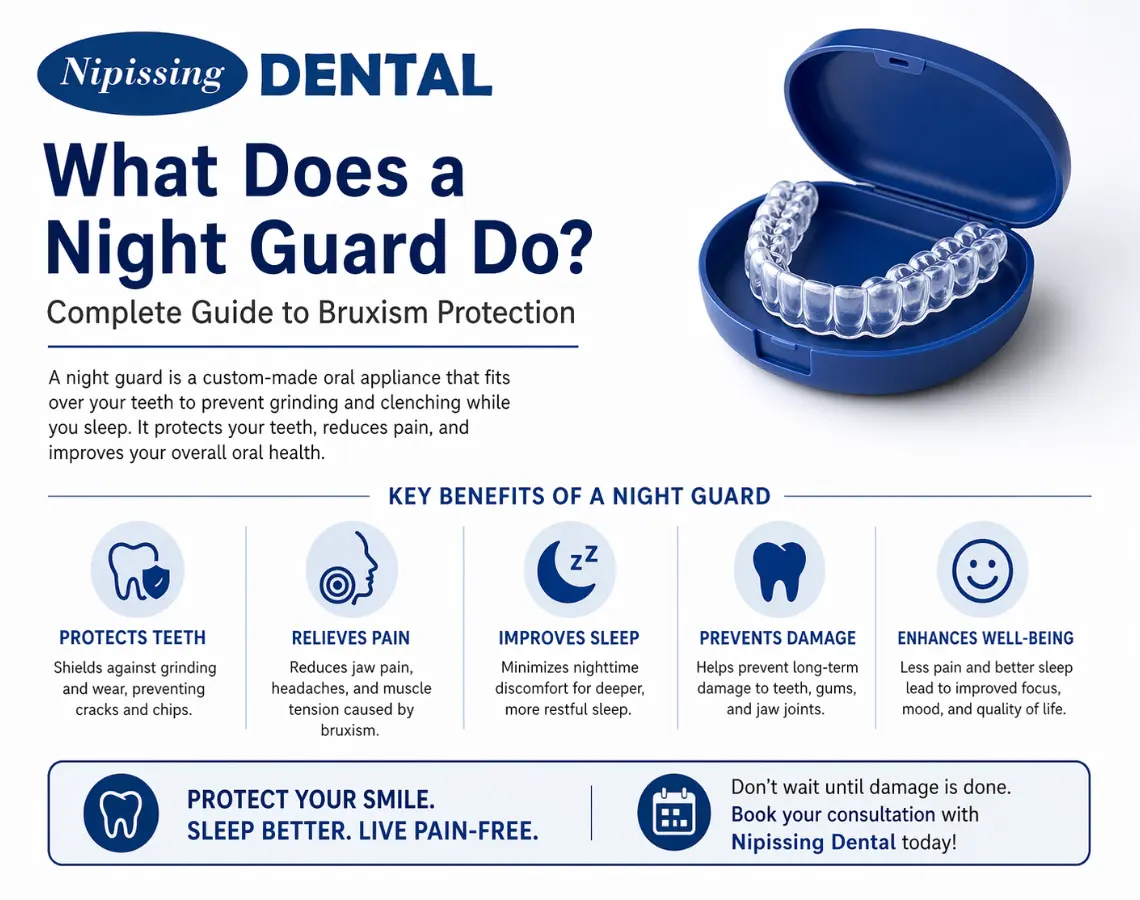
Bruxism is the involuntary grinding, gnashing, or clenching of teeth. It most commonly occurs at night during sleep (nocturnal bruxism), though some people also clench during the day without noticing. According to the American Dental Association (ADA), stress, anxiety, sleep disorders, and even certain medications are known contributing factors.
The mechanics are fairly straightforward. While you sleep, your jaw muscles fire involuntarily, pressing your upper and lower teeth together with force that can far exceed normal chewing pressure. Over time, this repeated strain wears down enamel, fractures teeth, stresses the jaw joint, and triggers chronic headaches.
What does a night guard do in this context? It acts as a protective buffer — absorbing and redistributing the force of grinding so your natural teeth don’t bear the full impact.
Signs and Symptoms: How to Know You Need a Night Guard for Teeth
Not everyone who grinds knows they’re doing it. Here are the most common signs I look for during an exam — and that you should look out for at home:
- Waking up with jaw pain, facial soreness, or headaches
- Teeth that look flat, chipped, or unusually worn
- Increased tooth sensitivity, especially to hot and cold
- Tight or tired jaw muscles in the morning
- Clicking or popping in the jaw joint (TMJ)
- Disrupted sleep, often noticed by a partner who hears grinding sounds
- Earaches without any signs of infection
These symptoms exist on a spectrum. Early-stage bruxism might cause only mild morning stiffness. Left untreated, it progresses to enamel loss, cracked teeth, and painful temporomandibular joint (TMJ) disorders that are much harder — and more expensive — to treat. If you’re noticing any of these signs, our emergency dentist in Milton is available for urgent concerns as well.
What Does a Night Guard Do? The Science Behind It
Here’s where the magic is. A mouthguard for sleeping works on a few key levels:
1. Mechanical Cushioning
The guard creates a physical barrier between your upper and lower teeth. Instead of hard enamel grinding against hard enamel, the force is absorbed by the material of the guard. Think of it like putting a shock absorber between two colliding surfaces.
2. Muscle Relaxation
Custom-fitted night guards are designed to hold your jaw in a slightly open, neutral position. This gentle repositioning reduces the intensity of muscle contractions during sleep. Many patients notice a dramatic reduction in jaw tension within the first few weeks of consistent use.
3. Joint Protection
Your temporomandibular joint takes a serious beating when you grind. A night guard mouthguard helps stabilize the joint by preventing the extreme jaw movements that cause stress on the surrounding cartilage and ligaments.
4. Enamel Preservation
Dental enamel does not regenerate — once it’s gone, it’s gone. Night guard teeth protection preserves what you have left and prevents further erosion that can lead to sensitivity, cavities, and eventual tooth loss. In cases where enamel has already been compromised, our team may also recommend dental fillings or crowns and bridges to restore the affected teeth.
Types of Mouth Guards: Which Is Right for You?
Before you ask where can you buy a mouthguard, it’s worth understanding the differences between your options. Not all guards are created equal, and the best type of mouth guard for sports or for bruxism depends on the severity of your grinding and your lifestyle needs.
| Type | Best For | Durability |
|---|---|---|
| Soft Night Guard | Light grinding | 6–12 months |
| Hard Night Guard | Heavy bruxism | 2–5 years |
| Dual-Laminate | Moderate grinding | 1–3 years |
| Sports Mouthguard | Contact sports | 1 season |
| Custom-Fitted (Dental) | All bruxism levels | 3–5+ years |
My honest recommendation: For anyone dealing with moderate to severe bruxism, a custom-fitted guard made by your dentist is always the best investment. Over-the-counter options can provide short-term relief, but they often don’t fit properly, which can actually worsen jaw positioning over time. At Nipissing Dental, we offer custom night guards and sports guards in Milton designed for your exact bite and grinding pattern.
Step-by-Step: What To Do If You Think You Grind Your Teeth
What You Should Do
- Schedule a dental exam so your dentist can assess the extent of wear
- Reduce stress through exercise, therapy, or relaxation techniques — stress is the #1 driver of nighttime grinding
- Limit caffeine and alcohol, especially in the evening, as both can intensify grinding
- Apply a warm compress to your jaw before bed to relax the muscles
- Ask your dentist about getting a custom night guard mouthguard fitted
- Practise good sleep hygiene — grinding is worse when you’re overtired or stressed
What You Should NOT Do
- Don’t ignore the symptoms hoping they’ll resolve on their own — they rarely do
- Don’t chew gum excessively, as it fatigues the same jaw muscles involved in grinding
- Don’t buy a cheap, bulky over-the-counter guard and assume it’s equivalent to a custom fit
- Don’t delay treatment — enamel damage is irreversible
How Long Do Mouth Guards Last?
This is one of the most common questions I get, and the answer depends on how severe your grinding is and what type of guard you’re using.
Generally speaking, a soft night guard may last anywhere from six months to a year for heavy grinders, while a hard acrylic guard can last two to five years with proper care. Custom dental guards tend to outlast store-bought options significantly.
Key factors that affect longevity:
- Severity of grinding (heavier grinders wear guards faster)
- Material quality (hard acrylic vs. soft thermoplastic)
- Daily care routine (rinsing, brushing, storing properly)
- Whether the guard is custom-fitted or over-the-counter
As a rule of thumb, bring your guard to every dental appointment so your dentist can check for wear. If it’s thinning significantly or no longer fits properly, it’s time for a replacement. Our team at Nipissing Dental’s family dentistry practice makes it easy to keep up with these regular check-ins.
What to Expect: Recovery and Long-Term Outlook
Once you start wearing a night guard consistently, most patients notice a meaningful improvement within two to four weeks. Morning jaw pain tends to decrease first, followed by fewer headaches and reduced tooth sensitivity.
Long-term, the goal is preservation — protecting the enamel and joint health you still have. A night guard won’t reverse existing wear, but it will stop it from progressing. Paired with stress management and regular dental check-ups, it becomes a cornerstone of your oral health routine.
If grinding is related to sleep apnea or a structural jaw issue, your dentist or specialist may recommend additional treatment alongside the guard. In those cases, a multidisciplinary approach tends to produce the best outcomes. Significant enamel loss may also require cosmetic dentistry or restorative treatment — such as dental crowns — to rebuild the damaged surfaces.
I Know This Can Feel Overwhelming — But You’re Not Alone
I understand how unsettling it can be to learn that you’ve been silently damaging your teeth while you sleep. Patients often feel a mix of frustration and anxiety when they first hear the word “bruxism” — and I completely get it.
Here’s the reassuring truth: this is one of the most manageable dental conditions we treat. The right mouth guard for grinding teeth at night, combined with a few lifestyle adjustments, can protect your smile for decades. The key is acting sooner rather than later.
If you’ve been waking up with jaw pain, noticing unusual wear on your teeth, or someone has pointed out that you grind at night, please don’t put this off. An early intervention today can save you considerable pain — and significant cost — down the road. The Canadian Dental Association (CDA) consistently emphasizes that early treatment of bruxism leads to significantly better long-term outcomes.
What Do Mouthguards Do for Children and Teens?
Bruxism isn’t limited to adults. Children and teenagers can grind their teeth too — often linked to stress, misaligned teeth, or airway issues. In younger patients, we typically monitor rather than immediately fit a guard, since the jaw is still developing. However, a sports mouthguard is always recommended for any child or teen playing contact sports.
If you’re concerned about your child’s grinding habits, our children’s dentist in Milton can assess whether intervention is needed and when it’s appropriate to consider a night guard.
Night Guard Teeth Milton: Getting Fitted at Nipissing Dental
If you’re specifically looking for night guard teeth services in Milton, here’s what the process looks like at our clinic:
- Step 1 — Exam & Assessment: We examine your teeth for wear patterns, take digital X-rays, and assess your bite and jaw function.
- Step 2 — Impressions: Precise impressions of your upper and lower teeth are taken to fabricate a guard that fits your exact bite.
- Step 3 — Fabrication: Your custom guard is created in a dental lab from high-quality materials suited to your grinding severity.
- Step 4 — Fitting Appointment: We ensure the guard fits comfortably, make any necessary adjustments, and provide care instructions.
- Step 5 — Follow-Up: We monitor wear at your regular check-ups and replace the guard when needed.
The entire process is straightforward and comfortable. Most patients are pleasantly surprised by how well a custom guard fits compared to anything they’ve tried from a pharmacy. Learn more about our custom night guards and sports guards in Milton or contact us to book your assessment.
Conclusion
So, what does a night guard do? Simply put — it protects everything you’ve worked to preserve. It shields your enamel, eases your jaw, reduces pain, and saves you from a cascade of dental problems that bruxism can cause if left unchecked.
Whether you’re in Milton or anywhere else, the message is the same: if you suspect you’re grinding your teeth at night, don’t wait. Book an appointment with your dentist, discuss your symptoms honestly, and ask about getting fitted for a custom night guard mouthguard. Health Canada’s oral health guidelines reinforce that preventive dental care — including protective devices like night guards — is a cornerstone of long-term oral wellness.
Your future self — and your teeth — will thank you. The team at Nipissing Dental is here to guide you through every step with care and expertise. Book your appointment today.
References & Trusted Sources
Frequently Asked Questions
What does a night guard do for teeth grinding?
A night guard acts as a protective barrier between your upper and lower teeth, absorbing the force of grinding and clenching. It prevents enamel wear, reduces jaw muscle tension, and protects the temporomandibular joint (TMJ) from stress-related damage.
How long does a mouth guard last?
It depends on the type and the severity of your grinding. Soft over-the-counter guards typically last six to twelve months, while custom-fitted hard guards can last two to five years or longer with proper care and regular dental checks.
What are the benefits of a night mouth guard?
The primary benefits include protection of tooth enamel, reduction in jaw and facial pain, fewer morning headaches, improved sleep quality (for both you and your partner), and prevention of costly restorative dental work in the future.
How to stop grinding teeth at night without a mouth guard?
While a guard is the most effective solution, stress reduction techniques (meditation, yoga, therapy), limiting caffeine and alcohol before bed, jaw stretching exercises, and applying warm compresses to the jaw can all help reduce the frequency and intensity of grinding. However, these methods work best as complements to — not replacements for — a properly fitted night guard.
Where can you buy a mouthguard?
Over-the-counter guards are available at most pharmacies and online retailers. However, for the best fit, protection, and longevity, I always recommend getting a custom night guard through your dentist. At Nipissing Dental in Milton, we fabricate guards tailored to your bite — offering far superior comfort and protection compared to generic options.
Ready to Protect Your Smile While You Sleep?
Our team at Nipissing Dental is here to assess your grinding, fit you with the right night guard, and make every visit as comfortable as possible. Take the first step toward better oral health today.