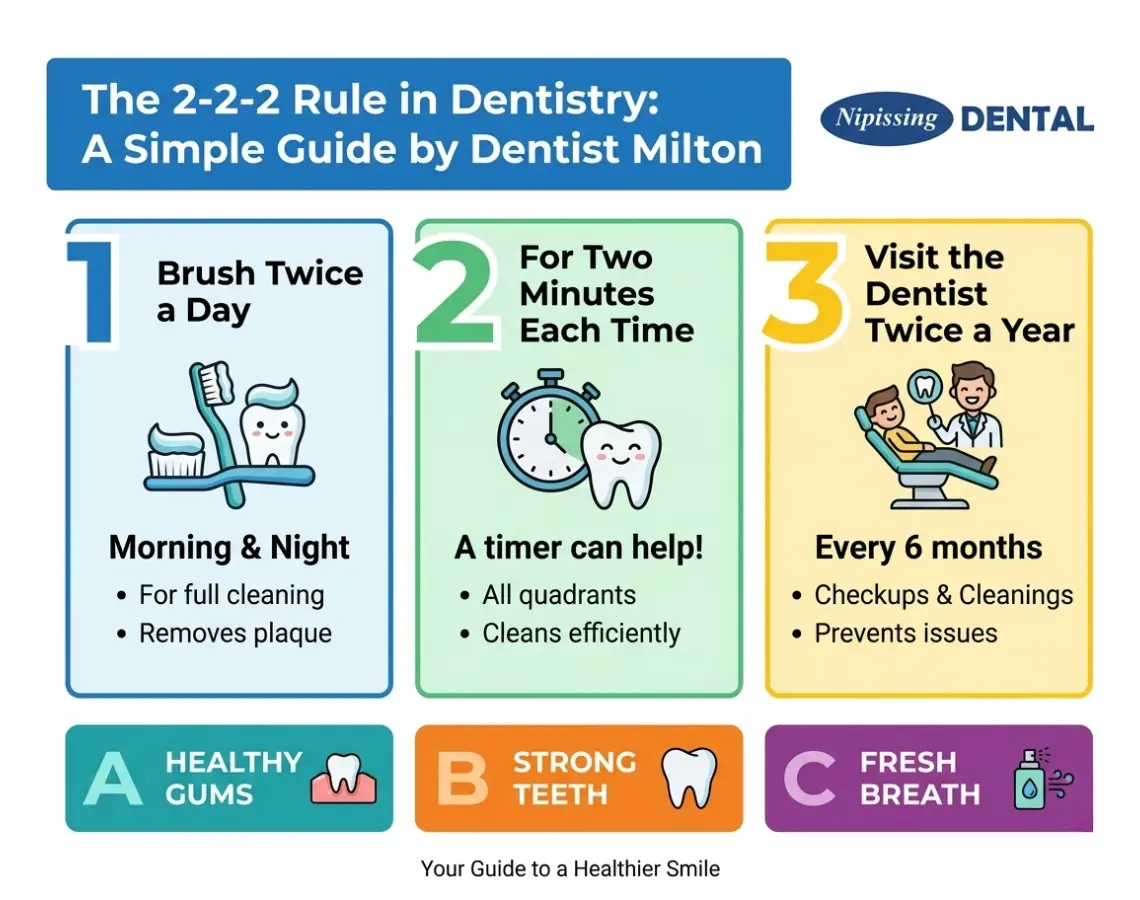
The 2-2-2 rule in dentistry means brushing for 2 minutes, twice a day, and visiting your dentist every 6 months. It’s the simplest, most evidence-based framework for lifelong oral health — and the single most repeatable system for protecting your smile across every life stage.
What Is the 2-2-2 Rule in Dentistry?
The 2-2-2 rule in dentistry is a three-part oral hygiene guideline built entirely around the number two. If you’ve ever wondered whether you’re brushing long enough, flossing often enough, or visiting your dentist at the right frequency — you’re not alone. Most patients at Nipissing Dental in Milton come in with the same uncertainty.
The Canadian Dental Association (CDA) and the American Dental Association (ADA) both identify these three habits as the foundation of preventive dentistry. Here is what the 2-2-2 rule covers:
| Rule | What It Means | Why It Matters |
|---|---|---|
| Brush for 2 minutes | Every time you brush, morning and night | Ensures thorough plaque removal from all surfaces |
| Brush 2 times a day | Consistently, without skipping the nighttime brush | Interrupts bacterial activity during overnight hours |
| Visit every 6 months | Professional cleaning and a full oral exam | Catches decay, disease, and cancer early |
How to Brush Teeth Properly: Making Every 2 Minutes Count
Knowing how to brush teeth properly matters just as much as brushing for the right duration. Two minutes of poor technique accomplishes far less than two minutes of focused, deliberate brushing.
Choose the Right Tool
Use a soft-bristled toothbrush — manual or electric. Hard bristles can erode enamel and irritate the gumline over time. The ADA recommends soft bristles for virtually all adults, and most dental associations globally agree.
Angle and Motion
Hold the brush at a 45-degree angle toward the gumline. Use small, circular strokes rather than aggressive back-and-forth scrubbing. The Mayo Clinic reinforces this technique as the gold standard for gumline care.
Divide and Conquer
Split your mouth into four quadrants: upper right, upper left, lower right, lower left. Spend roughly 30 seconds on each. A built-in timer on an electric brush, a phone timer, or a two-minute song all work equally well.
Don’t Forget the Soft Tissues
Brush your tongue and the insides of your cheeks. Bacteria don’t confine themselves to tooth surfaces. Cleaning soft tissue reduces overall bacterial load and is one of the most effective, underused strategies for controlling bad breath.
Finish With Floss
Brushing alone misses roughly 35% of tooth surfaces — specifically the contact points between teeth. The Canadian Dental Association’s patient resources outline several effective interdental cleaning options. For patients with active orthodontic treatment, Invisalign clear aligners make brushing and flossing significantly easier than traditional braces.
Why a Dental Checkup Every Six Months Is Non-Negotiable
The third element of the 2-2-2 rule is the one most patients skip first. Life gets busy. But a dental checkup every six months is not a luxury or a suggestion — it’s a cornerstone of disease prevention.
Early Detection of Cavities
Tooth decay doesn’t produce pain until it’s advanced. By the time you feel sensitivity, decay may have reached the dentin layer. At that stage, a straightforward dental filling has become a potential root canal treatment. During a biannual exam, early decay can be identified in its earliest form using clinical examination and digital X-rays.
Understanding Pain Levels: A Clinical Framework
| Level | What It Means | What to Do |
|---|---|---|
| Normal Discomfort | Mild sensitivity after a cleaning or new filling — resolves within 24–48 hours | No intervention required |
| Inflammation | Persistent gum tenderness, redness, swelling, or bleeding — signs of gingivitis | Schedule a professional cleaning |
| Infection | Throbbing pain radiating to jaw/ear/neck, swelling, fever, or foul taste | Contact your dentist immediately for same-day care |
How Often Should You Visit a Dentist in Milton?
For the majority of patients, the answer aligns with the 2-2-2 rule: every six months. That said, some patients benefit from more frequent visits — typically every three to four months — including patients with:
- A history of periodontal (gum) disease
- Elevated cavity risk due to diet, dry mouth, or genetics
- Systemic conditions such as diabetes, which significantly affect oral health
- Active orthodontic treatment, including braces or clear aligners
- Existing dental crowns or dental bridges that require regular monitoring
Professional Teeth Cleaning: What Actually Happens
A professional cleaning is not a cosmetic polishing session — it’s a clinical procedure with significant health implications.
Tartar (Calculus) Removal
No matter how disciplined your home routine, tartar builds up in areas a toothbrush cannot reach. Once mineralized, it can only be removed with professional scaling instruments.
Gum Disease Prevention
Subgingival tartar — tartar beneath the gumline — is the primary driver of periodontitis. Removing it at regular intervals interrupts the disease cycle before irreversible bone loss occurs.
Personalized Hygiene Guidance
Each cleaning ends with a review of your specific home care routine. For patients interested in cosmetic outcomes, professional cleaning also serves as ideal preparation before teeth whitening in Milton.
Signs You Should Schedule a Visit Sooner
The 2-2-2 rule sets a healthy baseline, but these symptoms signal you should contact your dentist before your next scheduled appointment:
- Persistent toothache or sharp, localized pain when biting
- Gums that bleed regularly when brushing or flossing
- Tooth sensitivity to heat or cold that doesn’t resolve within a few days
- A loose tooth or a noticeable change in your bite alignment
- An oral sore or ulcer that hasn’t healed within two weeks
- Jaw pain, clicking, or facial discomfort without a clear cause
- A visibly cracked, chipped, or fractured tooth
For patients who avoid dental visits due to anxiety, our approach to dental anxiety management in Milton is built entirely around patient comfort, open communication, and working at your pace.
The 2-2-2 Rule and Children: Starting Early
At our children’s dentist in Milton, the CDA recommends a child’s first dental visit by their first birthday or within six months of the first tooth appearing. Children who attend regular checkups from an early age are more likely to:
- Develop consistent brushing and flossing habits
- Experience lower rates of childhood tooth decay
- Approach adult dental care with less anxiety
- Avoid orthodontic complications through early developmental monitoring
Conclusion
The 2-2-2 rule is not complicated. It doesn’t require expensive products or advanced technology. It requires repetition. And repetition, over time, is what separates a smile that lasts a lifetime from one that demands constant, costly repair.
Whether you’re booking for yourself, your child, or your whole family, our team at Nipissing Dental is here Monday through Saturday. We’ll assess where you are today, create a personalized plan, and walk alongside you every step of the way. Book your appointment today.
References & Trusted Sources
Frequently Asked Questions
Who should follow the 2-2-2 rule?
Everyone — regardless of age, dental history, or current oral health status. It’s not a starting point you graduate from — it’s a lifelong standard that applies to children, teens, adults, and seniors alike.
Why is the 2-2-2 rule important for oral health?
Health Canada‘s oral health resources link chronic gum disease to elevated risk of cardiovascular disease, diabetes complications, and adverse pregnancy outcomes. The mouth is a direct gateway into the body — and the 2-2-2 rule builds habits that interrupt disease before it starts.
Is professional dental cleaning necessary every six months?
Yes, for most patients. Home care maintains daily hygiene, but it cannot remove hardened tartar or access subgingival areas. Both the CDA and ADA support biannual professional cleaning as the evidence-based standard.
What happens during a six-month dental visit?
A typical biannual visit includes: comprehensive oral examination, digital X-rays on an appropriate schedule, professional scaling and polishing, gum tissue assessment, oral cancer screening, and a personalized hygiene review. Most appointments take 45–60 minutes.
How long should you brush your teeth?
Two minutes, twice a day. Divide your mouth into four quadrants and spend 30 seconds on each. Use a soft-bristled brush at a 45-degree angle toward the gumline, with small circular strokes — not aggressive back-and-forth scrubbing.
Ready to Feel at Ease at the Dentist?
Our team at Nipissing Dental is here to make every visit as comfortable and stress-free as possible. Take the first step toward better oral health today.