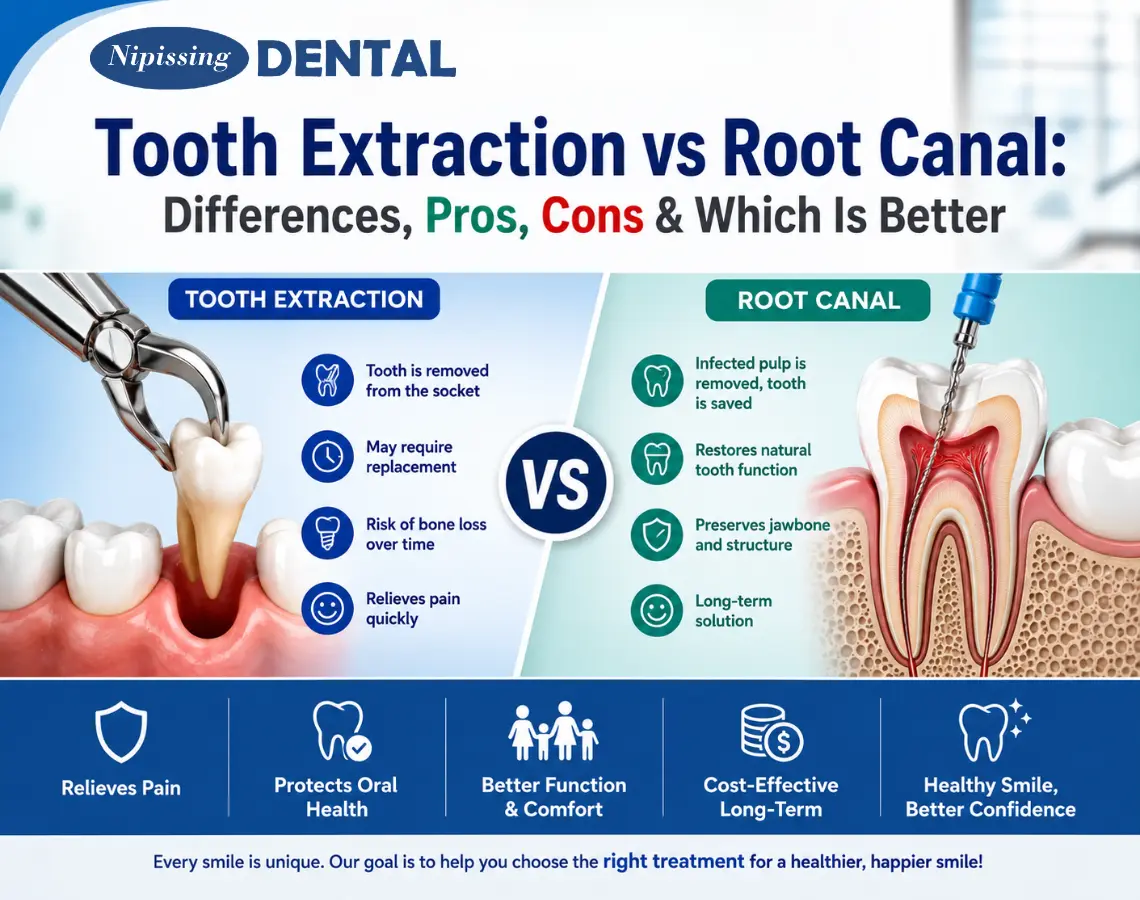
If you’re deciding between an extract tooth vs root canal treatment, the right choice depends on whether the tooth can be safely preserved. In most cases, dentists recommend a root canal because saving a natural tooth provides better long-term function and oral health. However, extraction may be the best option when the tooth is beyond repair due to severe damage, advanced infection, or extensive bone loss. At Nipissing Dental, every recommendation starts with a thorough exam so you can make an informed decision about your smile.
Key Takeaways
- A root canal saves the natural tooth; extraction removes it entirely.
- Root canal treatment has a success rate exceeding 95%, allowing many treated teeth to last a lifetime.
- Extraction is usually the right call when a tooth is fractured below the gum line or beyond restoration.
- Most root canals take 60–90 minutes and are completed in one visit.
- Replacing an extracted tooth later often costs more than saving it now.
- Understanding the extract tooth vs root canal difference up front helps you make a confident, informed decision about your care.
When Is a Root Canal Better Than Removing a Tooth?
A root canal is a restorative dental procedure designed to remove infected or inflamed pulp from inside a tooth while preserving the remaining healthy structure. Making the right call on extract tooth vs root canal treatment starts with understanding exactly what each procedure involves and why one may be preferable in your specific case.
As a family dentist, I’ve treated hundreds of patients facing this exact decision. One common misconception is that tooth pain automatically means extraction is necessary. In reality, many teeth that appear badly damaged on the outside can still be successfully saved through modern endodontic treatment.
At Nipissing Dental, we always begin with a thorough examination, digital X-rays, and clinical testing before recommending either treatment. Our goal is simple: preserve your natural tooth whenever it’s predictably possible.
Modern root canal therapy is significantly different from the outdated stories many patients have heard. Thanks to improved anesthesia, rotary instrumentation, digital imaging, and advanced sealing materials, most patients describe the procedure as being no more uncomfortable than receiving a dental filling.
According to the American Association of Endodontists (AAE), root canal treatment has a success rate exceeding 95%, allowing many treated teeth to last a lifetime with proper care. (Source: American Association of Endodontists, 2024)
Extract Tooth vs Root Canal: Understanding the Difference
Although both procedures eliminate infection and relieve pain, they accomplish this goal in very different ways.
| Root Canal | Tooth Extraction |
|---|---|
| Saves the natural tooth | Removes the entire tooth |
| Eliminates infected pulp | Removes infection by removing the tooth |
| Preserves chewing ability | Often requires replacement afterward |
| Protects jawbone structure | Bone loss begins after healing |
| Usually completed in one or two visits | Extraction plus possible implant or bridge later |
The biggest difference isn’t simply the procedure itself—it’s the long-term impact on your oral health. Saving a healthy tooth root helps maintain the surrounding bone, keeps neighboring teeth stable, and preserves your natural bite. Ultimately, the extract tooth vs root canal decision comes down to whether the remaining tooth structure and root can support a long-term, functional restoration.
Signs You May Need a Root Canal
One of the most common questions patients ask is: How to know if I need a root canal? While only a dentist can diagnose the problem, these symptoms often indicate that the dental pulp has become infected or severely inflamed.
Persistent Tooth Pain
Pain that lingers for hours or wakes you during the night may indicate infection inside the pulp chamber.
Sensitivity That Doesn’t Go Away
Sharp pain when drinking hot coffee or cold beverages that continues after the stimulus is removed often suggests nerve damage.
Swollen Gums
Localized swelling near one tooth may indicate an abscess developing around the root.
Pain While Chewing
Discomfort when biting down can occur when infection spreads toward the root tip.
Gum Pimple (Dental Abscess)
A recurring bump on the gum that releases fluid is a classic sign of chronic infection. These signs are often the tipping point in the extract tooth vs root canal conversation, since untreated infection can quickly turn a savable tooth into one that must be removed.
Important: Some infected teeth produce no pain at all. Regular dental examinations and X-rays remain the most reliable way to detect hidden infections before they become emergencies. If you’re ever in sudden pain, our emergency dentist team can see you promptly.
Expert Insight: From Clinical Practice
In her clinical experience, Dr. Disha Hans of Nipissing Dental often sees patients who assume a severely painful tooth needs to be extracted. However, after a thorough examination and diagnostic imaging, many of these teeth can be successfully treated with a root canal instead. Preserving the natural tooth typically leads to better chewing efficiency, helps maintain jawbone health, lowers long-term treatment costs, and results in higher patient satisfaction than removing and replacing the tooth whenever restoration is a predictable option. This is exactly the kind of extract tooth vs root canal decision that benefits from a second, evidence-based opinion before any tooth is removed.
When Is Tooth Extraction the Better Choice?
Although preserving natural teeth remains the gold standard in dentistry, extraction is sometimes the safest and most predictable treatment. Dentists may recommend removal when:
- The tooth has fractured below the gum line.
- Extensive decay has destroyed too much tooth structure.
- Severe periodontal disease has loosened the tooth beyond repair.
- Previous root canal treatment has failed and retreatment is not feasible.
- Wisdom teeth are impacted and causing pain or recurrent infections.
- The tooth interferes with orthodontic treatment.
- Infection has caused significant bone destruction.
These are among the clearest indicators that the extract tooth vs root canal decision should favor extraction over further attempts at preservation. In these situations, tooth extraction prevents infection from spreading while allowing for future tooth replacement with an implant, bridge, or partial denture.
Pros and Cons of Root Canal Treatment
Like every dental procedure, root canal therapy has advantages and limitations. Weighing these factors carefully is essential to making a confident extract tooth vs root canal decision.
Benefits
Preserves Your Natural Tooth
Keeping your own tooth maintains normal chewing, speech, and smile aesthetics.
Prevents Jawbone Loss
Because the tooth root remains in place, the surrounding bone continues receiving stimulation during chewing.
High Long-Term Success Rate
With a well-fitting crown and good oral hygiene, many root canal-treated teeth remain functional for decades.
Natural Appearance
A custom dental crown restores the tooth’s shape, color, and strength.
Lower Overall Cost Than Tooth Replacement
Although root canal treatment requires an upfront investment, it often costs less than extraction followed by an implant or bridge.
Possible Drawbacks
- The tooth may require a crown afterward.
- Treatment occasionally requires two appointments.
- Very complex infections may need referral to an endodontic specialist.
- Previously treated teeth sometimes require retreatment years later.
Fortunately, these situations are relatively uncommon when treatment is completed promptly.
Pros and Cons of Tooth Extraction
Removing a damaged tooth immediately eliminates infection but creates additional considerations. These trade-offs are equally important when evaluating the extract tooth vs root canal decision from a long-term perspective.
Benefits
Removes Severe Infection
Extraction completely removes the infected tooth when restoration is no longer possible.
Faster Procedure
Simple extractions often take less time than complex restorative treatment.
Eliminates Future Problems with Hopeless Teeth
For severely fractured or non-restorable teeth, extraction may prevent recurring infections.
Potential Disadvantages
Missing Teeth Affect Chewing
Even losing a single molar can reduce chewing efficiency.
Teeth Can Shift
Neighboring teeth gradually drift into the empty space, changing your bite.
Jawbone Shrinks Over Time
Without stimulation from the tooth root, bone naturally resorbs.
Additional Treatment Is Usually Needed
Many patients eventually require:
- Dental implants
- Fixed bridges
- Partial dentures
These restorative procedures increase the overall treatment cost compared with saving a healthy tooth whenever possible.
How Long Does a Root Canal Take?
Another frequent concern patients have is: How long does a root canal take? Most uncomplicated root canals require 60 to 90 minutes and can often be completed in one appointment. More complex cases involving multiple canals, curved roots, or severe infection may require two visits.
Treatment time depends on several factors:
- Tooth location
- Number of canals
- Infection severity
- Previous dental work
- Need for a crown afterward
Modern digital imaging and rotary instruments have significantly reduced treatment times compared with older techniques. Knowing what to expect from the appointment itself can make the extract tooth vs root canal decision feel far less intimidating.
Root Canals Before and After: What Patients Can Expect
Patients are often surprised by how dramatically symptoms improve after treatment.
Before treatment:
- Persistent toothache
- Pain while chewing
- Sensitivity to temperature
- Facial swelling
- Difficulty sleeping
After treatment:
- Infection removed
- Pain greatly reduced within days
- Normal chewing restored after final crown placement
- Natural tooth preserved
- Improved comfort and confidence
Clinical experience consistently shows that patients who choose to save a restorable tooth are generally pleased with both the functional and cosmetic outcome. Results like these are a strong reminder of why the extract tooth vs root canal decision so often favors saving the natural tooth.
Tooth Extraction Aftercare: Healing the Right Way
Proper tooth extraction aftercare plays a major role in preventing complications such as dry socket, delayed healing, or infection. While healing times vary depending on the type of extraction and your overall health, following your dentist’s instructions can make recovery smoother and more comfortable.
Immediately after the procedure, your body begins forming a blood clot inside the socket. This clot protects the underlying bone and nerves, making it essential not to disturb it during the first few days.
First 24 Hours
During the first day after an extraction:
- Bite gently on the gauze as instructed.
- Rest and avoid strenuous physical activity.
- Apply an ice pack to reduce swelling.
- Eat soft, cool foods.
- Stay hydrated.
Avoid:
- Smoking or vaping
- Drinking through a straw
- Vigorous rinsing
- Alcohol
- Touching the extraction site with your fingers or tongue
These activities can dislodge the blood clot and increase the risk of dry socket, one of the most common post-extraction complications.
The First Week
Most patients notice gradual improvement over the next several days. Continue to:
- Brush carefully around the extraction site.
- Rinse gently with warm salt water after the first 24 hours.
- Take prescribed or recommended pain medication as directed.
- Eat soft foods until chewing becomes comfortable — see our full guide on what to eat after wisdom teeth removal for ideas.
Contact your dentist if you experience:
- Severe pain beginning three to five days after extraction
- Persistent bleeding
- Fever
- Swelling that worsens instead of improving
- Pus or an unpleasant taste in the mouth
Recovery After Wisdom Tooth Extraction
Many patients also ask about recovery wisdom tooth extraction because impacted wisdom teeth often require a more involved surgical procedure than routine extractions. While every patient heals differently, a general recovery timeline looks like this:
| Recovery Stage | What to Expect |
|---|---|
| First 24 hours | Bleeding slows, swelling begins |
| Days 2–3 | Swelling reaches its peak |
| Days 4–7 | Pain and swelling gradually decrease |
| 1–2 weeks | Gum tissue largely heals |
| Several months | Bone continues remodeling beneath the gums |
Most people can return to work or school within two to three days after uncomplicated wisdom tooth removal, although physically demanding activities may require additional recovery time — our guide on how long a molar extraction takes covers this in more detail.
Eating soft foods such as yogurt, mashed potatoes, scrambled eggs, smoothies (without a straw), soup, oatmeal, and pasta can help keep you comfortable during healing.
Extract Tooth vs Root Canal: Long-Term Oral Health
When deciding between saving or removing a tooth, it’s important to think beyond immediate pain relief. A natural tooth contributes to:
- Balanced chewing forces
- Clear speech
- Stable neighboring teeth
- Healthy jawbone stimulation
- Better bite alignment
When a tooth is extracted, the surrounding bone gradually loses density because it no longer receives stimulation from the tooth root. According to the American Dental Association (ADA), replacing missing teeth can help restore oral function and reduce complications associated with tooth loss. (Source: American Dental Association, 2024)
Dental implants, bridges, and partial dentures are excellent restorative options, but none fully replicate the natural periodontal ligament that connects a healthy tooth to the surrounding bone. This is why dentists generally recommend preserving a restorable tooth whenever possible.
Cost Considerations: Looking Beyond the Initial Treatment
Many patients focus on the immediate cost of treatment, but the long-term financial picture is often more important.
A root canal usually involves:
- Examination
- Digital X-rays
- Root canal treatment
- Permanent restoration (often a crown)
A tooth extraction may initially cost less, but replacement options such as:
- Dental implants
- Implant-supported crowns
- Fixed bridges
- Partial dentures
can significantly increase the total investment over time. Factoring in these long-term costs is a critical part of any extract tooth vs root canal decision, since choosing the least expensive treatment today may not always be the most cost-effective solution in the future. During your consultation, your dentist should explain both the short-term and long-term costs so you can make an informed decision, including what’s covered under the Canadian Dental Care Plan (Health Canada) where applicable.
Expert Insight: From Practice
Dr. Disha Hans, a family dentist at Nipissing Dental, believes that preserving a natural tooth is almost always the best long-term solution when it can be done predictably and safely. In her clinical experience, many patients arrive expecting an extraction because of severe pain, only to discover that a root canal can successfully save the tooth. Dr. Hans emphasizes that every treatment recommendation should be based on a comprehensive examination, digital X-rays, and the tooth’s long-term prognosis. While root canal therapy often allows patients to maintain comfortable chewing and a healthy smile for many years, she also notes that extraction is the most appropriate option when a tooth is beyond repair or cannot be restored with a predictable outcome. Her approach reflects a broader philosophy in modern dentistry: the extract tooth vs root canal decision should always favor the option with the best long-term prognosis.
Conclusion
Choosing between an extract tooth vs root canal isn’t simply about relieving pain—it’s about protecting your long-term oral health. Whenever a tooth can be predictably restored, a root canal is typically the preferred treatment because it preserves your natural tooth, maintains jawbone health, and supports normal chewing function. Extraction becomes the appropriate choice when the tooth is severely damaged, fractured beyond repair, or affected by advanced infection or periodontal disease.
The most reliable way to determine the right treatment is through a comprehensive dental examination, digital X-rays, and a personalized discussion with your dentist. At Nipissing Dental, our goal is to provide honest recommendations and evidence-based care that helps you achieve a healthy, confident smile for years to come.
Not Sure Whether You Need a Root Canal or Extraction? Book at Nipissing Dental, Milton ON
Still deciding between saving or removing a tooth? Our team will assess your case with a thorough exam and digital X-rays to recommend the safest, most predictable treatment — in English, Hindi, Urdu, and Punjabi.
Frequently Asked Questions
Explore Our Related Services
Whichever treatment path fits your case, these related services support you before, during, and after care.
- Dental Cleanings in Milton — Regular cleanings and checkups help catch infections before they need a root canal or extraction
- Family Dentistry in Milton — Comprehensive preventive and general care for every member of your family
References & Trusted Sources
This article was developed using expert dental knowledge and validated against the following trusted health and dental authorities:
- American Dental Association (ADA) — Clinical guidelines on root canal therapy, extraction, and tooth replacement
- Canadian Dental Association (CDA) — Canadian standards for endodontic and oral surgery care
- Health Canada — Oral health guidance for Canadians, including coverage considerations under the Canadian Dental Care Plan (CDCP)