Dental Braces vs. Invisalign depends on your treatment needs, daily routine, and how visible you want your orthodontic care to be. Braces are often the better option for more complex tooth movements, while Invisalign is a popular choice for adults and teens who want a more discreet solution. At Nipissing Dental, we assess your bite, alignment, and long-term stability before recommending the right plan.
Key Takeaways
- Braces are fixed and often better for complex bite problems.
- Invisalign is removable and often preferred for a discreet look.
- Clear aligners vs metal braces is a choice between convenience and control.
- The best teeth alignment method depends on case complexity and daily habits.
- A personalized exam helps match the right orthodontic treatment options to your needs.
Dental Braces vs. Invisalign
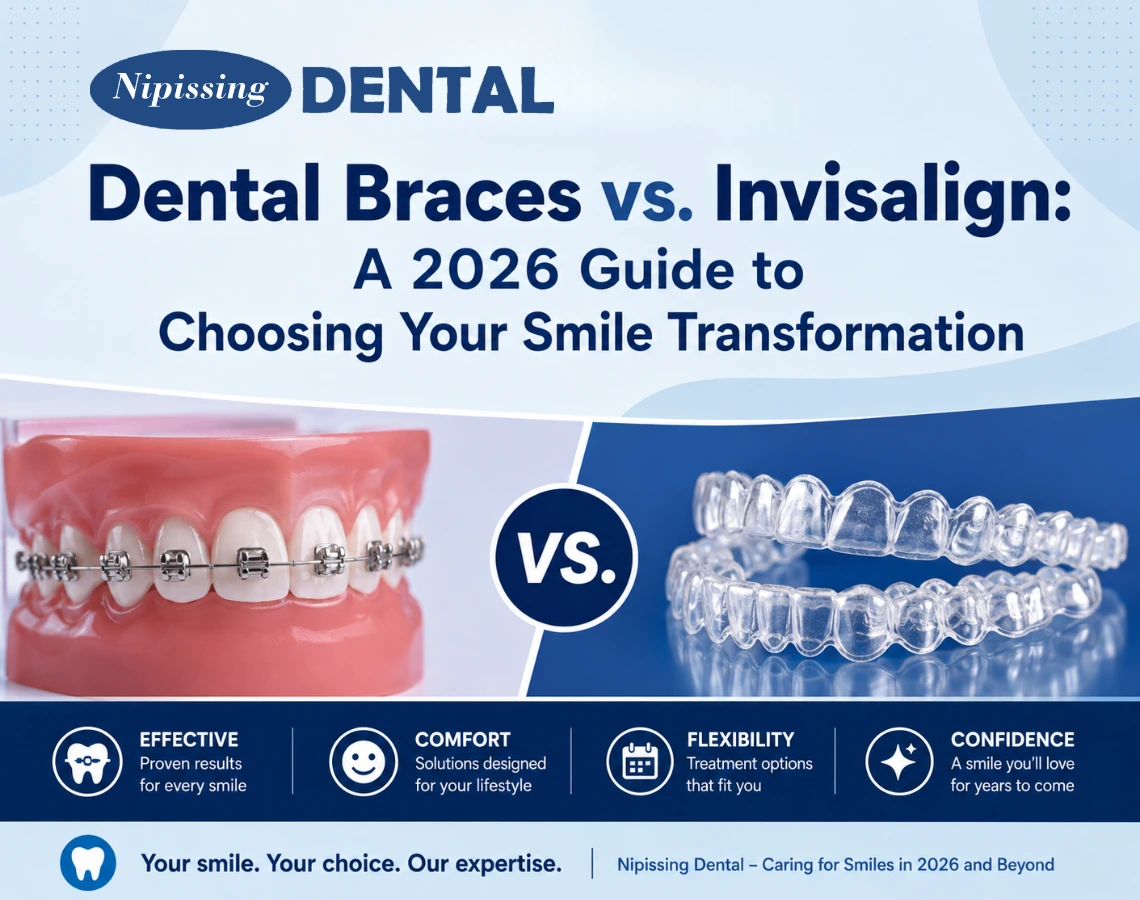
Dental Braces vs. Invisalign is a comparison between fixed braces and removable clear aligners for straightening teeth and improving bite function. Braces usually give the orthodontist more control in complex cases, while Invisalign appeals to patients who want a discreet option and easier cleaning. At Nipissing Dental, the right choice depends on your bite, goals, and how consistent you can be with treatment.
What Orthodontic Treatment Means
Orthodontic treatment options are designed to move teeth into healthier positions and improve long-term oral function. The goal is not only a straighter smile, but also better bite balance, easier cleaning, and less uneven wear on teeth over time. In some cases, treatment may also support jaw comfort and speech clarity. Understanding what orthodontic treatment actually involves is the first step before weighing Dental Braces vs. Invisalign for your own smile.
Clear Aligners vs Metal Braces
Clear aligners vs metal braces is one of the most important decisions patients face. Metal braces stay attached to the teeth all day, so they do not depend on patient memory and can be very effective for complex movement. Clear aligners are removable, which makes eating and brushing easier, but they only work well when worn as directed. This trade-off between fixed control and removable convenience sits at the heart of the Dental Braces vs. Invisalign decision.
Braces vs. Invisalign: Side-by-Side Comparison
The table below lays out Dental Braces vs. Invisalign feature by feature, so you can see exactly where each option stands out.
| Feature | Dental Braces | Invisalign |
|---|---|---|
| Appearance | More visible | Nearly invisible |
| Removability | Fixed in place | Removable |
| Best for | Complex bite and alignment issues | Mild to moderate alignment issues |
| Cleaning | Harder to clean around brackets and wires | Easier to brush and floss |
| Food restrictions | More restrictions | Fewer restrictions |
| Compliance needed | Low, because they stay on | High, because they must be worn consistently |
| Comfort | May cause more irritation at first | Often feels smoother |
| Treatment control | Very strong for difficult movements | Good for many routine cases |
| Risk of being lost | No | Yes, aligners can be misplaced |
| Lifestyle fit | Better for patients who want fixed treatment | Better for patients who want flexibility |
What to Compare Before Choosing Braces or Invisalign
Before you settle on Dental Braces vs. Invisalign, run through this checklist with your dentist:
- Braces are fixed; Invisalign is removable.
- Braces are often better for severe crowding or bite correction.
- Invisalign is usually more discreet.
- Braces do not rely on wear-time discipline.
- Invisalign makes brushing and flossing easier because trays come out.
- Braces can involve more food restrictions.
- Invisalign may be more comfortable for some patients.
- Braces can be more predictable for difficult tooth movement.
Invisalign Pros and Cons
Invisalign pros and cons should be reviewed carefully before starting treatment. The biggest pros are appearance, removability, and easier oral hygiene. The biggest cons are that aligners must be worn consistently, they may not suit every complex case, and they can be lost or misplaced if patients are not careful. Many of these benefits of Invisalign over braces are worth weighing against your daily routine before committing to treatment.
Invisalign Pros
- Nearly invisible in everyday life.
- Removable for eating and cleaning.
- Fewer food restrictions.
- Easier brushing and flossing compared with braces.
- Often a good option for adults who want subtle treatment.
Invisalign Cons
- Must be worn consistently to work properly.
- May not be ideal for severe orthodontic problems.
- Can be lost, misplaced, or damaged.
- Requires patient discipline.
- May not move teeth as predictably in some complex cases.
Best Teeth Alignment Method
Deciding on Dental Braces vs. Invisalign ultimately comes down to finding the best teeth alignment method for your case. The best teeth alignment method depends on the severity of the problem, your lifestyle, and your treatment goals. Patients with significant crowding, rotated teeth, or major bite concerns are often better suited to braces. Patients with milder to moderate alignment issues who value discretion may do well with Invisalign. If timeline is a deciding factor for you, our guide on Invisalign vs braces treatment speed breaks down what to expect for mild to moderate cases.
Best Choice by Patient Type
- Teens with complex alignment issues: braces may be better.
- Adults who want a discreet option: Invisalign may be a strong fit.
- Patients who forget to wear appliances: braces may be safer.
- Patients who want easier cleaning: Invisalign may be more convenient.
- Patients with severe bite problems: braces are often the stronger choice, though some cases — such as those covered in our guide on whether Invisalign fixes overbites — can still be treated with aligners.
Cost of Teeth Straightening
Cost of teeth straightening varies based on how complex the case is, how long treatment takes, and which appliance is used. The better question is not just which option costs less, but which one is more likely to give the result you want. A treatment that fits the case well often saves time and frustration later. Cost is a real factor in Dental Braces vs. Invisalign, but it should never be the only one you weigh.
What Patients Often Miss
When weighing Dental Braces vs. Invisalign, many people focus only on appearance and forget how daily life changes during treatment. Braces need careful cleaning around brackets and wires, while Invisalign needs consistent wear and proper tray care. Both treatments require follow-up visits, good home care, and commitment from the patient to get the best result — and once treatment ends, wearing a retainer after braces or Invisalign is what protects your results long-term.
Common Points Patients Overlook
- Braces need food caution and extra cleaning.
- Invisalign requires discipline with wear time.
- Both options need regular dental visits.
- Final results depend on case complexity and compliance.
- The “best” option is often the one that fits your habits.
Expert Insight: From Practice
On the question of Dental Braces vs. Invisalign, Dr. Disha Hans finds that the strongest results usually come from matching the appliance to the patient, not the other way around. A teen with more complex movement may benefit from braces because they are constant and predictable. An adult with moderate spacing who wants a lower-profile option may prefer Invisalign because it fits more easily into daily life.
Conclusion
Dental Braces vs. Invisalign is not about one being universally better. It is about choosing the orthodontic treatment options that fit your bite, your goals, and your habits. Braces can handle more complex corrections, while Invisalign may be ideal for patients who want a discreet and removable option. Nipissing Dental can help you choose the best teeth alignment method with a personalized consultation.
Not Sure Whether Braces or Invisalign Is Right for You? Book at Nipissing Dental, Milton ON
Still deciding between Dental Braces vs. Invisalign? Every bite is different, and the right orthodontic treatment option depends on your case complexity, goals, and daily habits. Our team will assess your bite and alignment to recommend the plan that fits you best — in English, Hindi, Urdu, and Punjabi.
FAQ Section
Explore Our Related Services
Whichever way you lean on Dental Braces vs. Invisalign, these related services support your treatment before, during, and after.
- Family Dentistry in Milton — Comprehensive preventive and general care for every member of your family
- Cosmetic Dentistry in Milton — Complement your new smile alignment with a fully cohesive cosmetic result
- Dental Cleanings in Milton — Professional cleanings to keep teeth and gums healthy throughout orthodontic treatment
- Emergency Dentist in Milton — Same-day care if a wire breaks or an aligner causes sudden discomfort
References & Trusted Sources
This article was developed using expert dental knowledge and validated against the following trusted health and dental authorities:
- American Dental Association (ADA) — Clinical guidelines on orthodontic treatment, braces, and clear aligner therapy
- Canadian Dental Association (CDA) — Canadian standards for orthodontic care and treatment planning
- Health Canada — Oral health guidance for Canadians, including coverage considerations under the Canadian Dental Care Plan (CDCP)