You’ve decided it’s time to fix your smile. Great move. But now comes the real question — do you go with Invisalign or traditional braces? And more importantly, which one will actually get you there faster?
This is one of the most common questions patients ask us, and the honest answer isn’t one-size-fits-all. Speed depends on the severity of your case, how consistent you are with your treatment, and which option your dentist recommends based on your specific needs. Let’s break it down clearly so you can make an informed decision.
Understanding the Basics: What Are You Comparing?
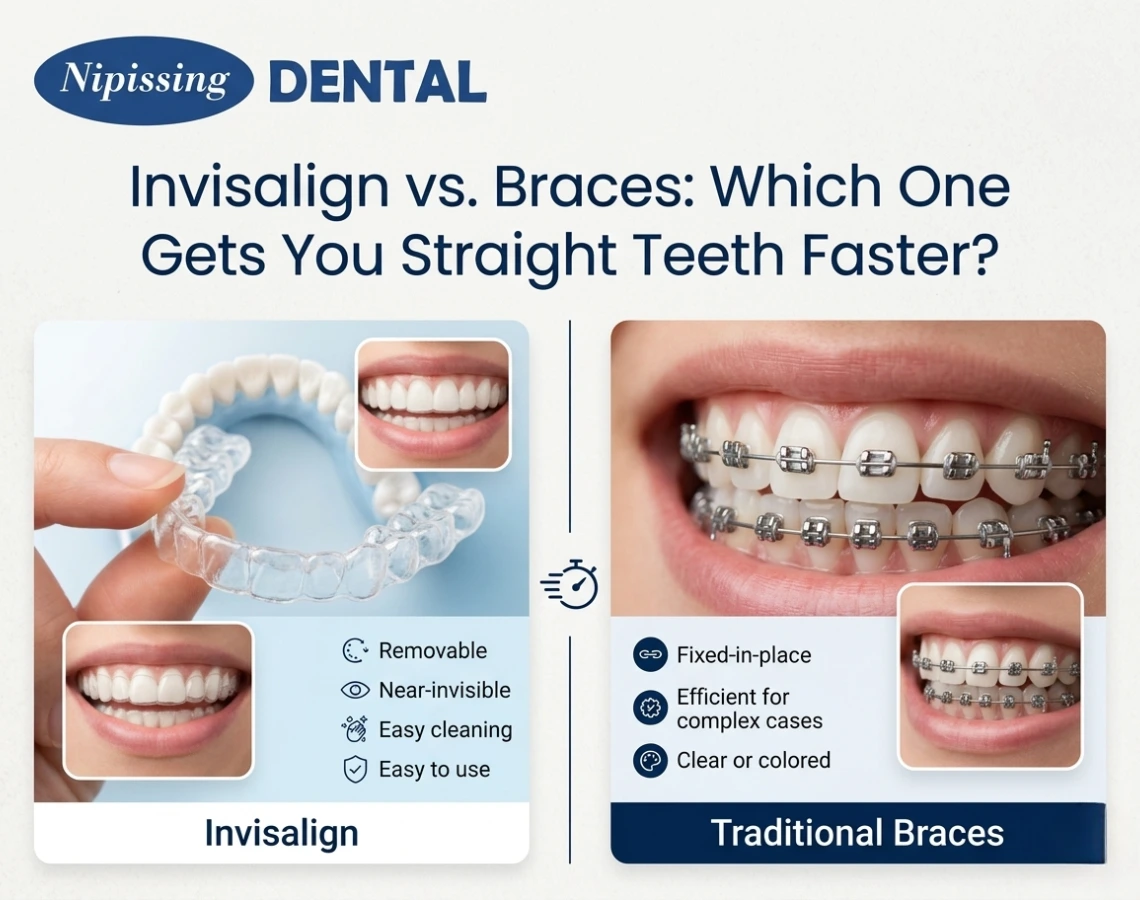
Traditional braces use metal brackets bonded to your teeth, connected by wires that your dentist tightens at regular intervals. They apply continuous pressure to shift teeth into alignment.
Invisalign treatment uses a series of custom-made, clear plastic aligners that you swap out roughly every one to two weeks. Each new set moves your teeth slightly further toward the final position. You wear them 20 to 22 hours a day — removing them only to eat, drink anything other than water, and clean your teeth.
Both systems work on the same biological principle: gradual, controlled pressure that encourages bone remodelling around your teeth.
Is Invisalign Faster Than Braces?
For mild to moderate cases, Invisalign can be just as fast as braces — and in some situations, slightly faster. The Canadian Dental Association recognizes clear aligner therapy as an effective orthodontic treatment option for appropriate cases.
Here’s a general comparison based on case complexity:
| Case Complexity | Traditional Braces | Invisalign |
|---|---|---|
| Mild (minor crowding/spacing) | 12–18 months | 6–18 months |
| Moderate (bite issues, moderate crowding) | 18–24 months | 12–18 months |
| Severe (significant misalignment) | 24–36 months | Often not ideal |
One important caveat: Invisalign treatment timelines depend entirely on patient compliance. If you forget to wear your aligners for several hours each day, your treatment extends. With braces, the hardware works around the clock — no compliance required.
What Factors Actually Determine Speed?
1. Severity of Misalignment
Minor spacing or crowding responds quickly to both options. Complex bite problems — like significant overbites, underbites, or severe crowding — often respond better to braces, which offer more precise control over tooth movement.
2. Patient Compliance (Invisalign Only)
The 20–22 hours per day rule isn’t a suggestion — it’s the treatment protocol. Missing hours consistently delays your results. This is the single biggest variable in how long Invisalign treatment takes to work.
3. Age
Teenagers and younger adults typically see faster results than older patients because bone density is lower and teeth move more readily.
4. How Often You Attend Check-Ups
Both treatments require regular visits. Skipping appointments delays adjustments and slows progress. At Nipissing Dental, we recommend routine dental check-ups every six months — not just during orthodontic treatment, but as part of your long-term oral health plan.
Invisalign vs. Braces: Beyond Speed
Speed matters, but it’s not the only factor. Here’s how the two options compare on things patients care about day-to-day:
Appearance
Invisalign clear aligners in Milton are nearly invisible. For adults and teens in professional or social settings, this is often the deciding factor. Metal braces are visible, though tooth-coloured ceramic braces offer a middle ground.
Comfort
Invisalign aligners are smooth plastic with no brackets or wires to irritate your cheeks and gums. Traditional braces can cause soreness after tightening appointments, and broken wires occasionally cause discomfort between visits. If you ever find yourself with a broken wire or orthodontic urgency, our emergency dental care in Milton is available with same-day appointments.
Eating and Oral Hygiene
With braces, you give up popcorn, hard candies, and chewy foods for the duration of your treatment. Brushing and flossing also takes more effort around the hardware. Poor hygiene during braces treatment increases the risk of dental cavities forming around brackets — an issue that’s much easier to avoid with removable aligners.
With Invisalign, you remove the aligners before eating — so your diet doesn’t change at all. Cleaning your teeth is straightforward, though you do need to clean the aligners themselves regularly. More on that below.
Effectiveness for Complex Cases
Braces still hold an edge for complex orthodontic cases involving significant bite correction, rotations, or vertical tooth movement. Your dentist will tell you honestly which option suits your specific needs.
How to Keep Your Invisalign Aligners Clean
Proper aligner hygiene isn’t just about aesthetics — it protects your oral health throughout treatment. Bacteria can accumulate on aligners, and wearing dirty aligners for hours each day creates an environment for plaque build-up. Just as we advise with dental fillings and other restorative work, protecting your teeth from bacterial exposure during treatment is essential to long-term outcomes.
How to use Invisalign cleaning crystals:
- Dissolve one packet of Invisalign cleaning crystals in a cup of lukewarm water (never hot — heat warps the plastic).
- Submerge your aligners fully and soak for 15 minutes.
- Use a soft-bristle toothbrush to gently brush away any loosened deposits.
- Rinse thoroughly with cool water before reinserting.
You can also use a clear, unscented antibacterial soap and a soft brush for daily cleaning. Avoid coloured toothpaste, mouthwash with dyes, or anything abrasive — these scratch or stain the clear plastic.
Is Invisalign More Expensive Than Braces?
In Canada, costs vary by province, clinic, and case complexity. Many dental insurance plans in Canada now cover Invisalign at the same rate as traditional braces — check your plan details carefully.
At Nipissing Dental, we offer direct insurance billing and flexible payment options to help make your treatment accessible. We’re happy to help you review your coverage and understand your out-of-pocket costs before committing to any treatment.
Can You Eat With Invisalign On?
No — and this is non-negotiable. You must remove your aligners before eating or drinking anything other than plain water. Eating with aligners in can crack or distort them, stain the plastic, and trap food particles against your teeth.
The good news? Removing aligners takes seconds. It quickly becomes habit, and unlike braces, there’s no food restriction list to memorize. It also makes maintaining good oral hygiene far simpler — something we always encourage throughout any orthodontic treatment.
Which Is Right for You?
Here’s a straightforward way to think about it:
Invisalign may be the better fit if you:
- Have mild to moderate crowding or spacing
- Want a discreet option for professional or social reasons
- Are disciplined about wearing them the required hours daily
- Want easier oral hygiene during treatment
- Are considering pairing your treatment with teeth whitening in Milton for a complete smile refresh
Traditional braces may be the better fit if you:
- Have complex bite issues or severe misalignment
- Prefer a “set it and forget it” approach with no daily compliance requirement
- Are treating a young child or teenager who may struggle with aligner responsibility
If you feel anxious about starting orthodontic treatment, you’re not alone. Our team has experience helping patients manage dental anxiety and making every visit as comfortable as possible.
The best answer always comes from a professional assessment. Every mouth is different, and what works fastest for one person may not be right for another.
Conclusion
So, is Invisalign faster than braces? For the right candidate — yes, it can be. For mild to moderate cases where the patient wears aligners consistently, Invisalign treatment timelines are competitive with traditional braces, and the added benefits of comfort, aesthetics, and easier hygiene make it a compelling choice for many adults and teens.
But speed alone shouldn’t drive your decision. The right treatment is the one your dental provider recommends based on your specific tooth and bite profile — not just the one that promises the quickest results.
At Nipissing Dental, our goal is to give you a straight, healthy smile in the most efficient and comfortable way possible. If you’re weighing your options and want a professional opinion tailored to your situation, book a consultation and we’ll walk you through everything — no pressure, just clarity.
Frequently Asked Questions
What is Invisalign treatment?
Invisalign is a clear aligner orthodontic system that gradually straightens teeth using a series of custom-fitted, removable plastic trays. Each aligner set moves your teeth a small amount, and you progress through the series over the course of your treatment plan. It’s an alternative to traditional braces, approved for a wide range of mild to moderate orthodontic cases. You can learn more about Invisalign clear aligners in Milton and schedule a consultation at Nipissing Dental to find out if it’s right for you.
How long is Invisalign treatment?
Invisalign treatment length varies depending on the complexity of your case. Simple cases may be resolved in six to twelve months. Moderate cases typically take twelve to eighteen months. Your dentist will give you a personalized estimate after examining your teeth and bite. Wearing your aligners for the full 20–22 hours per day is essential to staying on schedule.
How do I use Invisalign cleaning crystals?
Dissolve one packet of Invisalign cleaning crystals in lukewarm water, soak your aligners for 15 minutes, gently brush with a soft toothbrush, and rinse with cool water before placing them back in your mouth. Use this method once daily or as directed. Avoid hot water, which can warp the aligner material.
Is braces cheaper than Invisalign?
In many cases, traditional metal braces are modestly less expensive than Invisalign — but the difference has narrowed. Many insurance plans now cover Invisalign at the same benefit level as braces.
How long does Invisalign take to work?
You may notice subtle changes within the first few weeks of treatment as your teeth begin shifting. Visible progress is typically noticeable within two to three months. Full results depend on your treatment plan length, but consistent aligner wear is the most important factor in achieving results on schedule.
References:
Ready to Feel at Ease at the Dentist?
Our team at Nipissing Dental is here to make every visit as comfortable and stress-free as possible. Take the first step toward better oral health today.