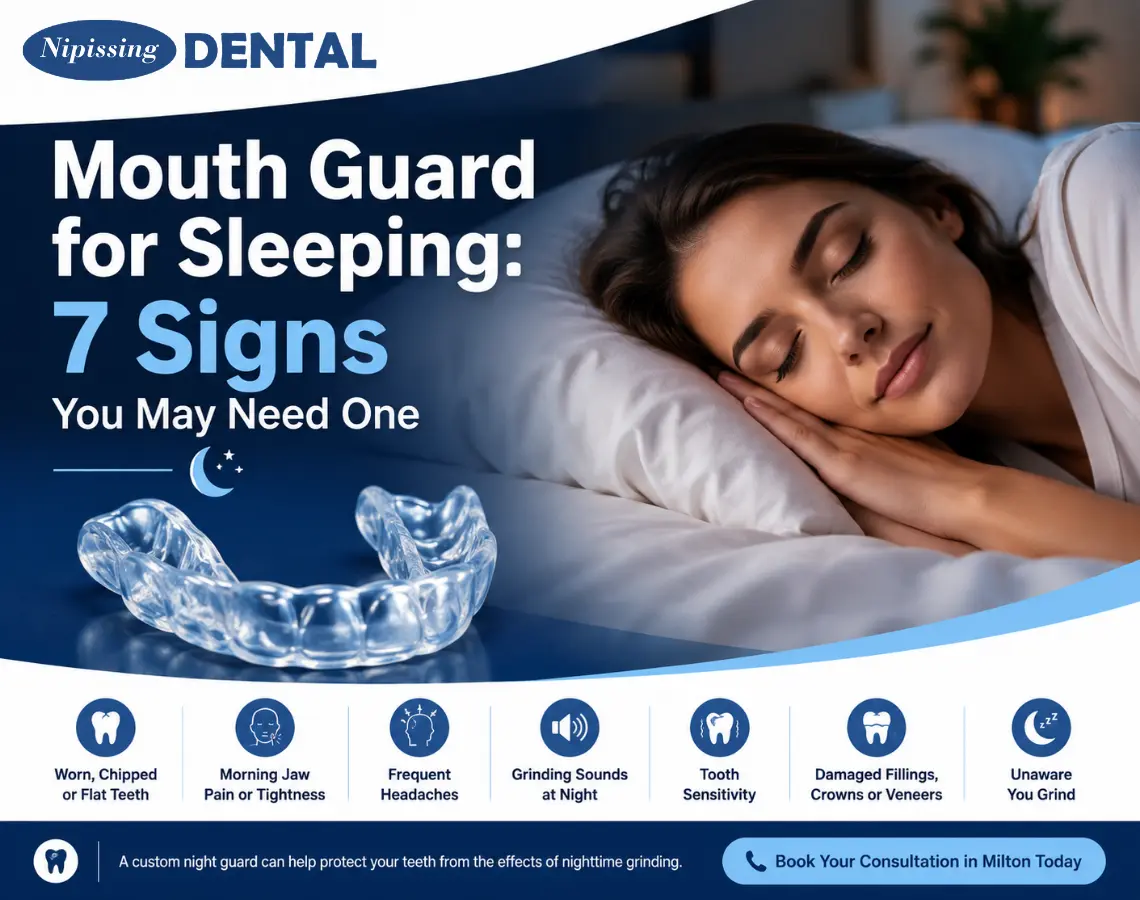
A mouth guard for sleeping may be appropriate when nighttime teeth grinding or clenching is placing excessive pressure on your teeth. Warning signs can include flattened or chipped teeth, morning jaw soreness, sensitivity, headaches, damaged restorations, or a partner hearing you grind. A dental examination can determine whether bruxism is likely.
Many people grind or clench their teeth during sleep without being aware of it.
You may go to bed normally, sleep through the night, and wake up with no memory of what happened to your teeth or jaw while you were asleep.
Sometimes, the first clue comes from a partner who hears grinding. In other cases, your dental team may notice tooth wear, small fractures, sensitivity, or changes to dental restorations during a routine examination.
The important question isn’t simply:
“Should I buy a night guard?”
A better question is:
“Are there signs that nighttime grinding or clenching is putting my teeth or jaw at risk?”
That distinction matters because a night mouth guard isn’t automatically appropriate for every person with jaw pain, headaches, or tooth sensitivity.
Key Takeaways
- A mouth guard for sleeping may be worth discussing with a dentist when there are signs of nighttime teeth grinding or clenching.
- Flattened teeth, chips, sensitivity, morning jaw soreness, headaches, and repeated dental restoration damage can be important warning signs.
- You can grind your teeth during sleep without realizing it.
- Not every headache, jaw ache, or sensitive tooth is caused by bruxism, so symptoms should be evaluated rather than self-diagnosed.
- The right next step is to determine whether nighttime grinding is actually occurring and whether your teeth need protection.
1. Your Teeth Look More Worn or Flattened
One of the most important signs of possible nighttime grinding is unusual tooth wear.
Your teeth naturally experience some wear over your lifetime. However, repeated clenching and grinding can place significantly greater mechanical forces on the teeth.
You may notice:
- Flattened biting surfaces
- Small chips
- Worn edges
- Cracks or fractures
- Changes in tooth shape
- Increased sensitivity
Sometimes these changes develop gradually, which means you may not notice them until your dentist points them out.
The Canadian Dental Association identifies tooth damage, including worn, cracked, or broken teeth, as a possible consequence of prolonged bruxism.
Why this is important
You don’t necessarily need to feel pain for grinding to be affecting your teeth.
Tooth wear can sometimes be the first visible evidence that excessive forces are occurring.
If your dental team notices patterns of wear that are consistent with clenching or grinding, they can assess whether nighttime protection should be considered.
This is often one of the clearest early indicators that a mouth guard for sleeping may be worth discussing with your dentist.
2. You Wake Up With a Sore or Tired Jaw
Do your jaw muscles feel tight when you wake up?
Perhaps your first few bites of breakfast feel uncomfortable, or your jaw seems tired even though you haven’t used it yet that morning.
These symptoms can sometimes be associated with nighttime clenching or grinding.
Possible signs include:
- Morning jaw soreness
- Tight chewing muscles
- Facial muscle fatigue
- Temple-area discomfort
- Jaw tenderness
- Discomfort when chewing
The Canadian Dental Association lists jaw aching, facial pain, and stiffness among possible symptoms associated with bruxism.
However, jaw pain does not automatically mean you grind your teeth.
Temporomandibular disorders, dental problems, muscle tension, injuries, and other conditions can cause similar symptoms.
That’s why the goal should be to identify the cause rather than automatically treating the symptom with a mouth guard.
Morning jaw discomfort becomes more relevant when it occurs alongside other signs such as tooth wear, sensitivity, or a history of clenching.
Looking at the complete picture is more useful than relying on one symptom.
If this pattern continues, it may be a sign that a mouth guard for sleeping could help protect your jaw and teeth overnight.
3. You Frequently Wake Up With Headaches
Morning headaches can have many causes.
But if you regularly wake with headaches and also experience jaw tightness, tooth wear, or other signs of grinding, it may be worth discussing bruxism with your dental team.
Possible associated symptoms include:
- Headaches after waking
- Temple-area tension
- Jaw soreness
- Facial muscle discomfort
- Tooth sensitivity
The Canadian Dental Association lists headaches among symptoms that can occur with prolonged bruxism.
Still, a headache alone isn’t enough to conclude that you need a mouth guard for sleeping.
Headaches can also be related to sleep quality, dehydration, migraines, medications, sinus problems, and numerous other factors.
The key distinction
Morning headache alone ≠ proof of teeth grinding.
But:
Morning headache + jaw soreness + tooth wear = a good reason to discuss possible grinding with a dental professional.
This combination is often when patients start researching a mouth guard for sleeping.
4. Your Partner Says You Grind Your Teeth at Night
Sometimes another person notices the problem before you do.
If your partner regularly hears clicking, clenching, or grinding sounds while you’re asleep, don’t ignore the observation.
The Canadian Dental Association notes that a partner, spouse, or parent may sometimes be the first person to notice nighttime grinding.
You may wake up feeling completely normal while your teeth have been exposed to repeated forces during sleep.
A dentist can look for evidence that supports the possibility of bruxism, including:
- Tooth wear
- Chipped enamel
- Cracks
- Sensitivity
- Restoration damage
- Jaw muscle tenderness
The combination of an outside observation and clinical findings can be more meaningful than either one alone.
A partner’s observation is often the first practical reason people begin looking into a mouth guard for sleeping.
5. Your Teeth Have Become Sensitive Without an Obvious Cause
Tooth sensitivity is another reason to investigate what’s happening in your mouth.
If cold water, hot foods, sweet foods, or brushing suddenly cause discomfort, don’t automatically assume grinding is responsible.
Sensitivity can result from:
- Tooth decay
- Gum recession
- Enamel erosion
- Cracked teeth
- Exposed tooth surfaces
- Tooth wear
- Clenching or grinding
The Canadian Dental Association includes tooth sensitivity among possible symptoms associated with bruxism.
This is why the correct sequence is:
Identify the cause → assess the risk → determine whether protection is appropriate.
A mouth guard cannot treat tooth decay, repair a cracked tooth, or reverse gum disease.
If excessive nighttime forces are contributing to the problem, however, your dental team may discuss protective options with you.
When sensitivity is linked to grinding, a mouth guard for sleeping may be part of the discussion once the underlying cause is confirmed.
6. Your Fillings, Crowns, or Other Dental Work Keep Getting Damaged
Repeated dental restoration problems can sometimes provide another clue.
If fillings, crowns, veneers, or other dental work repeatedly chip, fracture, or become damaged, excessive biting forces may be one factor worth investigating.
The Canadian Dental Association notes that prolonged bruxism can contribute to damage involving teeth and dental restorations.
This does not mean that every broken filling or crown is caused by grinding.
Dental restorations can fail for many reasons.
But if repeated restoration damage occurs alongside:
- Tooth wear
- Jaw soreness
- Morning headaches
- Clenching
- Partner-reported grinding
then nighttime grinding becomes an important possibility to discuss with your dental team.
Repeated restoration damage is one of the more convincing reasons to evaluate whether a mouth guard for sleeping is appropriate.
7. Your Dentist Has Noticed Signs of Grinding—Even Though You Feel Fine
This may be the most overlooked warning sign.
You don’t have to hear yourself grind.
You don’t have to wake up with jaw pain.
And you don’t have to experience headaches.
Your dental team may identify evidence of excessive forces during a regular examination.
For example, they may notice:
- Flattened tooth surfaces
- Unusual wear patterns
- Small fractures
- Repeated restoration damage
- Tooth sensitivity
- Changes in how your teeth contact one another
Why dental examinations matter
Bruxism can vary considerably between individuals, and there isn’t one symptom that confirms the condition.
Research has also shown that reported prevalence varies depending on the population studied and the method used to assess bruxism.
That means a general internet checklist cannot diagnose you.
Your own dental findings provide much more useful information.
This is often how patients first learn that a mouth guard for sleeping may be worth considering, even without noticeable symptoms.
What If I Have Some of These Signs?
Having one or more symptoms doesn’t automatically mean you need a nighttime mouth guard for grinding teeth.
Instead, consider the pattern.
The pattern of your symptoms, rather than any single sign, is what helps determine whether a mouth guard for sleeping is worth pursuing.
Lower concern
You have:
- Occasional jaw tension
- No noticeable tooth wear
- No restoration damage
- No grinding reported by a partner
Worth discussing with your dentist
You have several of the following:
- Morning jaw soreness
- Flattened teeth
- Tooth sensitivity
- Repeated chips
- Morning headaches
- Partner-reported grinding
- Repeated restoration damage
Particularly important to assess
You have significant tooth wear, cracked teeth, persistent jaw symptoms, or repeated dental restoration failures.
The purpose of an examination is to determine what is causing the problem and whether your teeth require protection.
At this stage, a mouth guard for sleeping is often part of the conversation about protecting your teeth going forward.
When Jaw Pain May Not Be a Grinding Problem
This is an important distinction.
A common mistake is assuming:
“My jaw hurts, so I must need a night guard.”
Not necessarily.
Jaw discomfort can have several causes.
These can include:
- Temporomandibular disorders
- Dental infections
- Tooth problems
- Muscle-related pain
- Injury
- Inflammation
- Other oral or medical conditions
If your jaw locks, your ability to open your mouth changes, or pain persists, seek professional assessment.
A mouth guard mouthpiece should not be used as a substitute for determining the underlying cause of persistent symptoms.
In other words, jaw pain by itself doesn’t automatically point to needing a mouth guard for sleeping.
When a Mouth Guard May Not Be the First Step
There are situations where a dental assessment should come before considering a nighttime appliance.
Before considering a mouth guard for sleeping, it helps to rule out these situations first.
You have severe tooth pain
A painful tooth may have decay, infection, a crack, or another dental problem that needs treatment.
You have persistent jaw dysfunction
Jaw locking, significant movement limitations, or persistent pain should be professionally evaluated.
You have possible sleep-disordered breathing
If someone notices that you stop breathing during sleep, or you experience gasping, loud snoring, or significant daytime sleepiness, discuss those symptoms with an appropriate healthcare professional.
A conventional grinding guard is not the same appliance as an oral device designed for certain sleep-related breathing disorders.
You are undergoing orthodontic treatment
If you’re wearing braces or clear aligners, talk to your dental or orthodontic provider before using another appliance.
Why Early Assessment Matters
One of the biggest advantages of identifying possible bruxism early is that you can address the problem before damage becomes extensive.
Tooth enamel and natural tooth structure don’t simply regenerate after significant mechanical wear.
Likewise, repeatedly repairing damaged dental restorations without investigating contributing factors may not address the reason they keep failing.
A preventive approach asks:
- What is happening?
- What is causing it?
- Which structures are at risk?
- What can we do to protect them?
That’s a much more useful approach than simply purchasing an appliance because you saw one recommended online.
Addressing bruxism early, rather than waiting, is one of the best reasons to have a mouth guard for sleeping evaluated sooner rather than later.
What Happens During a Dental Assessment?
If you visit Nipissing Dental because you suspect nighttime grinding, the dental team can evaluate the overall condition of your mouth and look for signs that may be consistent with excessive biting forces.
Depending on your situation, the assessment may consider:
- Tooth wear
- Cracks or chips
- Existing restorations
- Tooth sensitivity
- Jaw symptoms
- Bite relationships
- Your reported symptoms
- Reports from your sleep partner
The purpose isn’t simply to decide whether you should wear a night mouth guard.
It’s to understand whether you are experiencing a problem that requires protection or another form of care.
If protection is appropriate, your dental team can then discuss suitable treatment options.
This assessment is the most reliable way to determine whether a mouth guard for sleeping is the right next step for you.
What About a Store-Bought Mouth Guard?
If you’ve searched online for a mouth guard night solution, you’ve probably seen many inexpensive options.
However, this article isn’t intended to rank or compare different guard types—that is covered in Nipissing Dental’s dedicated guide to mouth-guard benefits, types, and selection.
The important point here is:
Don’t choose an appliance before determining whether you actually need one.
A professionally evaluated appliance can be considered in the context of your teeth, bite, symptoms, restorations, and overall oral health.
For detailed information about the different types of guards and how to choose one, readers can visit Nipissing Dental’s dedicated mouth-guard guide.
Choosing a mouth guard for sleeping without this assessment means guessing at a solution instead of addressing the actual cause.
Adults, Children, and Orthodontic Patients
The signs of nighttime grinding can appear in different age groups, but the approach isn’t necessarily identical.
Adults
Adults may experience tooth wear, jaw soreness, headaches, sensitivity, and restoration damage associated with clenching or grinding.
Adults are generally the most common group evaluated for a mouth guard for sleeping.
Children
Children can also grind their teeth, but their teeth and jaws are still developing.
Parents should consult their child’s dental provider before purchasing an adult-style night mouth guard.
Orthodontic Patients
If you’re undergoing orthodontic treatment, speak with your orthodontic or dental provider before using an additional appliance.
Patients searching for an orthodontic centre in Milton should mention any nighttime clenching or grinding during their consultation.
When Should You Talk to a Dentist?
These are among the clearest signs that it’s time to ask your dentist about a mouth guard for sleeping.
Consider booking an assessment if you:
- Notice significant tooth wear
- Frequently wake with jaw soreness
- Have unexplained tooth sensitivity
- Have chipped or cracked teeth
- Are told you grind your teeth
- Repeatedly damage dental restorations
- Experience persistent jaw discomfort
- Notice changes in how your teeth meet
If you’re unsure whether your symptoms are related to grinding, that’s exactly when a professional assessment can be useful.
Mouth Guard for Sleeping: The Bottom Line
A mouth guard for sleeping may be worth considering when there is evidence that nighttime clenching or grinding is putting your teeth or jaw at risk.
The most useful warning signs include flattened or damaged teeth, morning jaw soreness, tooth sensitivity, headaches associated with jaw tension, partner-reported grinding, and repeated damage to dental restorations.
But symptoms alone don’t establish a diagnosis.
The right approach is to determine whether bruxism is actually contributing to the problem and then decide whether dental protection is appropriate.
For patients in Milton, the Nipissing Dental Team can assess signs of nighttime grinding and discuss the next appropriate step based on your individual oral health needs.
Choosing the right mouth guard for sleeping starts with understanding whether grinding is actually occurring, not with picking a product off a shelf.
Concerned that you may be grinding your teeth while you sleep? Contact Nipissing Dental in Milton to arrange a dental assessment.
Think You May Need a Mouth Guard for Sleeping? Nipissing Dental, Milton ON
Get a personalized assessment for nighttime teeth grinding or clenching from a dental team that puts diagnosis before treatment. Our team evaluates your teeth, jaw, and bite before recommending any protective appliance, so you know whether a mouth guard for sleeping is truly the right solution.
FAQ
Explore Our Related Services
These services work well alongside a mouth guard for sleeping assessment to support long-term oral health.
- Family Dentistry in Milton — Preventive and restorative dental care for every age
- Dental Cleanings in Milton — Routine hygiene visits that help your dentist catch early signs of grinding
References & Trusted Sources
This article was developed using expert dental knowledge and validated against the following trusted health and dental authorities:
- American Dental Association (ADA) — Clinical guidance on bruxism, night guards, and restorative dental care
- Canadian Dental Association (CDA) — Oral health resources on teeth grinding and tooth damage
- Health Canada — Oral health and preventive dental care guidance
These trusted sources also inform how Nipissing Dental approaches nighttime grinding assessments for patients in Milton.