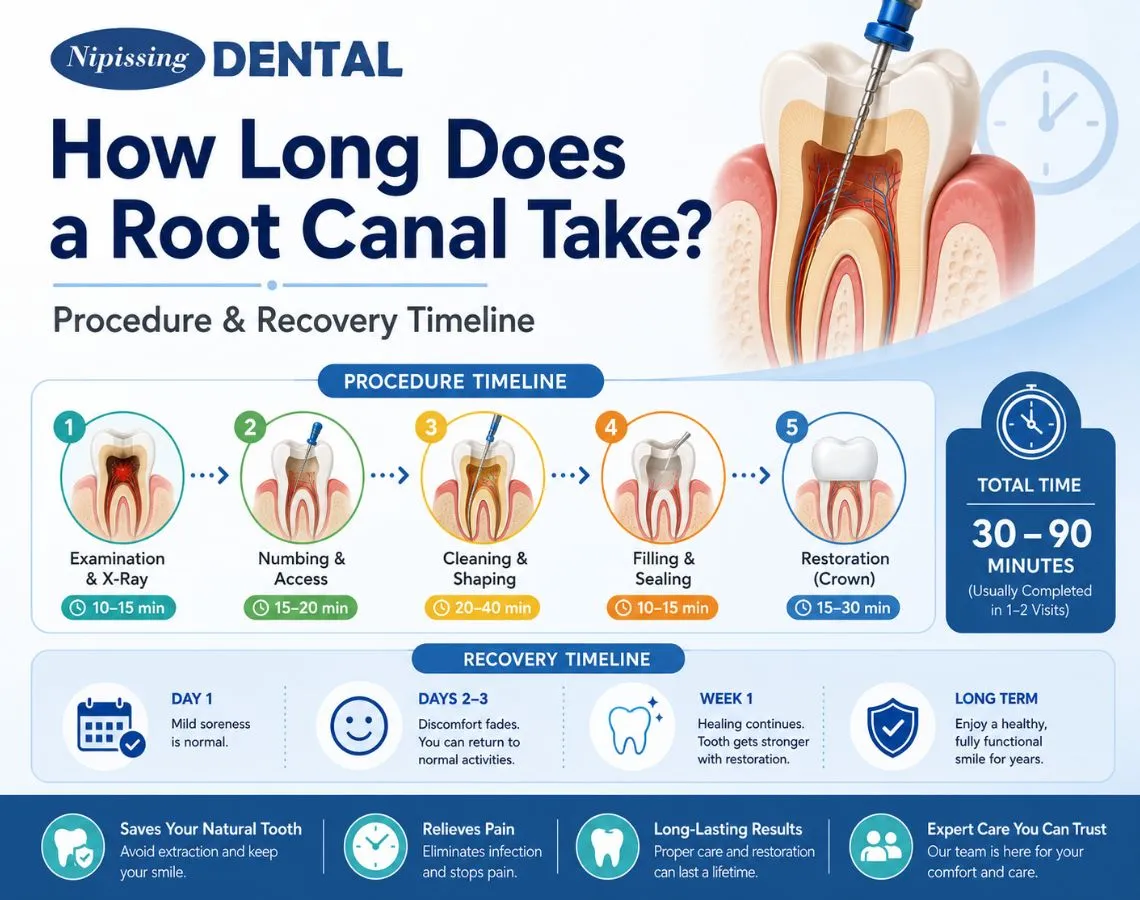
If your dentist just reviewed your digital X-rays and told you that you need endodontic treatment, your very first question is likely practical: how long does a root canal take? There is a widespread, persistent myth that a root canal procedure is a grueling, multi-hour ordeal. The reality is that modern dental technology has turned this infected tooth treatment into a highly predictable, routine visit. Thanks to advanced rotatory instruments and digital imaging, a root canal takes no longer than a standard deep filling. At Nipissing Dental in Milton, we break down the exact clinical timeline, step-by-step procedure mechanics, and what to expect during your recovery — so you walk in informed and walk out relieved.
What Is a Root Canal and How Does It Work?
To accurately calculate how long does a root canal take, it helps to understand what a root canal is and what it is designed to do.
Many patients sit in our chairs wondering, what is a root canal and how does it work? This specialized procedure is an infected tooth treatment designed to deliver permanent damaged tooth repair — rather than pulling a compromised tooth out completely.
Your tooth features a hard outer shell of enamel and dentin that shields a soft inner core. This inner core is the pulp chamber, which contains blood vessels, connective tissues, and the tooth nerve lines.
When deep decay, a cracked tooth, or sudden trauma allows bacteria to breach the pulp chamber, the internal living tissue becomes irreversibly inflamed or dead. Left untreated, this bacterial spread creates a high-pressure infection that transforms into a painful dental abscess or migrates into the surrounding jawbone.
During a standard root canal procedure, our root canal team in Milton cleans out the damaged tissue, completely sterilizes the microscopic root pathways, and seals the interior to block future bacterial invasions.
How Long Does a Root Canal Take?
On average, the direct answer to how long does a root canal take is 60 to 90 minutes from start to finish.
While a large percentage of standard cases are fully completed in a single appointment, the total time depends heavily on which tooth is infected, how many root canals it contains, and the severity of the structural inflammation. When estimating how long does a root canal take, dentists evaluate your specific oral anatomy to block out the correct amount of clinical time. Understanding how long does a root canal take also helps you plan your day — most patients return to normal activity the same evening.
Time Breakdown by Tooth Type
Teeth possess highly diverse root blueprints depending on their location in your mouth, which directly dictates how long does a root canal procedure take:
- Front Teeth (Incisors & Canines): 45 to 60 minutes. These teeth are built for biting and contain a single root with one root canal. Because they are easily accessible and straightforward to clean, they represent the quickest treatment times.
- Premolars (Bicuspids): 60 to 90 minutes. Located in the middle of your smile, premolars typically house one or two roots. Safely shaping and cleaning multiple canals adds slightly more time to your overall appointment.
- Molars: 90 to 120+ minutes. Your rear chewing teeth are complex structural powerhouses containing three, four, or occasionally five distinct root canals. Because these rear pathways are often narrow, curved, or calcified, a molar root canal usually lands closer to the two-hour mark. In highly complex cases, your practitioner may split treatment into two separate visits to ensure thorough sterilization.
Step-by-Step Guide: The Root Canal Procedure Explained
If you are looking for a clear root canal procedure explained step-by-step, our clinical team at Nipissing Dental Milton follows a highly structured, efficient chronological sequence. Patients often ask us directly: how long does a root canal take at each individual stage? Here is the complete breakdown:
1. Diagnosis & Digital Mapping — 10 to 15 Minutes
We capture high-definition digital X-rays to assess the underlying bone density, trace the exact curves of your roots, and determine if an active dental abscess treatment is required. According to the American Dental Association (ADA), accurate diagnostic imaging is a foundational step in safe endodontic therapy.
2. Numbing & Isolation — 5 to 10 Minutes
Local anesthesia is precisely administered to ensure the treatment zone is entirely numb. We then place a thin, protective rubber sheet called a dental dam over the tooth to keep it isolated from oral bacteria and saliva.
3. Accessing the Pulp Chamber — 5 to 10 Minutes
Using specialized precision instruments, your dentist creates a microscopic access opening through the top surface of a molar or the rear surface of a front tooth to safely reach the infected pulp chamber.
4. Deep Cleaning & Canal Shaping — 20 to 45 Minutes
This is the core phase that determines how long does a root canal take. We utilize highly flexible micro-files to sweep out the infected pulp tissue and dead nerve structures. The hollow canals are then thoroughly flushed with advanced antibacterial irrigation solutions to eliminate all deep-seated pathogens. The Canadian Dental Association (CDA) emphasizes that thorough canal debridement is critical to long-term treatment success.
5. Sealing the Canals — 10 to 15 Minutes
Once the root interior is clinically sterile and dry, the empty canals are filled with a rubbery, biocompatible material called gutta-percha. This is cemented firmly into place with therapeutic sealants to form a permanent barrier against future bacterial leaks.
How to Know If You Need a Root Canal Treatment
Teeth send very distinct, unmistakable distress signals when the internal nerve is actively dying. Knowing how to know if you need a root canal treatment means monitoring your mouth for key clinical warnings.
Common Root Canal Symptoms
Unprovoked, Thumping Pain
A deep, throbbing ache that flashes out of nowhere, intensifies when you lie flat, and fails to respond to over-the-counter pain medications.
Lingering Thermal Sensitivity
Pain from hot coffee or cold water that hangs around for 30 seconds or longer after you swallow, signaling that the nerve is too damaged to repair itself.
Biting and Chewing Discomfort
Sharp, localized pain whenever your teeth touch together, indicating that the bacterial infection has leaked into the surrounding ligament and jawbone.
Localized Gum Changes
Spotting a small, raised, pimple-like bump on your gums (a gum boil) near the aching tooth, which indicates a draining infection.
Enamel Discoloration
A dark grey or blackish tint developing across the enamel, which indicates that the internal blood supply has completely failed.
If you are experiencing severe, localized pain along with swelling or a fever, do not wait for a routine checkup. Seeking out emergency dental care in Milton can instantly halt an aggressive infection and provide rapid pain relief. According to Health Canada, untreated dental infections carry real systemic health risks if left unaddressed.
Root Canal vs. Tooth Extraction: The Ultimate Comparison
When patients are confronted with a deep internal infection, they often ask if it is simpler to just pull the tooth. When evaluating a root canal vs tooth extraction, choosing to preserve your natural smile via endodontic treatment is almost always the superior choice for your long-term health and financial budget.
| Feature | Root Canal Treatment | Tooth Extraction |
|---|---|---|
| Primary Goal | Salvages and reinforces your existing natural tooth structure. | Completely removes the entire tooth and root structure from the jaw. |
| Bite Alignment | Keeps your natural dental alignment perfectly intact. | Leaves an empty gap that causes surrounding teeth to drift and shift. |
| Follow-Up Work | Requires a simple final filling or dental crown in Milton. | Requires a surgical dental implant in Milton or dental bridge to restore function. |
| Lifetime Cost | Moderate upfront cost; highly cost-effective over time. | Low initial cost; very high lifetime cost for structural replacements. |
| Healing Duration | 2 to 4 days of minor localized tissue tenderness. | 1 to 2 weeks for the jawbone and extraction socket to fully close. |
Pulling a tooth leaves an open gap in your jawbone. Over time, your neighboring teeth will naturally tilt and shift into that empty space, disrupting your bite alignment, causing uneven enamel wear, and potentially triggering TMJ (jaw joint) disorders. To correct a missing tooth later, you will require a structural bridge, implant, or other restoration — a path that demands multiple appointments, surgical healing phases, and thousands of dollars more out-of-pocket than a single-day root canal. Keeping your original tooth intact should always be your primary goal.
Do Root Canals Hurt?
Let us address the oldest myth in dentistry. Alongside the common question of how long does a root canal take, the most frequent concern patients raise is: do root canals hurt during the procedure?
The clinical fact: No. The actual physical experience is practically identical to receiving a routine dental filling in Milton for a standard cavity.
The widespread cultural idea that a root canal is an agonizing experience is a leftover relic from the early days of dentistry, long before the invention of modern local anesthetics, advanced numbing gels, and digital diagnostic tools. Today, a root canal procedure is explicitly executed to eliminate the excruciating pain caused by your internal tooth infection — not to cause more pain.
With modern numbing solutions, you will feel some mild pressure and vibration while our team works, but you should not feel any sharp discomfort. Most patients experience an immediate wave of relief the moment the anesthetic blocks the throbbing, high-pressure ache of the infected pulp. Leaving the active infection untreated is infinitely more painful than the actual clinical cure.
Post-Procedure Recovery Timeline
Once you know how long does a root canal take, the next question is always: what happens after? While the appointment itself is completely comfortable, experiencing a baseline amount of tenderness after your root canal therapy is a normal part of the body’s natural healing response once the local numbing wears off. Here is what your root canal recovery timeline generally looks like:
- Days 1 to 2: The treated tooth and surrounding gum line will feel tender or bruised. This mild ache is not coming from inside the tooth, but rather from the healing ligaments around the root tips. You can easily control this discomfort using common over-the-counter anti-inflammatories like ibuprofen.
- Days 3 to 5: The tenderness should steadily taper off. You will find yourself going about your day without noticing the tooth, though it might still feel slightly distinct when pressed down on firmly.
- Week 2 and Beyond: The tooth should settle into the background completely, feeling just like its neighbors. If you ever experience a sudden flare-up of intense pain or noticeable swelling weeks down the line, call our office right away for a quick check.
What to Eat After a Root Canal Procedure
While your tooth is in its transitional healing phase — especially if it currently has a temporary filling while you wait for your permanent crown — you need to treat it gently. Knowing exactly what to eat after a root canal procedure ensures you do not accidentally crack the enamel:
- Smart Food Choices: Stick directly to soft, non-challenging items. Greek yogurt, nutrient-dense smoothies (enjoyed without a straw), fluffy mashed potatoes, scrambled eggs, warm soups, soft oatmeal, and applesauce are perfect choices.
- Foods to Skip: Steer clear of anything hard, ultra-crunchy, or sticky. Keep away from tortilla chips, nuts, crusty bread, popcorn, and chewy candies.
- The Chewing Rule: Make a conscious effort to chew your food entirely on the opposite side of your mouth until your permanent restoration is securely bonded in place.
Root Canal and Dental Crown: What Comes Next?
Now that you know how long does a root canal take and what the procedure involves, the final step is understanding what restoration comes after. Once your root canal is complete, your tooth will need a final restoration to protect its long-term structural integrity. For back chewing teeth — molars and premolars — a dental crown is highly recommended. Once the living pulp is cleared out, the tooth no longer receives an internal blood and moisture supply, causing it to become brittle over time. Because your back teeth handle immense chewing pressure, an uncrowned tooth is at high risk for structural fractures. A crown restores its original biting strength and shields it from new decay. Front teeth can sometimes be repaired with a simple composite filling if the remaining structure is solid.
Looking for Quality Root Canal Care Near Milton?
If you are dealing with a nagging toothache, unexplained swelling, or suspect a deep cavity has reached the nerve, acting early is the absolute best way to protect your smile. For families living near the Niagara Escarpment or commuting via the 401, accessing a family dentistry clinic in Milton like Nipissing Dental ensures prompt, localized emergency care without traveling outside Halton Region.
Whether you need a routine dental cleaning in Milton, are browsing options for Invisalign clear aligners in Milton, or find yourself needing an emergency root canal, working with our experienced team ensures your care is completely personalized and comfortable.
Our clinic is led by Dr. Disha Hans (DMD, Boston University), our team proudly serves patients in English, Hindi, Urdu, and Punjabi. Do not ignore a warning ache until it disrupts your sleep. Book your root canal consultation today and get fast, professional relief right when you need it most.
Frequently Asked Questions: Root Canal Procedure & Recovery
Protect Your Smile at Nipissing Dental Milton
A toothache that wakes you up at night or refuses to go away is your body telling you something is wrong. The sooner you act, the simpler and more affordable the solution. At Nipissing Dental, our dedicated team — led by Dr. Disha Hans (DMD, Boston University) offers comprehensive, gentle, and highly effective root canal treatment right here in Milton. We combine advanced dental technologies with a patient-first approach to make sure your treatment is thoroughly comfortable and highly successful. We proudly serve patients in English, Hindi, Urdu, and Punjabi.
Do not let a hidden infection put your smile or your systemic health at risk. Contact our team today to schedule your comprehensive endodontic evaluation and take the first step toward lasting oral health.
Explore our related services:
- Root Canals in Milton — Advanced endodontic therapy to save your natural tooth
- Crowns and Bridges in Milton — Protecting and restoring teeth after root canal therapy
- Dental Fillings in Milton — Treating early decay before it reaches the nerve
- Dental Cleanings in Milton — Preventive care to reduce your risk of future infections
- Emergency Dentist in Milton — Fast care for sudden tooth pain, swelling, or dental infections
- Dental Implants in Milton — Restorative solutions if a tooth cannot be saved
- Extractions and Wisdom Teeth Removal in Milton — When a tooth cannot be preserved despite endodontic therapy
- Family Dentistry in Milton — Comprehensive oral health care for every member of your household
- Cosmetic Dentistry in Milton — Restoring the appearance of your smile after restorative treatment
- Children’s Dentist in Milton — Gentle dental care and early cavity prevention for kids
- Teeth Whitening in Milton — Brighten your smile once your restorative treatment is complete
- Invisalign Clear Aligners in Milton — Straighten your teeth comfortably and discreetly
- Night Guards and Sports Guards in Milton — Protect your restored teeth from grinding and impact
Book Your Root Canal Consultation at Nipissing Dental, Milton ON
Don’t let tooth pain steal your sleep or your smile. At Nipissing Dental, our friendly team provides fast, comfortable, and effective root canal treatment in Milton — with no surprises and no unnecessary waiting.
References & Trusted Sources
This article was developed using expert dental knowledge and validated against the following trusted health and dental authorities:
- American Dental Association (ADA) — Clinical guidelines on root canal therapy, endodontic treatment, anesthesia protocols, and patient comfort standards
- Canadian Dental Association (CDA) — Canadian clinical standards for endodontic care, cavity progression, and restorative treatment sequencing
- Health Canada — Oral health guidance, dental care recommendations for Canadians, and systemic connections to oral infections