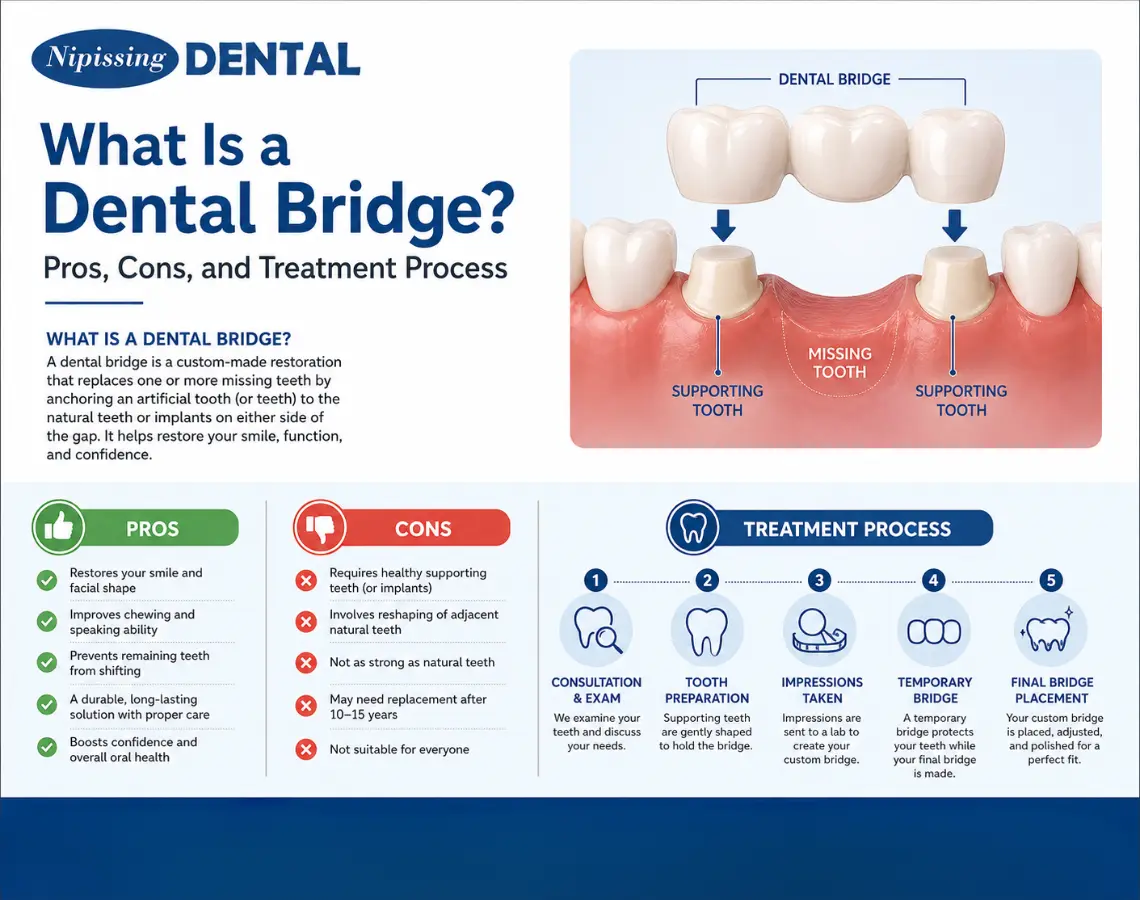
Losing a tooth affects more than your smile. It changes how you chew, how you speak, and over time, how your remaining teeth align. One of the most trusted, time-tested solutions for replacing missing teeth is a dental bridge. At Nipissing Dental, we’ve helped hundreds of patients navigate this decision — and in this guide we want to walk you through everything you need to know, clearly and without jargon.
If you’ve been searching for answers about what a bridge for dental purposes really involves, you’re in the right place. Whether you’re exploring dental bridges in Milton or simply trying to understand your options after tooth loss, let’s start with the essentials. We always recommend beginning with a comprehensive dental cleaning and exam before any restorative treatment so we can assess your full oral health picture.
What Is a Dental Bridge?
A dental bridge is a fixed prosthetic device that replaces one or more missing teeth by anchoring artificial teeth (called pontics) to dental crowns placed on the natural teeth on either side of the gap. It is cemented permanently and functions like natural teeth — making it one of the most comfortable, practical tooth replacement options available.
The term “bridge” is literal: the device spans the gap left by a missing tooth. The neighbouring natural teeth used as anchors are called abutment teeth. Unlike a denture, which you remove each day, a dental bridge is fixed in your mouth. It looks, feels, and functions much like your natural teeth.
According to the American Dental Association (ADA), fixed dental bridges are a clinically proven, evidence-based option for restoring function and aesthetics following tooth loss. The Canadian Dental Association (CDA) similarly supports bridge therapy as a reliable restorative standard when appropriate clinical criteria are met.
Key terms to know:
- Pontic — the artificial tooth that fills the gap
- Abutment teeth — the natural teeth on either side that support the bridge
- Dental crown — the cap placed over each abutment tooth to anchor the bridge
Our crowns and bridges in Milton service covers both individual crowns and full bridge systems — your dentist can walk you through exactly which applies to your situation.
Types of Dental Bridges
Not every bridge is the same. The best type for you depends on which teeth are missing, the health of your adjacent teeth, and your goals. Here are the four main types:
- Traditional Bridge — The most common type. Two dental crowns on either side of the gap support one or more pontics in between. Requires healthy natural teeth on both sides of the missing tooth.
- Cantilever Bridge — Used when there’s only one adjacent tooth available. The pontic is anchored to a single abutment. Less common today due to higher stress on the supporting tooth.
- Maryland Bridge (Resin-Bonded) — A conservative option using a metal or porcelain framework bonded to the backs of adjacent teeth — no crowns required. Ideal for front teeth where biting forces are lower.
- Implant-Supported Bridge — Uses dental implants as anchors instead of natural teeth. The most stable option for multiple missing teeth — doesn’t rely on neighbouring teeth at all, but requires surgery.
If a tooth was recently lost or extracted, our extractions and wisdom teeth removal in Milton team can help assess whether the site is ready for bridge placement, or whether an implant may be the better long-term solution.
Pros and Cons of Dental Bridges
Like any dental treatment, bridges come with real advantages and genuine trade-offs. Understanding both helps you make a confident, informed decision.
| Advantages | Disadvantages |
|---|---|
| Non-surgical procedure | Adjacent teeth must be reshaped |
| Faster treatment (1–2 weeks) | Does not prevent jawbone loss |
| More affordable than implants | May need replacement after 10–15 years |
| Covered by many insurance plans | Harder to clean underneath |
| Restores full chewing function | Risk of decay under crowns if neglected |
Dental Bridge vs. Implant: Which Is Right for You?
The dental bridge vs. implant question is the one we’re asked most often. Both are excellent, evidence-based solutions — but they suit different clinical situations and patient priorities. Understanding dental implants versus bridges comes down to several key factors.
| Factor | Dental Bridge | Dental Implant |
|---|---|---|
| Surgery | No surgery needed | Minor oral surgery required |
| Timeline | 1–2 weeks | 3–6+ months |
| Upfront Cost | Lower | Higher |
| Bone Health | Does not preserve jawbone | Preserves jawbone density |
| Longevity | 10–15 years average | 15–25+ years with care |
| Adjacent Teeth | Must be reshaped for crowns | Adjacent teeth untouched |
| Insurance | Often partially covered | Rarely covered |
When a Bridge Makes More Sense:
- You want a faster, non-surgical solution
- You have strong, healthy adjacent teeth
- Your insurance covers bridges but not implants
- Health conditions make surgery inadvisable
- You need an affordable solution now
When an Implant Makes More Sense:
- Long-term jawbone preservation is a priority
- You prefer not to alter your adjacent teeth
- You want the most durable, natural-feeling result
- You’re replacing a single tooth with healthy neighbours
A proper clinical evaluation — including X-rays and a full oral health assessment — is the only reliable way to determine which option is best for your specific situation. Our dental implants in Milton page explains the implant process in detail if you’d like to explore that path further. Every mouth is different, and our team is here to guide you through both options without pressure.
The Dental Bridge Treatment Process
Many patients feel nervous about treatments they haven’t experienced before. The bridge process is actually very manageable — most people are pleasantly surprised by how straightforward it is. Before any restorative work begins, we confirm your teeth and gums are healthy. Issues like cavities may require dental fillings in Milton first, and gum health is verified through a professional dental cleaning.
- Step 1 — Initial Consultation & Assessment: Your dentist examines your teeth, takes digital X-rays, and reviews your overall oral health. This visit determines whether a bridge is appropriate and which type best suits your needs. Our family dentistry in Milton team can also assess bite stability during regular visits for an early picture of your oral health.
- Step 2 — Preparing the Abutment Teeth: The adjacent teeth are gently reshaped under local anaesthetic to make room for the dental crowns. You won’t feel pain during this step — just mild pressure.
- Step 3 — Taking Impressions: Precise impressions — either traditional putty or a digital scan — are taken and sent to a dental laboratory. Your bridge is custom-made to match the shape and colour of your natural teeth.
- Step 4 — Temporary Bridge Placement: While your permanent bridge is fabricated (typically 1–2 weeks), a temporary bridge protects your prepared teeth and keeps you comfortable.
- Step 5 — Fitting & Cementing the Permanent Bridge: The temporary is removed, the permanent bridge is checked for fit and bite alignment, then cemented into place. This appointment usually takes 30–60 minutes.
- Step 6 — Follow-Up & Aftercare Guidance: A brief follow-up lets your dentist check the bite and make minor adjustments. You’ll receive personalised care instructions to keep your bridge lasting as long as possible.
Most patients complete the full dental bridge treatment in 2–3 appointments over 2–3 weeks. The preparation appointment takes 1–2 hours; the fitting is usually 30–60 minutes. If you experience dental anxiety at any point, our team has dedicated resources for dental anxiety support in Milton to make every visit as comfortable as possible.
If a tooth infection arises or endodontic care is needed before or during treatment, our root canals in Milton team coordinates closely to minimise disruption to your treatment timeline. And for any dental emergency that may arise, our emergency dentist in Milton is available for prompt, same-day care.
Before and After a Dental Bridge
One of the most common things patients ask is how their daily life changes once a bridge is placed. Here’s a clear picture of before and after bridge dental treatment:
| Before the Bridge | After the Bridge |
|---|---|
| Gap in smile affecting confidence | Complete, natural-looking smile |
| Difficulty chewing on that side | Full chewing function restored |
| Neighbouring teeth shifting | Adjacent teeth held in position |
| Possible changes in speech | Improved speech clarity |
| Ongoing jawbone loss risk | Comfortable, confident bite |
Most patients adapt to their new bridge within a few days. There may be mild sensitivity initially, which settles quickly. After that, most people forget the bridge is even there — which is exactly the goal. If you’re also interested in improving the overall appearance of your smile alongside bridge placement, our cosmetic dentistry in Milton services can be planned in coordination for a complete transformation. Patients often combine their bridge with teeth whitening in Milton for a fuller smile refresh.
How to Care for Your Dental Bridge
A bridge doesn’t decay the way natural teeth do, but the surrounding teeth and gum tissue need consistent care. Health Canada recognises oral hygiene maintenance as a foundational component of overall health — and this applies especially when you have a fixed prosthetic in place. Here’s how to keep yours lasting as long as possible:
- Daily Flossing Under the Bridge: Use a floss threader, super floss, or interdental brush to clean under the pontic every day. This prevents the plaque buildup that causes most early bridge failures.
- Twice-Daily Brushing: Brush all surfaces — including the sides of the abutment crowns — with a soft-bristled toothbrush and fluoride toothpaste.
- Avoid Excessive Force: Skip very hard foods (ice, hard candy) and extremely sticky foods (toffee, caramel) directly on the bridge. Unnecessary force shortens its lifespan.
- Regular Dental Checkups: Visit your dentist at least twice a year. X-rays help monitor the health of the abutment teeth beneath the crowns — catching problems early. Schedule your ongoing dental cleanings in Milton to keep gums and enamel healthy throughout the life of your bridge.
- Consider a Nightguard: If you grind your teeth at night, a custom night guard protects both the bridge and natural teeth from excessive wear. This step is strongly recommended for bruxism patients.
- Use an Antimicrobial Rinse: A dentist-recommended mouthwash can help reduce bacterial buildup around the bridge margins, supporting long-term gum health.
How Much Does a Dental Bridge Cost?
Cost is understandably a major consideration. Dental bridge pricing varies based on several factors:
| Cost Factor | Details |
|---|---|
| Number of Units | A 3-unit bridge (2 crowns + 1 pontic) costs less than a 4 or 5-unit bridge |
| Material | Porcelain-fused-to-metal, full zirconia, and gold carry different price points |
| Location | Fees vary by region, province, and individual dental practice |
| Complexity | Preparatory work (extractions, gum treatment) adds to overall cost |
A standard 3-unit dental bridge in Canada typically costs $****–$**** CAD, depending on material and complexity. Many dental insurance plans cover a portion of the cost. Ask your dentist to submit a pre-determination to your insurer before starting treatment — so you know your out-of-pocket costs upfront. Health Canada’s dental care guidelines support seeking pre-authorization as a best practice for planned restorative procedures.
How Long Do Dental Bridges Last?
A dental bridge typically lasts 10 to 15 years with proper care. Some bridges last 20 years or more. Implant-supported bridges often last 20–25+ years due to the stability of the implant anchor. The American Dental Association (ADA) notes that longevity is strongly influenced by patient hygiene habits and regular professional monitoring.
The factors that most influence longevity include:
- Oral hygiene habits — especially cleaning under the bridge daily
- Diet and lifestyle choices — avoiding hard and sticky foods
- Bruxism (teeth grinding or clenching) — use a custom nightguard if applicable
- Quality of original placement and materials used
- Regular professional monitoring — X-rays and dental cleanings catch issues early
Can You Eat Normally With a Dental Bridge?
Yes — and this is one of the most reassuring aspects of getting a bridge. Most patients return to a completely normal diet within 1–2 weeks of placement. A well-fitted bridge restores full chewing function on both sides of the mouth.
In the first few days, we recommend starting with softer foods: yoghurt, scrambled eggs, soup, soft pasta. Within a week, most patients are comfortably eating their usual meals. The foods to be mindful of long-term are sticky sweets like toffee, hard foods like ice or hard nuts, and extremely chewy items placed directly on the bridge for extended periods. Outside of those exceptions, a properly placed dental bridge lets you eat, speak, and smile with complete comfort and confidence.
For children showing early signs of bite or tooth issues, our children’s dentist in Milton team can evaluate dental development and recommend the right timing for any restorative intervention. Early detection through family dentistry in Milton checkups can prevent more complex corrections later.
References & Trusted Sources
- American Dental Association (ADA) – Clinical Guidelines on Restorative Dentistry
- Canadian Dental Association (CDA) – Patient Care Standards
- Health Canada – Dental Care Guidelines
- Mayo Clinic – Dental Bridge Overview
- National Institutes of Health (NIH) – Research on Fixed Dental Prosthetics
Frequently Asked Questions
What is a bridge for dental use — is it the same as a crown?
A dental bridge and a crown are related but different. A crown covers and protects a single damaged tooth. A dental bridge uses crowns on the adjacent teeth (abutments) to support artificial teeth (pontics) that replace missing teeth. Think of it this way: a crown saves a tooth; a bridge replaces one. Our crowns and bridges in Milton page explains both options in detail.
What is a bridge in dental terms, exactly?
In clinical terms, a dental bridge is a fixed prosthetic restoration that spans the space left by one or more missing teeth. It’s called a “bridge” because it literally bridges a gap — anchored to existing teeth or implants on each side, with artificial teeth filling the space in between. This is the definition recognised by both the ADA and CDA in their restorative care standards.
How long do dental bridges last?
A traditional dental bridge lasts an average of 10 to 15 years. With excellent oral hygiene, regular dental visits, and mindful eating habits, some bridges last 20 years or more. Implant-supported bridges often last 20–25+ years due to the stability of the implant anchors in the jawbone.
How much should a dental bridge cost?
In Canada, a standard 3-unit dental bridge typically costs between $**** and $**** CAD. The final price depends on the material used, the number of units, and the complexity of your case. Ask your dentist to request a pre-authorization from your insurance provider so you know your exact out-of-pocket costs before treatment begins.
Can you eat with a dental bridge?
Absolutely. Once fully adjusted — usually within 1–2 weeks — most patients eat normally with a dental bridge. Avoid very sticky or extremely hard foods to protect the bridge long-term. Outside of those exceptions, a well-placed bridge fully restores your chewing function.
Is a dental bridge better than an implant?
Neither is universally better — they serve different needs. Bridges are faster, non-surgical, and more affordable upfront. Implants preserve jawbone, last longer, and don’t require reshaping adjacent teeth. The right choice depends on your bone health, budget, timeline, and overall oral health. Visit our dental implants in Milton page or book a consultation for a personalised recommendation.
What happens to the bone under a dental bridge?
When a tooth root is missing, the jawbone in that area slowly resorbs because it no longer receives stimulation from chewing. A traditional bridge replaces the visible tooth but doesn’t address this bone loss. A dental implant, by contrast, acts like a tooth root and helps preserve bone density — which is why implants are often recommended for younger patients or those missing multiple teeth.
Ready to Replace Your Missing Tooth and Restore Your Smile?
Our team at Nipissing Dental is here to assess your situation, confirm whether a dental bridge is right for you, and guide you through every step of the process. Take the first step toward better oral health today.