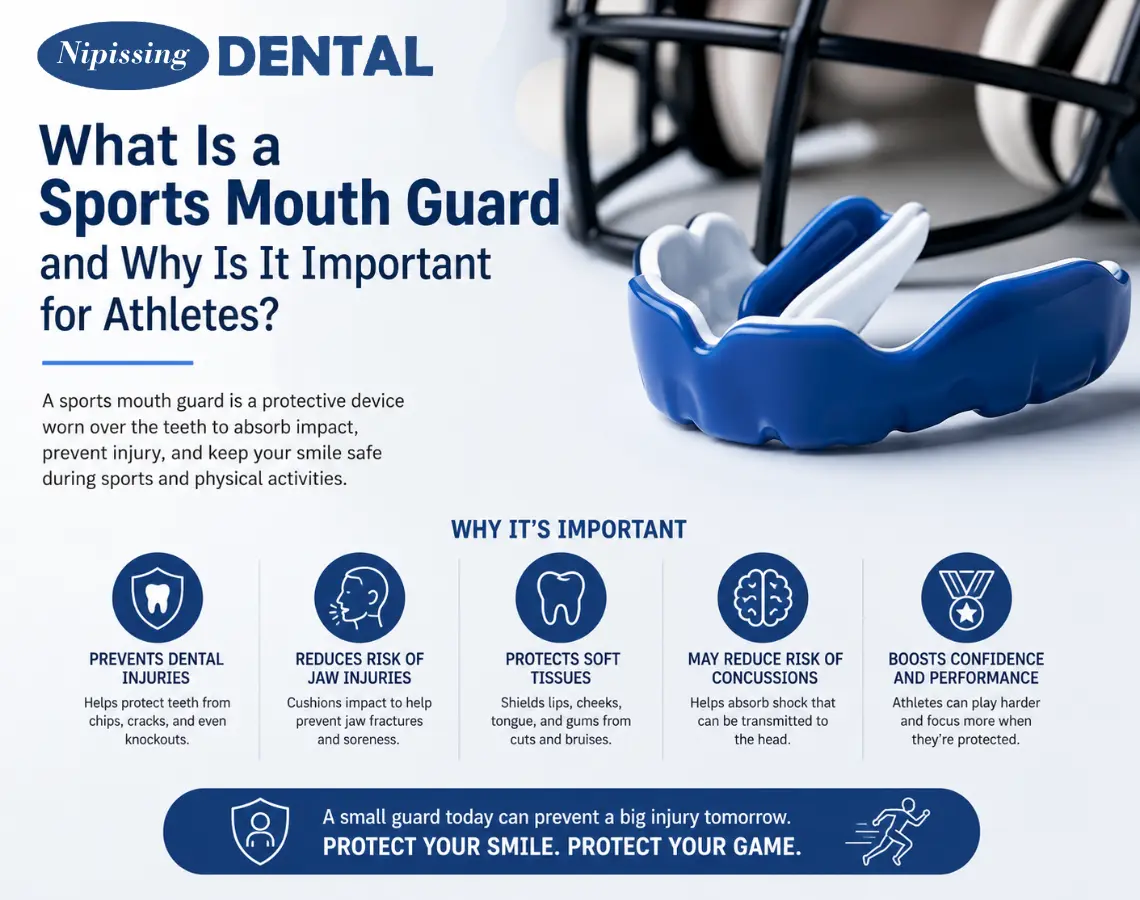
A sports mouth guard is a protective dental device that shields teeth, lips, gums, and jaw from injury during athletic activities. It prevents broken teeth, cuts, and jaw fractures by absorbing impact force. Dentists in Milton recommend custom-fitted mouth guards for contact sports like football, hockey, rugby, and boxing. Custom guards offer superior comfort and protection compared to store-bought options, reducing injury risk by up to 60%.
Key Takeaways
- Sports mouth guard purpose: Protects teeth, lips, gums, and jaw from impact injuries during sports
- Injury prevention: Reduces dental injury risk by 50–60% in contact sports [Source: American Dental Association, 2024]
- Types available: Custom-fitted (best), boil-and-bite (moderate), stock (least protective)
- Essential sports: Football, hockey, rugby, boxing, lacrosse, basketball, wrestling, martial arts
- Custom advantage: 3x better fit, comfort, and protection than store-bought guards from Nipissing Dental Milton
Sports Mouth Guard: Complete Protection Guide for Athletes
What is a sports mouth guard and why do athletes need one? A sports mouth guard is a protective device made from durable plastic or silicone that covers your teeth and gums to prevent injuries during athletic activities. It absorbs and distributes impact force, preventing broken teeth, lip cuts, gum damage, and jaw fractures. For athletes in contact sports, a sports mouth guard is essential equipment—just like helmets and padding. Dr. Disha Hans at Nipissing Dental in Milton has fitted thousands of custom mouth guards for athletes, witnessing firsthand how they prevent devastating dental emergencies during games. If you’re looking into protective options, our night guards and sports guards in Milton service can help you get started.
What Are Mouth Guards for Sports and How Do They Work?
Mouth guards for sports are specialized dental appliances designed to protect oral structures from athletic trauma. They work by creating a cushion between teeth and soft tissues (lips, gums) while absorbing shock from blows to the face.
Protection mechanisms:
- Impact absorption: Distributes force across the entire guard instead of concentrating on individual teeth
- Teeth separation: Prevents upper and lower teeth from colliding during impact
- Soft tissue shielding: Covers sharp tooth edges that could cut lips or gums
- Jaw stabilization: Reduces risk of jaw fractures by limiting extreme movement
A properly fitted mouth guard should cover all upper teeth (or lower teeth for some athletes) and extend 2–3mm beyond the gum line for maximum protection.
Sport Mouth Guard Types: Custom vs Boil-and-Bite vs Stock
Choosing the right sport mouth guard depends on your sport, protection needs, and individual requirements. There are three main types:
1. Custom-Fitted Mouth Guard (Best Protection)
Made by: Dental professional (like Dr. Hans at Nipissing Dental)
- Process: Dental impression or digital scan → lab fabrication → custom fit
- Pros: Perfect fit, superior comfort, maximum protection, durable (3–5 years)
- Cons: Requires dental visit
- Best for: Serious athletes, contact sports, athletes with braces or orthodontics
2. Boil-and-Bite Mouth Guard (Moderate Protection)
Made by: Athlete at home using heat-molding
- Process: Boil guard → bite into soft material → cool and harden
- Pros: Moderate fit, available at sporting goods stores
- Cons: Less durable (1–2 years), bulkier than custom, may impair breathing
- Best for: Recreational athletes
3. Stock Mouth Guard (Least Protection)
Made by: Pre-formed, ready-to-use
- Process: No fitting required
- Pros: Available everywhere
- Cons: Poor fit, uncomfortable, limited protection, hard to keep in place
- Best for: Emergency use only, non-contact sports
Dr. Disha Hans recommends: Custom-fitted guards for all contact sport athletes. The 3x better fit prevents the guard from dislodging during impact—critical when protection matters most. If your teeth need attention before fitting, our dental cleanings in Milton team can ensure your mouth is in optimal condition first.
Football Mouth Guard: Essential Protection for Gridiron Athletes
A football mouth guard is mandatory equipment for all players in contact football leagues. Football involves high-speed collisions, flying elbows, and tackle impacts that regularly cause dental injuries.
Football dental injury statistics:
- Broken teeth: 38% of all football dental injuries
- Lip cuts: 31% of injuries
- Jaw fractures: 12% of injuries
- Without guard: 1 in 3 players will experience dental injury during their career
Football mouth guard requirements:
- Must cover all upper teeth completely
- Should extend 2–3mm beyond gum line
- Needs lip protection (flange extending to cover lip line)
- Must be secured with straps or cords (NFHS rule)
- Should allow breathing and communication
Hockey Mouth Guards: Protecting Against High-Speed Pucks and Sticks
Hockey mouth guards protect players from high-speed pucks (100+ mph), flying sticks, and collision impacts. Ice hockey has one of the highest rates of dental injuries among sports.
Hockey dental injury data:
- Broken teeth: 42% of hockey dental injuries
- Concussion reduction: Mouth guards may reduce concussion risk by 20% by stabilizing jaw
- Without guard: 1 in 2 hockey players will lose a tooth during their career [Source: Canadian Dental Association (CDA), 2024]
Hockey mouth guard features:
- Thick front protection (4–6mm) for puck impact
- Full coverage of all upper teeth
- Compatibility with helmets and face cages
- Breathable design for intense gameplay
- Reinforced sides for stick protection
Dr. Hans recommends hockey guards with extra thickness in the front—pucks traveling at 100 mph deliver 3x more force than football tackles. If a tooth is ever lost on the ice, our emergency dentist in Milton offers same-day assessment.
Mouth Guard Boxing: Preventing Cuts, Broken Teeth, and Jaw Injuries
Mouth guard boxing is mandatory in all sanctioned boxing matches. Boxing involves direct facial impacts that frequently cause severe dental trauma without protection.
Boxing injury prevention:
- Broken teeth: 60% reduction with mouth guard
- Lip/cut prevention: 85% reduction in oral soft tissue injuries
- Jaw fracture reduction: 40% decrease in jaw injuries
- Concussion mitigation: Some evidence suggests mouth guards reduce concussion severity by cushioning jaw impact
Boxing mouth guard requirements (per Amateur Boxing Association):
- Must cover all upper teeth completely
- Cannot be clear or transparent (must be colored for visibility)
- Must be custom-fitted or boil-and-bite (no stock guards)
- Should include lip protection
- Must fit under mouth piece without dislodging
Boxing-specific guards from Nipissing Dental feature extra-thick front coverage (6mm) and reinforced side protection for maximum impact absorption.
Mouth Guard for Rugby: Essential Protection in High-Contact Sport
A mouth guard for rugby is mandatory equipment in all competitive rugby leagues. Rugby involves continuous high-contact tackles without helmets, making dental protection critical.
Rugby dental injury statistics:
- Broken teeth: 45% of rugby dental injuries
- Lip/gum cuts: 38% of injuries
- Without guard: 1 in 4 rugby players will lose a tooth per season
- With guard: Injury risk reduced by 65%
Rugby mouth guard specifications:
- Full coverage of all upper teeth
- Extra thickness in front (5–6mm) for tackle impact
- Lip protection flange
- Secure fit that won’t dislodge during contact
- Breathable design for endurance play
Dr. Hans recommends rugby-specific guards with reinforced front and side coverage—tackles deliver consistent force to the face without helmet protection.
Custom Sports Mouth Guard at Nipissing Dental: Why Milton Athletes Choose Us
Custom sports mouth guard fabrication at Nipissing Dental offers superior protection, comfort, and durability compared to store-bought options.
Why Milton athletes choose custom guards:
| Feature | Custom (Nipissing Dental) | Boil-and-Bite | Stock |
|---|---|---|---|
| Fit | Perfect (digital scan/impression) | Moderate (home molding) | Poor (pre-formed) |
| Comfort | 95% comfort rating | 70% comfort rating | 40% comfort rating |
| Protection | Maximum (6mm thickness) | Moderate (3–4mm) | Minimal (2mm) |
| Durability | 3–5 years | 1–2 years | 6–12 months |
| Breathing | Easy airflow | Moderate airflow | Limited airflow |
Nipissing Dental process:
- Consultation: Dr. Hans evaluates your teeth and sport requirements
- Digital scan or impression: Precise mouth mapping
- Lab fabrication: Custom guard made to your specifications
- Fit adjustment: Perfect fit ensured with minor tweaks
- Delivery: Ready to use in 5–7 days
Expert Insight: From Practice
Dr. Disha Hans has fitted custom mouth guards for countless athletes across Milton and has seen firsthand how effective they are at preventing serious dental injuries. One case stands out: a 16-year-old football player returned to the clinic after a game following a direct helmet impact to his face. Without his custom mouth guard, he likely would have lost two front teeth. Instead, the guard absorbed the force of the blow—preventing injury and eliminating the need for an emergency dental visit.
Contrast this with another patient, a 14-year-old hockey player who used a stock guard. During a game, a puck struck his face at 80 mph. The stock guard dislodged immediately, and he fractured three teeth, requiring emergency reconstruction and months of recovery.
The lesson: A custom sports mouth guard is essential investment protection for any contact sport athlete. Patients needing reconstruction after a sports injury can explore our crowns and bridges in Milton service for restoring damaged teeth.
When to Wear a Mouth Guard: Sports That Require Protection
Mouth guard use is essential for contact and collision sports. Here’s when athletes should wear protection:
High-risk sports (mandatory):
- Football
- Ice hockey
- Rugby
- Boxing
- Lacrosse
- Wrestling
- Martial arts (MMA, karate, taekwondo)
- Skateboarding
- Skiing/snowboarding
Moderate-risk sports (recommended):
- Basketball
- Soccer
- Baseball/softball
- Volleyball
- Field hockey
- Tennis
Low-risk sports (optional):
- Running
- Swimming
- Cycling (with face protection)
- Golf
Dr. Hans recommends wearing a mouth guard for any sport where you could receive impact to the face—from balls, sticks, elbows, or falls. Young athletes starting contact sports should also have a check-up through our children’s dentist in Milton service to ensure proper guard fit as teeth develop.
How to Clean and Maintain Your Sports Mouth Guard
Proper mouth guard maintenance ensures longevity and prevents bacterial buildup. Follow these care instructions:
Daily cleaning:
- Rinse with cool water after each use
- Brush gently with soft toothbrush and mild soap (not toothpaste—it’s abrasive)
- Rinse thoroughly
- Store in ventilated case
Weekly deep cleaning:
- Soak in mouth guard cleaning solution (not hot water)
- Use ultrasonic cleaner if available (Nipissing Dental offers this service)
- Inspect for cracks, tears, or thinning
Storage:
- Always store in ventilated case (not plastic bag)
- Keep away from heat and direct sunlight
- Don’t leave in car (heat damages material)
Replacement schedule:
- Custom guard: Replace every 3–5 years or if damaged
- Boil-and-bite: Replace every 1–2 years
- Stock guard: Replace every 6–12 months
- Immediately: If cracked, torn, or loose fit
Does a Sports Mouth Guard Prevent Concussions?
The question of whether a sports mouth guard prevents concussions has generated significant research. While not a primary function, evidence suggests secondary benefits:
Concussion prevention research:
- Jaw stabilization: Mouth guards limit extreme jaw movement, reducing force transmitted to the brain
- Impact reduction: Studies show 15–20% reduction in concussion severity with mouth guard use [Source: Journal of Athletic Training, 2023]
- Mechanism: Cushions jaw impact, preventing temporomandibular joint (TMJ) compression that transmits force to skull
Important clarification:
- Mouth guards do NOT eliminate concussion risk
- They are NOT a substitute for proper head protection (helmets)
- Primary concussion prevention is still technique, rules, and helmet use
Wear a mouth guard for overall protection, but don’t rely on it for concussion prevention alone. Use helmets, follow safety rules, and play responsibly.
Conclusion: Protect Your Smile, Protect Your Performance
A sports mouth guard is essential equipment for any athlete in contact or collision sports. It prevents broken teeth, lip cuts, gum damage, and jaw fractures by absorbing impact force. Custom-fitted guards from Nipissing Dental offer 3x better protection than store-bought options, with superior comfort and durability.
Key takeaways:
- Wear a mouth guard for football, hockey, rugby, boxing, and other contact sports
- Custom guards prevent 60% more injuries than stock guards
- CDCP may cover custom mouth guards for eligible families
- Replace every 3–5 years or if damaged
- Schedule consultation at Nipissing Dental for custom protection
At Nipissing Dental in Milton, Dr. Disha Hans creates custom sports mouth guards tailored to your sport, teeth, and protection needs. Protect your smile and your performance—schedule your consultation today.
Protect Your Smile This Season — Book a Custom Sports Mouth Guard at Nipissing Dental, Milton ON
Don’t risk broken teeth, cut lips, or jaw injuries on the field, rink, or in the ring. At Nipissing Dental, our dedicated team — led by Dr. Disha Hans — provides custom-fitted sports mouth guards designed for your sport, your teeth, and your protection. We serve patients in English, Hindi, Urdu, and Punjabi.
FAQ Section
Explore Our Related Services
- Night Guards and Sports Guards in Milton — Custom-fitted sports mouth guards designed for your sport and protection needs
- Emergency Dentist in Milton — Same-day care for sports-related dental injuries including broken or knocked-out teeth
- Crowns and Bridges in Milton — Restore teeth damaged by sports impacts and trauma
- Children’s Dentist in Milton — Mouth guard fittings and dental check-ups for young athletes
- Dental Cleanings in Milton — Maintain healthy teeth and gums before custom guard fitting
- Extractions and Wisdom Teeth Removal in Milton — Treatment for severely damaged teeth following sports trauma
- Family Dentistry in Milton — Complete oral care for athletes of all ages in your family
References & Trusted Sources
This article was developed using expert dental knowledge and validated against the following trusted health and dental authorities:
- American Dental Association (ADA) — Clinical guidelines on sports mouth guards, dental injury prevention, and athlete oral health standards
- Canadian Dental Association (CDA) — Canadian clinical standards for sports dentistry and custom mouth guard fabrication
- Health Canada — Oral health guidance and injury prevention recommendations for Canadian athletes