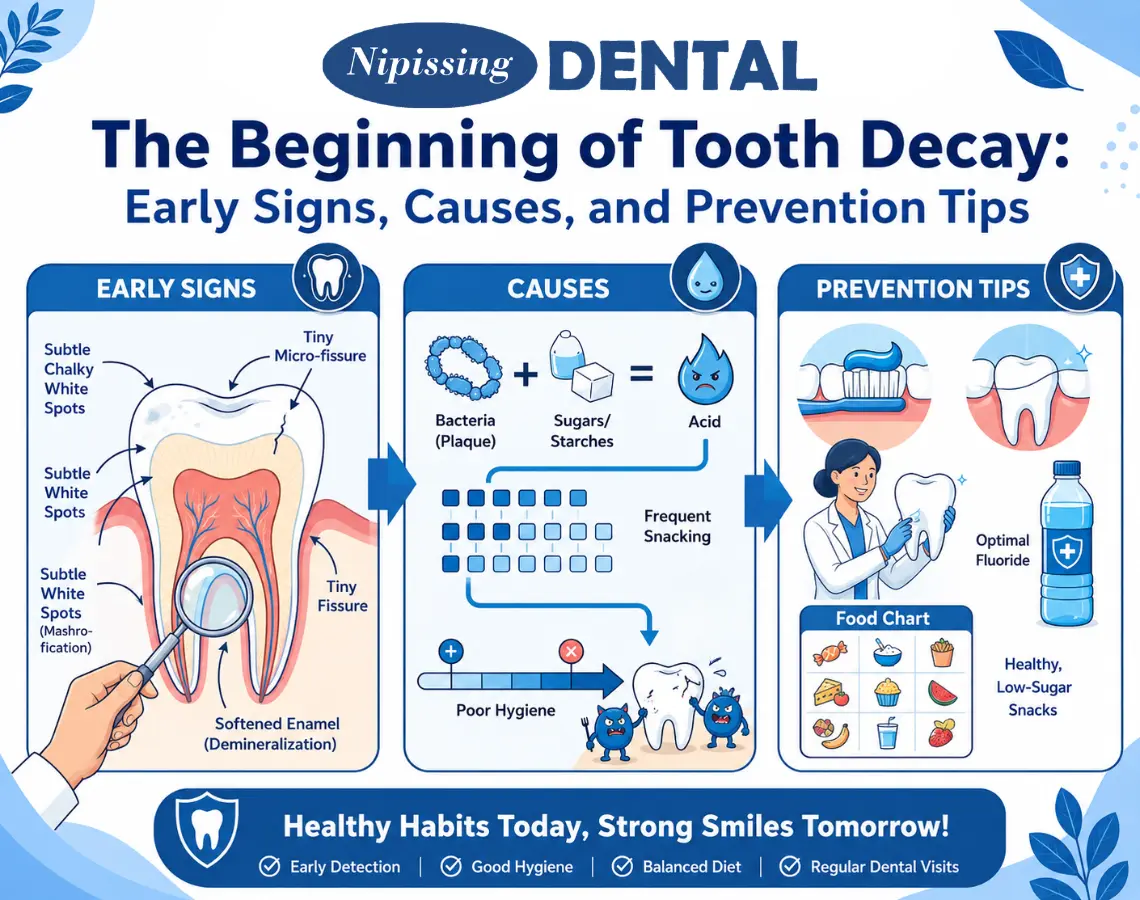
The tooth decay beginning shows as white spots on teeth, sensitivity to sweet foods, and faint discoloration. Early decay is reversible with proper care. It starts when bacteria produce acid that dissolves enamel. Bottle feeding tooth decay affects preschoolers who drink sugary liquids at night. Family dentistry in Milton at Nipissing Dental offers preventive care to stop decay before it becomes a cavity. [Source: Canadian Dental Association, 2024]
Key Takeaways
- Early signs: White spots, mild sensitivity, faint discoloration on tooth surface (reversible stage)
- Main cause: Bacteria + sugar = acid that dissolves enamel (takes 6–12 months to become cavity)
- Bottle feeding risk: 30% of preschoolers develop decay from nighttime bottle feeding [Source: CDA, 2024]
- Prevention: Brush 2x daily, limit sugar, floss daily, visit dentist every 6 months
- Milton families: Nipissing Dental offers preventive care for infants, preschoolers, and all ages — including children’s dental care in Milton
tooth decay beginning: Early Signs You Can Reverse
What does tooth decay beginning look like and how can you stop it? The beginning of tooth decay appears as white, chalky spots on the tooth surface — often near the gum line. These spots indicate enamel demineralization, the first stage of decay. Unlike cavities, early tooth decay beginning is reversible with proper cleaning, fluoride, and reduced sugar. Dr. Disha Hans at Nipissing Dental in Milton has treated thousands of families, witnessing how early intervention prevents 80% of cavities. Parents often miss these white spots until decay progresses — recognizing them early saves time, money, and pain. If you notice early warning signs, don’t wait — book a visit with our dental hygiene and cleaning team in Milton for professional assessment.
What Causes Tooth Decay: The Science Behind Enamel Destruction
What causes tooth decay is a simple chemical process: bacteria in your mouth mix with sugar to produce acid, which dissolves tooth enamel over time. When tooth decay beginning occurs, acid pH drops below 5.5 and starts dissolving minerals.
The decay process (4 steps):
- Bacteria accumulation: Plaque forms on teeth (sticky film of bacteria)
- Sugar consumption: You eat sugary foods or drinks
- Acid production: Bacteria convert sugar to acid (pH drops below 5.5)
- Enamel dissolution: Acid dissolves minerals in enamel (demineralization)
Key factors that accelerate tooth decay beginning:
- Frequent sugar intake (snacking throughout day)
- Poor brushing/flossing technique
- Dry mouth (less saliva to neutralize acid)
- Lack of fluoride (weakens enamel)
- Genetic enamel weakness
- Bottle feeding tooth decay in children
[Source: American Dental Association, 2023]
Beginning Stages of Tooth Decay: 4 Progressive Stages Explained
Understanding the beginning stages of tooth decay helps you intervene before permanent damage occurs. The tooth decay beginning stage is critical for prevention.
Stage 1: Demineralization (Reversible)
- What it looks like: White, chalky spots on tooth surface
- Location: Near gum line, between teeth
- Symptoms: None or mild sensitivity to sweet foods
- Treatment: Fluoride toothpaste, improved brushing, reduced sugar
- Outcome: 100% reversible with proper care — this is tooth decay beginning
Stage 2: Enamel Decay (Still Reversible)
- What it looks like: White spots turn brown or yellow
- Location: Surface of tooth enamel
- Symptoms: Sensitivity to sweet, hot, or cold
- Treatment: Fluoride varnish, professional cleaning, possible sealant — ask about dental cleanings in Milton
- Outcome: Reversible with professional intervention
Stage 3: Dentin Decay (Permanent)
- What it looks like: Brown/black visible hole or dark spot
- Location: Under enamel, in softer dentin layer
- Symptoms: Pain when eating, persistent sensitivity
- Treatment: Fillings required (cavity formed) — learn about dental fillings in Milton
- Outcome: Permanent — cannot reverse, needs restoration
Stage 4: Pulp Infection (Severe)
- What it looks like: Large dark cavity, possible swelling
- Location: Inside tooth pulp (nerve)
- Symptoms: Severe pain, fever, swelling, infection
- Treatment: Root canal in Milton or extraction needed
- Outcome: Major procedure required, possible tooth loss
Timeline: Stage 1 (tooth decay beginning) to Stage 3 typically takes 6–12 months with regular sugar exposure.
What Does Tooth Decay Look Like: Visual Signs by Stage
Knowing what does tooth decay look like at each stage helps parents and adults identify problems early. Recognizing tooth decay beginning visually is key to reversal.
Stage 1 (Early decay / tooth decay beginning):
- White, chalky spots (like frost on glass)
- Smooth surface (no hole yet)
- Often between teeth or near gum line
Stage 2 (Enamel decay):
- Yellow or light brown discoloration
- Still smooth surface
- White spots may darken
Stage 3 (Dentin decay / cavity):
- Visible brown or black hole
- Rough or jagged surface
- Dark spot you can feel with fingernail
Stage 4 (Pulp infection):
- Large dark cavity
- Possible gum swelling or bump
- Tooth may appear gray or darkened
Signs of a decaying tooth include:
- Pain when biting
- Sensitivity to temperature
- Bad taste in mouth
- Visible holes or dark spots
- Broken tooth edges
If you see white spots (tooth decay beginning), act immediately — they’re your last chance to reverse decay. Contact our emergency dentist in Milton if you experience sudden severe pain or swelling.
Bottle Feeding Tooth Decay: Why Nighttime Bottles Harm Preschoolers
Bottle feeding tooth decay (also called “nursing bottle syndrome”) is a severe form of early childhood decay caused by nighttime bottle feeding with sugary liquids. This accelerates tooth decay beginning in preschoolers.
How bottle feeding tooth decay happens:
- Infant drinks sugary liquid (milk, juice, formula) from bottle
- Liquid pools around teeth during sleep
- Saliva production decreases at night (less acid neutralization)
- Bacteria convert sugar to acid for hours
- Enamel dissolves rapidly, especially upper front teeth
Statistics on tooth decay from bottle feeding:
- 30% of preschoolers develop decay from nighttime bottle feeding [Source: Canadian Dental Association, 2024]
- Upper front teeth are most affected (first to show decay)
- Severe cases: Entire tooth structure can melt away in 6–12 months
- Without intervention: Root infection, pain, eating difficulty, tooth loss
Tooth decay in preschoolers from bottles is preventable:
- Never put baby to bed with sugary bottle
- Use water only in nighttime bottles after 6 months
- Wipe teeth with clean cloth after last feeding
- Start brushing with tiny fluoride toothpaste at first tooth
- First dental visit: By age 1 or first tooth (per CDA) — book with our children’s dentist in Milton
Dr. Hans recommends switching to a cup by age 1 and eliminating nighttime bottles entirely by age 2 to prevent tooth decay beginning.
Tooth Decay vs Cavity: What’s the Difference?
Understanding tooth decay vs cavity clarifies when decay is reversible versus permanent. The difference starts at tooth decay beginning.
| Feature | Tooth Decay (Early) | Cavity (Advanced) |
|---|---|---|
| Stage | Stage 1–2 (demineralization) | Stage 3+ (enamel breakdown) |
| Appearance | White/yellow spots | Brown/black hole |
| Surface | Smooth | Rough, jagged |
| Reversible? | YES (with fluoride) | NO (needs filling) |
| Symptoms | None or mild sensitivity | Pain, sensitivity, discomfort |
| Treatment | Brushing, fluoride, diet change | Filling required |
| Time to develop | 6–12 months | 6–12 months from early decay |
Key difference: Early tooth decay beginning is reversible; a cavity is permanent damage requiring a dental filling. When does decay become a cavity? When acid dissolves through enamel into the dentin layer — this creates a physical hole that cannot heal.
Prevention Tips: How to Stop Tooth Decay Before It Starts
Preventing tooth decay beginning is simpler than fixing cavities. Follow these proven strategies to stop decay at the earliest stage:
Daily Prevention (Non-Negotiable)
- Brush 2x daily: 2 minutes each time with fluoride toothpaste
- Floss daily: Remove plaque between teeth
- Rinse after sugar: Water or fluoride rinse neutralizes acid
- Wait 30 minutes: Don’t brush immediately after acid (softens enamel)
Diet Changes (Critical)
- Limit sugary drinks: Juice, soda, sports drinks
- Avoid snacking: Eat meals instead of constant grazing
- No sugar at night: Brush before bed, no food after
- Choose healthy snacks: Cheese, vegetables, nuts
- Water only: Replace sugary beverages with water
Professional Prevention
- Visit dentist every 6 months
- Fluoride treatments: Strengthens enamel (ask at Nipissing Dental)
- Sealants: Plastic coating on back teeth (prevents 80% of cavities)
- X-rays: Detect decay between teeth early
For Parents (Infants & Preschoolers)
- Wipe baby’s teeth: Clean cloth after feeding
- Tiny fluoride amount: Rice-sized for under 3, pea-sized for 3–6
- No nighttime bottles: Water only after 6 months
- First visit by age 1: Per Canadian Dental Association
- Supervise brushing: Until age 7–8 (when they can do it alone) — our children’s dentist in Milton can demonstrate proper technique
Dr. Hans recommendation: Start prevention before the first tooth appears. Wipe gums daily, then brush immediately when teeth emerge to prevent tooth decay beginning. Health Canada also recommends early oral hygiene habits as the foundation of lifelong dental health.
Expert Insight: From Practice
Dr. Disha Hans has treated hundreds of preschoolers with bottle feeding tooth decay starting at the tooth decay beginning stage. One case: a 3-year-old from Milton arrived with severely decayed upper front teeth. His parents gave him a juice bottle at night for 18 months. The sugar pooled around his teeth while he slept, accelerating tooth decay beginning into complete destruction. Four teeth required extraction, affecting his ability to eat and speak properly.
Contrast this with a 2-year-old patient whose parents followed CDA guidelines: water-only nighttime bottles, brushing twice daily, first visit at age 1. At her checkup, Dr. Hans found perfect white teeth with no white spots — zero tooth decay beginning.
The lesson: Bottle feeding tooth decay is 100% preventable. Small changes in routine prevent devastating outcomes from tooth decay beginning.
Family Dentistry Milton: Why Regular Visits Prevent Decay
Family dentistry in Milton at Nipissing Dental provides comprehensive preventive care for all ages — from infants to seniors. Regular visits catch tooth decay beginning before it becomes a cavity.
What Nipissing Dental offers:
- Infant exams: First visit by age 1 (per CDA)
- Preschool checkups: Monitor tooth decay in preschoolers via our children’s dentistry services
- Fluoride treatments: Strengthen enamel twice yearly
- Sealants: Protect back teeth from decay
- Educational counseling: Brushing/flossing technique for parents
- Digital X-rays: Detect decay between teeth early
- CDCP accepted: Canadian Dental Care Plan for eligible families
Prevention statistics:
- Regular visitors: 80% fewer cavities
- Fluoride treatments: 30% reduction in decay
- Sealants: 80% cavity prevention in back teeth
- Early detection: 100% reversal of Stage 1 tooth decay beginning
[Source: Canadian Dental Association, 2024]
Call Nipissing Dental at 905-844-3244 to schedule your family’s preventive care appointment and stop tooth decay beginning early.
When to See a Dentist: Red Flags for Tooth Decay
Don’t wait for pain — see a dentist immediately if you notice these signs of a decaying tooth, especially tooth decay beginning:
Immediate appointment needed:
- White spots on teeth (Stage 1 tooth decay beginning)
- Yellow/brown discoloration (Stage 2 decay)
- Sensitivity to sweet, hot, or cold
- Pain when biting
- Visible holes or dark spots
- Broken tooth edges
- Bad taste in mouth
- Gum swelling near tooth — contact our emergency dentist in Milton immediately
Regular schedule:
- Infants: First visit by age 1
- Children: Every 6 months
- Adults: Every 6 months
- High-risk patients: Every 3–4 months (Dr. Hans may recommend)
Early detection at tooth decay beginning (Stage 1 or 2) means reversible decay. Stage 3+ requires permanent restoration such as dental fillings, crowns and bridges, or in severe cases, root canal therapy. According to the American Dental Association (ADA), patients who schedule regular dental visits are significantly more likely to catch decay in its early, reversible stage.
Conclusion: Stop Tooth Decay Before It Becomes Permanent
The tooth decay beginning appears as white spots, mild sensitivity, and discoloration — all reversible with proper care. Understanding what causes tooth decay (bacteria + sugar = acid) helps you prevent it through brushing, flossing, and reduced sugar intake. Bottle feeding tooth decay affects 30% of preschoolers but is 100% preventable with water-only nighttime bottles.
Key prevention steps:
- Brush 2x daily with fluoride toothpaste
- Floss daily
- Limit sugary foods and drinks
- Visit dentist every 6 months
- No nighttime bottles with sugar
- First dental visit by age 1
At Nipissing Dental in Milton, Dr. Disha Hans provides family dentistry for all ages, catching tooth decay beginning early and preventing cavities. Protect your family’s smile — schedule your preventive care appointment today.
Worried About Tooth Decay? Book at Nipissing Dental, Milton ON
Don’t let early decay go unnoticed until it becomes a painful, costly cavity. Whether you’ve spotted white spots on your teeth or your child’s, or you simply want to get ahead of tooth decay beginning, our team has the tools and expertise to help. At Nipissing Dental, Dr. Disha Hans and our dedicated team provide comprehensive, comfortable, and highly effective preventive dental care right here in Milton. We serve patients in English, Hindi, Urdu, and Punjabi.
Frequently Asked Questions
Explore Our Related Services
- Family Dentistry in Milton — Preventive and general dental care for every member of your family
- Children’s Dentist in Milton — Early childhood dental exams to catch tooth decay beginning at the source
- Dental Cleanings in Milton — Professional cleanings and fluoride treatments to reverse early decay
- Dental Fillings in Milton — Conservative cavity restoration when decay has progressed past the reversible stage
- Crowns and Bridges in Milton — Full tooth restoration for severely decayed or damaged teeth
- Root Canals in Milton — Save an infected tooth when decay has reached the pulp
- Extractions and Wisdom Teeth Removal in Milton — When decay is too advanced to restore, safe removal is available
- Dental Implants in Milton — Permanent tooth replacement after extraction due to severe decay
- Emergency Dentist in Milton — Urgent same-day care for sudden tooth pain, abscess, or infection
- Cosmetic Dentistry in Milton — Restore your smile after decay treatment with whitening and cosmetic options
- Teeth Whitening in Milton — Brighten your smile once your teeth are decay-free and healthy
- Invisalign Clear Aligners in Milton — Straighten teeth and eliminate crowding that traps plaque and accelerates decay
- Night Guards and Sports Guards in Milton — Protect healthy teeth and restorations from grinding and impact damage
References & Trusted Sources
This article was developed using expert dental knowledge and validated against the following trusted health and dental authorities:
- American Dental Association (ADA) — Clinical guidelines on tooth decay, enamel demineralization, cavity prevention, and fluoride use
- Canadian Dental Association (CDA) — Canadian standards for preventive dentistry, infant oral health, and bottle feeding tooth decay
- Health Canada — Oral health guidance for Canadians including fluoride recommendations and preventive dental care for children