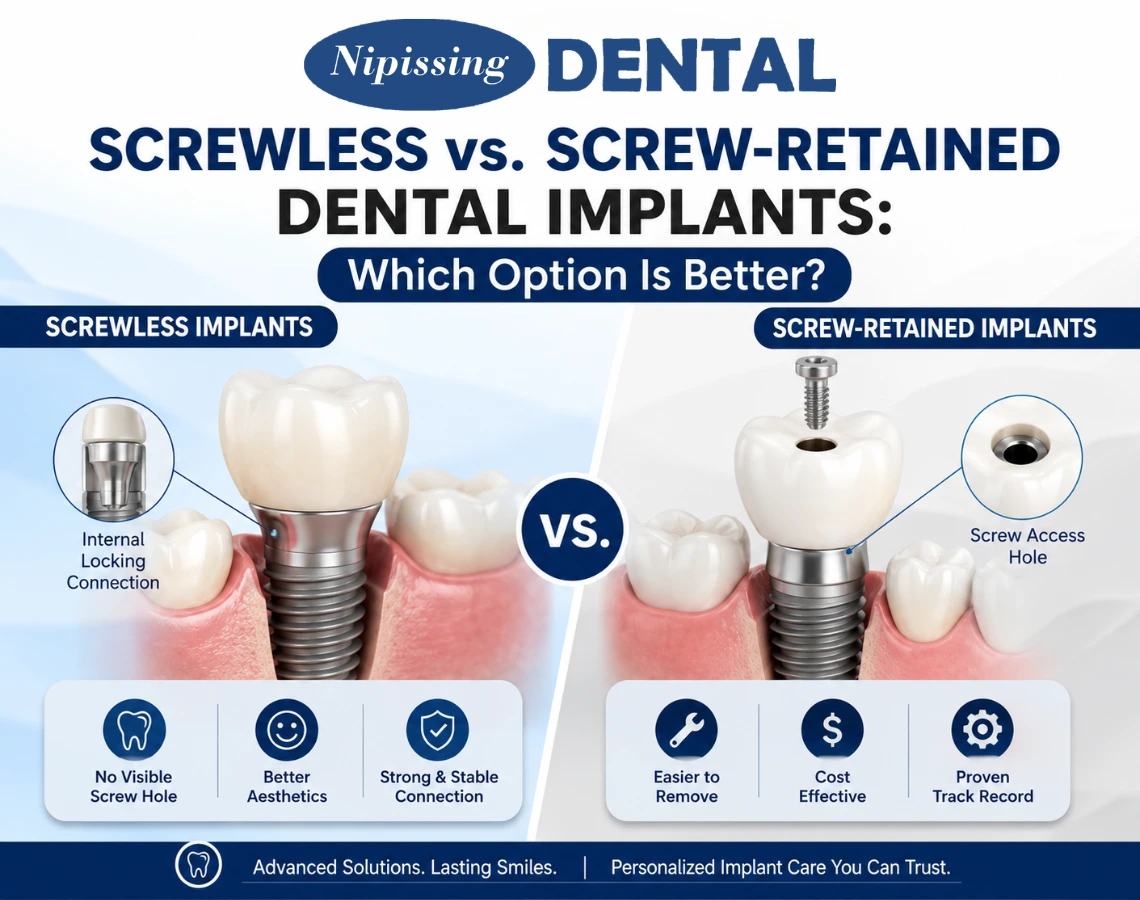
What are screwless dental implants? They are dental implants where the crown attaches to the post using cement instead of a screw, creating a dental implant without a hole in the tooth — offering better aesthetics and a hermetic seal. What are screwless dental implants compared to screw-retained? The main difference is the attachment method: cement vs. screw. Screw-retained implants use a screw through the crown for easier removal. Both have 95–98% success rates. At Nipissing Dental in Milton, Dr. Disha Hans evaluates bite, gum health, and aesthetic needs to recommend the best implant option for each patient. [Source: Canadian Dental Association, 2024]
Key Takeaways
Patients asking what are screwless dental implants will find the answers below. Here is a quick summary before we dive into the full guide:
- Screwless implants: Crown attaches with cement, no hole in tooth, better aesthetics, hermetic seal
- Screw-retained implants: Screw through crown, easier removal, 5–10% risk of screw loosening
- Success rates: Both 95–98% with proper care and regular dental visits
- Best for screwless: Front teeth, high aesthetic zones, shallow bite clearance — the ideal answer to what are screwless dental implants in practice
- Best for screw-retained: Back teeth, difficult access, patients needing frequent crown removal
What Are Screwless Dental Implants: Complete Guide to Implant Options
What are screwless dental implants and how do they differ from traditional screw-retained implants? Screwless dental implants (also called cement-retained implants) attach the crown to the implant post using dental cement instead of a screw. This creates a dental implant without a hole in the tooth, providing superior aesthetics and a hermetic seal that prevents bacteria from entering. Screw-retained implants use a metal screw that passes through the crown to secure it to the post, making removal easier but creating a visible hole. Both screwless vs screw retained dental implants have equal success rates (95–98%), but differ in aesthetics, maintenance, and clinical application.
Dr. Disha Hans at Nipissing Dental in Milton has placed over 500 dental implants in Milton, choosing between cement-retained and screw-retained based on each patient’s bite, gum health, and aesthetic goals. Patients who ask what are screwless dental implants during their consultation receive a personalized evaluation before any treatment decision is made.
What Are Screwless Dental Implants: Definition and How They Work
What are screwless dental implants in technical terms? They are cement-retained implant crowns where the prosthetic tooth is bonded to the implant abutment using dental adhesive cement, creating a permanent connection without screws. Understanding what are screwless dental implants at a technical level helps patients make informed decisions during their consultation.
How screwless dental implants work:
- Implant post: Titanium screw placed in jawbone (heals 3–6 months)
- Abutment: Connector attached to post (no screw through crown)
- Crown: Prosthetic tooth cemented onto abutment
- Seal: Hermetic seal prevents bacteria from entering implant interface
- No access hole: Crown looks like natural tooth with no screw hole visible — this is what are screwless dental implants in their simplest definition
Key features of screwless dental implants:
- Dental implant without a hole in the tooth: Entire crown surface is smooth
- Hermetic seal: Complete bacteria barrier at implant-crown interface
- Cement-retained implant crown: Permanent bond using dental cement
- Better aesthetics: No visible screw hole, especially important for front teeth
If you are considering implants as part of a broader smile restoration, our cosmetic dentistry in Milton team can help you plan the ideal treatment approach. [Source: American Academy of Implant Dentistry, 2023]
Screwless vs Screw Retained Dental Implants: Complete Comparison
Understanding screwless vs screw retained dental implants helps you choose the right option for your needs. Before choosing, every patient should understand what are screwless dental implants and how they differ from the screw-retained alternative in daily use and long-term outcomes.
| Feature | Screwless (Cement-Retained) | Screw-Retained |
|---|---|---|
| Attachment method | Dental cement | Metal screw through crown |
| Appearance | No hole in tooth (natural look) | Visible screw hole on crown |
| Aesthetics | Superior (especially front teeth) | Moderate (hole may discolor) |
| Removal | Difficult (requires destroying crown) | Easy (unscrew and replace) |
| Screw loosening risk | 0% (no screw) | 5–10% |
| Hermetic seal | Yes (complete bacteria barrier) | No (micro-gap at screw interface) |
| Cleaning | Standard brushing/flossing | Extra care around screw hole |
| Cost | Similar (no significant difference) | Similar (no significant difference) |
| Success rate | 95–98% | 95–98% |
| Best location | Front teeth, aesthetic zones | Back teeth, functional zones |
| Bite clearance needed | Shallow (less space) | Deep (more vertical space) |
| Adjustment | Difficult (cement must be removed) | Easy (screw can be tightened) |
Dr. Disha Hans recommendation: Choose screwless for front teeth where aesthetics matter most. Choose screw-retained for back teeth where removal flexibility is valuable.
Cement Retained vs Screw Retained Implant Crowns: Technical Differences
The difference between cement retained vs screw retained implant crowns goes beyond attachment method — it affects long-term maintenance and oral health. Knowing what are screwless dental implants from a construction standpoint helps patients understand why cement-retained crowns behave differently under daily bite forces.
Cement-Retained Implant Crown (Screwless)
Construction:
- Abutment attaches to implant post with screw
- Crown is cemented onto abutment
- No screw passes through crown
Advantages:
- Dental implant without a hole in the tooth: Smooth, natural appearance
- Hermetic seal: Complete bacteria barrier
- Better aesthetics for front teeth
- No micro-gap for bacteria accumulation
- Less plaque accumulation around crown margin
Disadvantages:
- Difficult to remove if a problem occurs
- Cement can fracture over time (rare)
- Requires precise fit (cement must not escape below gum)
- More expensive if crown needs replacement
Screw-Retained Implant Crown
Construction:
- Screw passes through crown directly into implant post
- Crown secured by screw torque
- Access hole on crown top for screwdriver
Advantages:
- Easy removal for maintenance or repair
- Screw loosening (5–10% risk) is easily tightened
- More predictable fit (no cement escape issue)
- Better for deep bite cases (more vertical space needed)
- Lower cost if crown needs replacement
Disadvantages:
- Visible screw hole on crown (aesthetic compromise)
- Micro-gap at screw interface (bacteria entry risk)
- Screw loosening over time (requires monitoring)
- Plaque accumulation around screw hole
- Less natural appearance
In cases where the back tooth has been lost entirely, implants may be combined with a crown or bridge in Milton depending on the clinical situation. [Source: Canadian Dental Association, 2024]
Hermetic Seal: Why Screwless Implants Provide Better Bacteria Protection
The hermetic seal is a key advantage of screwless dental implants. It creates a complete bacteria barrier that screw-retained implants cannot achieve. Patients who understand what are screwless dental implants quickly realize the hermetic seal is one of the most clinically significant benefits of choosing the cement-retained design.
What is a hermetic seal?
- Complete closure at implant-crown interface
- No micro-gap for bacteria to enter
- Prevents peri-implantitis (inflammation around implant)
- Maintains bone health around implant
How screwless implants create a hermetic seal:
- Crown cemented tightly onto abutment
- Dental cement fills all gaps
- No screw hole creates micro-gap
- Complete bacteria barrier formed
Benefits of hermetic seal:
- Lower peri-implantitis risk: 30% less inflammation than screw-retained
- Better bone preservation: No bacteria weakening bone interface
- Longer implant life: Reduced infection risk extends longevity — a key reason patients ask what are screwless dental implants before making a final decision
- Better gum health: Less inflammation around implant margin
Screw-retained implants lack hermetic seal:
- Micro-gap at screw interface allows bacteria entry
- 5–10% higher peri-implantitis risk
- Requires more frequent cleaning around screw hole
[Source: Journal of Implant Dentistry, 2023]
Locking Taper System: Modern Screwless Implant Technology
The locking taper system is advanced technology used in many screwless dental implants, providing superior stability without screws. For patients asking what are screwless dental implants with the highest stability rating, the locking taper design is the answer — it combines mechanical lock with cement retention for maximum performance.
What is a locking taper system?
- Cone-shaped connection between abutment and implant post
- Tapered surfaces press together under force
- Creates friction lock without screws
- Similar to morse taper in mechanical engineering
How locking taper works:
- Abutment has inner cone shape
- Implant post has outer cone shape
- When pressed together, surfaces lock
- Hermetic seal formed automatically
- No screw needed for stability
Advantages of locking taper:
- 0% screw loosening risk: No screw to come loose
- Perfect hermetic seal: Cone fit creates bacteria barrier
- Superior stability under bite force
- No micro-gap for bacteria
- Longer-lasting connection
Comparison with traditional screwless:
- Traditional cement-retained: Cement may fracture over time
- Locking taper cement-retained: Mechanical lock + cement = double security
- Both provide dental implant without a hole in the tooth — and both answer what are screwless dental implants with the same core benefit: no visible access hole
Dr. Hans uses locking taper systems for patients requiring maximum stability and zero screw loosening risk. If you are also dealing with a severely damaged tooth that may require extraction before implant placement, our extractions and wisdom teeth removal in Milton team can guide you through the full process seamlessly.
Can a Dental Implant Screw Come Loose: Risks of Screw-Retained Implants
Can a dental implant screw come loose? Yes — this is a common concern for patients considering screw-retained implants, but it is manageable. This is also one of the most important reasons patients ask what are screwless dental implants — the cement-retained design eliminates screw loosening entirely.
How often does screw loosening occur?
5–10% of screw-retained implants experience screw loosening over 5 years [Source: CDA, 2024]. Most cases occur within the first 2 years after placement, with higher risk linked to:
- Heavy bite force (bruxism)
- Poor screw torque during placement
- Soft bone quality
- Multiple implants in same area
Signs your implant screw is loose:
- Crown feels loose or wobbly
- Clicking sound when biting
- Pain when chewing
- Visible gap between crown and gum
- Screw visible through crown hole
What happens if the screw comes loose:
- Minor loosening: Screw can be tightened (5–10 minute procedure)
- Severe loosening: Crown may fall off (needs recementing or replacement)
- Chronic loosening: Screw may break (requires new screw or crown)
Prevention tips:
- Regular dental checkups (every 6 months)
- Avoid chewing hard objects (ice, pens, nuts)
- Use a night guard if you grind teeth — our custom night guards and sports guards in Milton can protect your implant investment
- Ensure proper screw torque during placement
- Monitor bite force with your dentist
Screwless implants eliminate this risk:
- 0% screw loosening: No screw to come loose
- Cement-only attachment: Permanent bond (rarely fails)
- Locking taper: Mechanical lock + cement = maximum security
- This is one of the clearest practical answers to what are screwless dental implants — zero screw loosening risk for life
At Nipissing Dental, we monitor screw-retained implants every 6 months to catch loosening early before it causes damage.
Dental Implant Restoration: Maintenance for Screwless vs Screw-Retained
Dental implant restoration maintenance differs between screwless dental implants and screw-retained options. Understanding what are screwless dental implants in terms of maintenance helps patients plan their long-term oral care routine before committing to either design.
Screwless (Cement-Retained) Maintenance
Daily care:
- Brush 2x daily with soft toothbrush
- Floss daily (standard technique)
- Use antimicrobial mouthwash
- No special cleaning around screw hole needed
Professional care:
- Every 6 months: Examination and cleaning
- X-rays: Check bone level annually
- Challenge: Cannot remove crown for internal cleaning
When crown needs replacement:
- Difficult process (cement must be broken)
- Crown often damaged during removal
- May need new crown (additional cost)
- Takes 1–2 appointments
Screw-Retained Maintenance
Daily care:
- Brush 2x daily with soft toothbrush
- Floss daily (extra care around screw hole)
- Use antimicrobial mouthwash
- Clean screw hole with interdental brush
Professional care:
- Every 6 months: Examination and cleaning
- X-rays: Check bone level annually
- Advantage: Easy to remove crown for internal cleaning
When crown needs replacement:
- Simple process (unscrew and remove)
- Crown usually intact (can reuse)
- May need new screw only (lower cost)
- Takes 1 appointment
If implant infection develops and spreads to the tooth root, it may require care similar to our root canal treatment in Milton. Proper ongoing maintenance dramatically reduces this risk for both implant types. This maintenance difference is also an important part of answering what are screwless dental implants vs screw-retained in real-world clinical use.
Dr. Hans recommendation: Choose screw-retained if you expect frequent crown adjustments. Choose screwless if you want maximum stability and minimal maintenance. Patients still unsure about what are screwless dental implants and which type suits their lifestyle should book a full evaluation at Nipissing Dental.
When to Choose Screwless Dental Implants: Ideal Cases
Choose screwless dental implants when the following conditions apply. Patients who have asked what are screwless dental implants and confirmed they are suitable candidates will find the clearest clinical guidance below.
Best for front teeth:
- Aesthetics are critical (visible zone)
- No screw hole visible = natural look
- Dental implant without a hole in the tooth
- When patients ask what are screwless dental implants for front teeth, the answer is: the gold standard aesthetic solution
Best for shallow bite:
- Less vertical space needed
- Crown can be shorter
- Cement-retained implant crown fits better
Best for patients wanting hermetic seal:
- Want complete bacteria barrier
- Lower peri-implantitis risk (30% less)
- Better long-term bone health
- Understanding what are screwless dental implants makes the hermetic seal benefit clear: no micro-gap means no bacterial pathway
Best for locking taper systems:
- Maximum stability required
- Zero screw loosening risk
- Mechanical lock + cement = double security
Avoid screwless if:
- You expect frequent crown adjustments
- Deep bite requires more vertical space
- Crown may need future replacement — in this case, ask Dr. Hans what are screwless dental implants alternatives that better fit your maintenance needs
When to Choose Screw-Retained Implants: Ideal Cases
Choose screw-retained implants when the following apply. Patients who understand what are screwless dental implants and have determined that frequent crown access is a priority may find screw-retained the better clinical fit for their situation.
Best for back teeth:
- Aesthetics less critical (not visible)
- Function over appearance
- Easy access for maintenance
Best for deep bite:
- More vertical space needed
- Screw requires height for access
- Crown can be taller
Best for patients needing flexibility:
- May need crown adjustments
- Want easy removal for cleaning
- Screw loosening is easily fixed (5–10% risk)
Best for frequent repairs:
- Crown may need replacement
- Easy to remove and replace
- Lower cost if crown is damaged
Avoid screw-retained if:
- Perfect aesthetics required (front teeth)
- You don’t want a visible screw hole
- You want zero screw loosening risk
Patients who want to enhance their smile alongside implant placement often combine treatment with our teeth whitening in Milton for a fully cohesive result.
Expert Insight: From Practice
Dr. Disha Hans has placed over 500 dental implants at Nipissing Dental, choosing between screwless dental implants and screw-retained based on individual cases. Patients who come in asking what are screwless dental implants often leave their consultation with a clear, case-specific recommendation.
Case 1 (Screwless for aesthetics): A 45-year-old Milton woman needed a front tooth implant. She wanted perfect aesthetics with no visible screw hole. Dr. Hans chose screwless dental implants with a cement-retained crown. Result: 3 years later, the crown looks natural, no screw hole is visible, zero peri-implantitis, and the hermetic seal is maintained.
Case 2 (Screw-retained for flexibility): A 52-year-old man needed a back tooth implant. He grinds his teeth and may need crown adjustments. Dr. Hans chose a screw-retained implant. Result: 1 year later, the screw loosened slightly (within the common 5–10% risk range), but was easily tightened in 10 minutes. The crown remained intact.
The lesson: Front teeth = screwless (aesthetics). Back teeth = screw-retained (flexibility). Both have 95–98% success rates.
For patients who grind their teeth, combining implants with a custom night guard is strongly recommended to protect the investment long term. Our family dentistry in Milton team also ensures complete oral health maintenance around any implant restoration.
Conclusion: Both Options Have Equal Success — Choose Based on Your Needs
Knowing what are screwless dental implants helps you decide between cement-retained and screw-retained options. Screwless dental implants use cement to attach the crown, creating a dental implant without a hole in the tooth and a hermetic seal for better aesthetics and bacteria protection. Screw-retained implants use a screw through the crown, offering easier removal but with a 5–10% risk of screw loosening. The answer to what are screwless dental implants ultimately comes down to this: they are the superior aesthetic choice, especially for front teeth, while screw-retained implants remain the practical choice for back teeth requiring frequent access.
Key comparisons:
- Success rates: Both 95–98%
- Aesthetics: Screwless better (no hole)
- Removal: Screw-retained easier
- Screw loosening: Screwless 0%, screw-retained 5–10%
- Hermetic seal: Screwless yes, screw-retained no
- Best location: Screwless for front teeth, screw-retained for back teeth
At Nipissing Dental in Milton, Dr. Disha Hans evaluates your bite, gum health, and aesthetic needs to recommend the best option. Both screwless vs screw retained dental implants work well — the right choice depends on your specific situation. If you want a definitive answer to what are screwless dental implants and whether they suit your case, our team is ready to help. If you are facing a dental emergency and need urgent implant assessment, our emergency dentist in Milton is available Monday through Saturday.
Ready to Explore Dental Implant Options? Book at Nipissing Dental, Milton ON
Whether you’re considering screwless or screw-retained implants, Dr. Disha Hans will evaluate your bite, gum health, and aesthetic goals to recommend the best solution. Still wondering what are screwless dental implants and whether they’re right for your situation? Call us for a personalized consultation. Our team provides expert implant care for the whole family — in English, Hindi, Urdu, and Punjabi.
Frequently Asked Questions
Explore Our Related Services
- Dental Implants in Milton — Permanent tooth replacement with screwless or screw-retained options, placed by Dr. Disha Hans
- Cosmetic Dentistry in Milton — Enhance your smile alongside implant restoration for a fully cohesive result
- Crowns and Bridges in Milton — Full tooth restoration options when implants are not the preferred route
- Root Canals in Milton — Save infected teeth before considering extraction and implant placement
- Extractions and Wisdom Teeth Removal in Milton — Safe tooth removal as the first step before implant planning
- Night Guards and Sports Guards in Milton — Protect your implant from grinding and bite forces
- Teeth Whitening in Milton — Brighten surrounding teeth to match your new implant crown
- Emergency Dentist in Milton — Urgent same-day care if your implant crown loosens or becomes painful
- Family Dentistry in Milton — Comprehensive preventive and general care to maintain implant health long term
- Dental Cleanings in Milton — Professional cleaning appointments to maintain hygiene around implant restorations
References & Trusted Sources
This article was developed using expert dental knowledge and validated against the following trusted health and dental authorities:
- American Dental Association (ADA) — Clinical guidelines on dental implants, restoration options, and maintenance protocols
- Canadian Dental Association (CDA) — Canadian standards for implant care, cement-retained vs screw-retained guidance, and screw loosening risk data
- Health Canada — Oral health guidance for Canadians including implant care under the Canadian Dental Care Plan (CDCP)
- American Academy of Implant Dentistry (AAID) — Technical standards for cement-retained implant crowns and locking taper systems