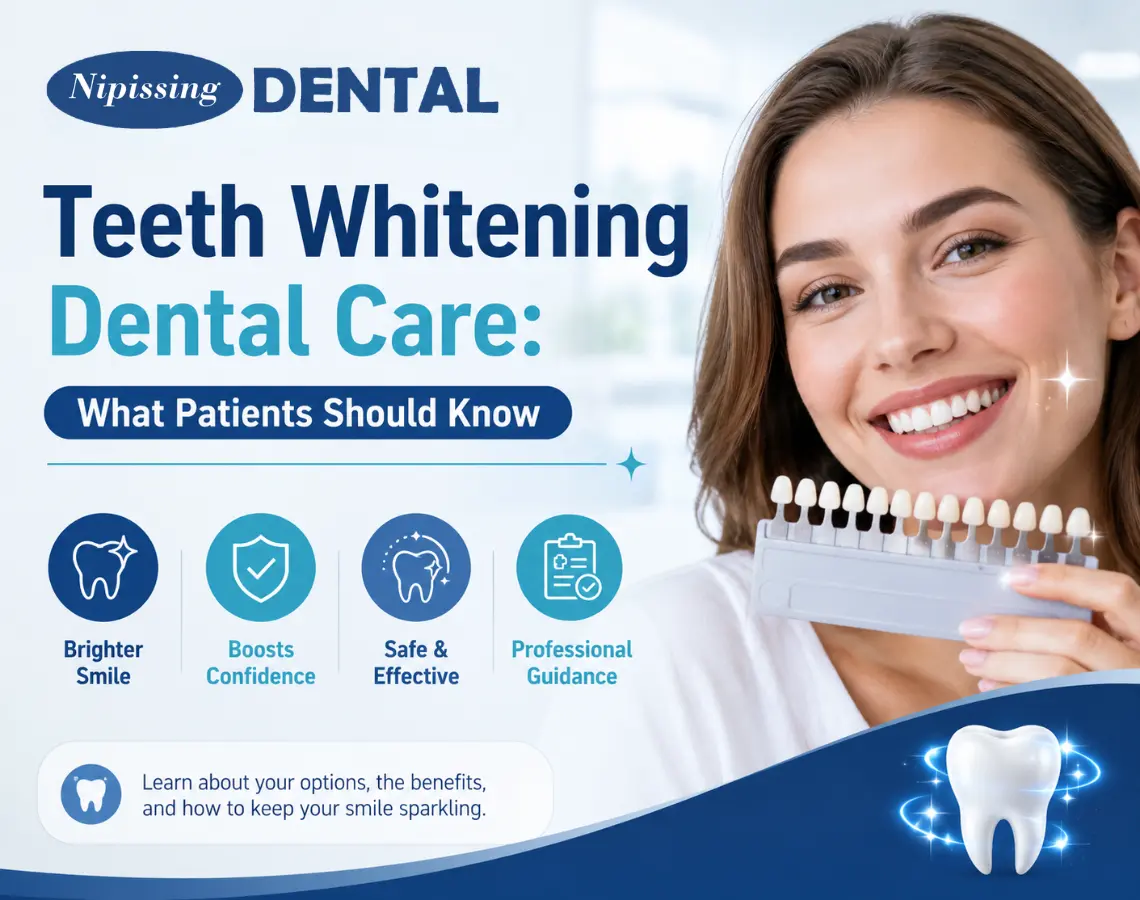
A brighter smile can improve your confidence, but effective teeth whitening dental care starts with more than choosing a whitening product. Before whitening, it is important to understand what is causing tooth discolouration, whether your teeth and gums are healthy enough for treatment, how existing fillings or crowns may affect the result, and which whitening option fits your needs.
If you are considering teeth whitening in Milton, understanding how whitening fits into your overall dental care can help you make a more informed decision.
Key Takeaways
- Teeth whitening dental care combines cosmetic whitening with good everyday oral-health habits.
- Whitening is designed to lighten the colour of natural teeth.
- Different types of tooth discolouration can respond differently to whitening.
- Whitening does not change the colour of crowns, veneers, fillings, dentures, or other tooth-coloured restorations.
- Temporary tooth sensitivity and gum irritation are among the most common side effects of whitening.
- People with cavities, gum problems, significant sensitivity, or other dental concerns should speak with a dental professional before whitening.
- Professional assessment can help you understand your options and set realistic expectations.
- Whitening does not replace brushing, cleaning between your teeth, routine dental care, or treatment for existing dental problems.
What Is Teeth Whitening?
Teeth whitening is a cosmetic dental treatment designed to lighten the colour of natural teeth.
Many whitening systems use peroxide-based ingredients, including hydrogen peroxide or carbamide peroxide. These ingredients interact with compounds responsible for tooth discolouration and can make natural teeth appear lighter.
There are several approaches to whitening, including:
- Professional in-office whitening
- Dentist-supervised take-home whitening
- Over-the-counter whitening strips and gels
- Whitening toothpastes that primarily help remove surface stains
These approaches are not identical. They can differ in their active ingredients, concentration, application method, treatment schedule, and degree of professional supervision.
The right option depends on your teeth, oral health, type of discolouration, and cosmetic goals.
For that reason, teeth whitening dental care should begin with understanding your individual circumstances rather than simply choosing the strongest whitening product available.
Why Do Teeth Become Discoloured?
Teeth naturally change colour over time. Discolouration can develop on the surface of the tooth or within its internal structure.
Surface stains
Surface, or extrinsic, stains can accumulate from exposure to strongly pigmented foods and beverages.
Common contributors include:
- Coffee
- Tea
- Red wine
- Cola and other dark beverages
- Tobacco
- Highly pigmented foods
- Certain oral-hygiene habits
The American Dental Association notes that surface stains can be associated with factors including tobacco use and oral-hygiene habits.
Some surface staining may be reduced through regular brushing, professional cleaning, or products designed to remove external stains. Whitening may provide an additional cosmetic improvement when appropriate.
Internal tooth discolouration
Intrinsic discolouration occurs within the tooth rather than simply on its outer surface.
It can have several causes, including aging, certain medications, changes that occurred during tooth development, trauma, and other dental factors.
This distinction matters because not every type of discolouration responds to whitening in the same way.
If one tooth has become noticeably darker than the others, for example, it is better to have the change evaluated rather than automatically assuming that whitening is the appropriate solution.
Is Teeth Whitening Part of Good Dental Care?
Teeth whitening dental care should be viewed as cosmetic care that works alongside—not instead of—your regular oral-health routine.
Good dental care includes habits such as:
- Brushing with fluoride toothpaste
- Cleaning between your teeth
- Maintaining appropriate dental examinations
- Having professional cleaning when recommended
- Addressing cavities and other dental concerns
- Following recommendations from your dental team
Whitening changes the appearance of natural teeth. It does not treat cavities, gum disease, damaged teeth, or other underlying dental conditions.
That distinction is important.
A simple way to think about it
Dental care protects the health of your smile.
Teeth whitening changes its appearance.
The two can work together, but whitening should not be used to cover up a dental problem that needs attention.
Health Canada recommends consulting an oral health professional before using home whitening products if you have gum disease, unfilled cavities, pre-existing tooth sensitivity, or other dental conditions.
This is one of the most important principles of teeth whitening dental care: address oral-health concerns first and consider cosmetic whitening as part of an overall approach to your smile.
What Should You Check Before Whitening?
Before choosing a whitening treatment, consider four questions.
1. Are your teeth and gums healthy?
Untreated dental concerns may need attention before cosmetic whitening.
If you have tooth pain, significant sensitivity, gum problems, or an unexplained change in tooth colour, speak with a dental professional before beginning treatment.
2. What is causing the discolouration?
Whitening is not equally effective for every type of stain.
Knowing whether the concern is primarily surface staining, internal discolouration, or something related to a dental restoration can help establish realistic expectations.
The ADA notes that the type of stain can influence how responsive it is to bleaching.
3. Do you have visible dental restorations?
This is particularly important if you have crowns, veneers, fillings, or other restorations on visible teeth.
Whitening affects natural teeth, but it does not whiten tooth-coloured restorations in the same way.
4. What result are you looking for?
A natural-looking improvement may require a different approach from someone seeking a more noticeable cosmetic change.
Discussing your expectations before treatment can help you understand what whitening can realistically accomplish.
Taking these factors into account is a key part of responsible teeth whitening dental care.
Professional Teeth Whitening vs. At-Home Whitening
There is no single whitening method that is right for everyone.
Professional in-office whitening
Professional in-office whitening is performed in a dental setting under professional supervision.
It can be an option for patients who want a professionally managed whitening experience and whose oral health and treatment goals make them suitable candidates.
The exact procedure, materials, treatment time, and protocol depend on the whitening system used.
Dentist-supervised take-home whitening
A dental professional may also provide a whitening system for use at home.
This allows patients to complete treatment outside the dental office while receiving professional instructions about how the system should be used.
Health Canada notes that oral health professionals can provide guidance on take-home whitening products and can advise patients if an adverse reaction occurs.
Over-the-counter whitening products
Consumers can purchase whitening strips, gels, toothpastes, and other products directly.
These products vary, so following the manufacturer’s directions carefully is important.
Health Canada advises consumers to read and follow product instructions and consult an oral health professional before prolonged use.
Which option is best?
Instead of asking which whitening method is universally best, a more useful question is:
Which method is appropriate for my teeth, oral health, type of discolouration, and goals?
That is where professional assessment can be valuable.
Choosing an appropriate treatment rather than simply pursuing the strongest available whitening product is an important part of teeth whitening dental care.
Is Professional Teeth Whitening Safe?
For appropriate patients, professional whitening can be a safe cosmetic treatment when the whitening system is used correctly.
However, whitening is not completely free of potential side effects.
The two most commonly reported concerns are:
- Temporary tooth sensitivity
- Gum or soft-tissue irritation
The American Dental Association identifies temporary sensitivity and gingival irritation as common adverse effects associated with vital tooth whitening.
Health Canada likewise notes that sensitivity and soft-tissue irritation can occur with home-use whitening products.
The important point is that safe whitening depends on appropriate use.
Increasing the amount, frequency, or duration of whitening on your own is not necessarily a better approach.
Good teeth whitening dental care means following professional or product instructions rather than assuming that more treatment will produce a better result.
Can Teeth Whitening Cause Sensitivity?
Yes. Tooth sensitivity is one of the most common temporary effects associated with whitening.
Sensitivity can vary from person to person and may be influenced by factors such as the whitening product, its concentration, exposure, and individual dental characteristics.
If sensitivity occurs while using a home whitening product:
- Follow the product instructions
- Do not increase the treatment frequency
- Follow any recommended changes to use
- Speak with a dental professional if sensitivity is significant, persistent, or concerning
Health Canada advises consumers to follow product directions and seek professional advice when needed.
If you already experience tooth sensitivity, discussing it with a dental professional before whitening can help you make a more informed decision.
Can Teeth Whitening Work on Fillings, Crowns, and Veneers?
Whitening does not change the colour of tooth-coloured restorations in the same way it changes natural teeth.
This can include:
- Crowns
- Veneers
- Composite fillings
- Dentures
- Other tooth-coloured restorations
The American Dental Association explains that bleaching affects natural teeth rather than existing tooth-coloured restorations.
Health Canada similarly notes that whitening products whiten natural teeth but do not whiten crowns, veneers, fillings, dentures, or other restorations.
Why does this matter?
Imagine that you have a front tooth with a crown and several natural teeth beside it.
If the natural teeth become lighter while the crown remains its existing colour, the difference between them could become more noticeable.
This is why patients with visible restorations should consider the colour of those restorations before whitening rather than discovering the issue afterward.
A dental professional can assess the situation and discuss the likely cosmetic implications.
Understanding how restorations respond differently is an essential part of teeth whitening dental care.
What Teeth Whitening Cannot Fix
Whitening has limitations.
It is not designed to:
- Treat cavities
- Treat gum disease
- Repair cracked or damaged teeth
- Replace missing teeth
- Change the colour of crowns or veneers
- Correct every type of intrinsic discolouration
- Replace routine dental care
If the reason for tooth discolouration is uncertain, identifying the cause should come before assuming that bleaching is the appropriate solution.
In some situations, another cosmetic or restorative approach may be more appropriate.
This is why teeth whitening dental care should focus on the overall condition of your smile, not simply on achieving a lighter shade.
Who Should Talk to a Dentist Before Whitening?
Professional advice is particularly important if you:
- Have untreated cavities
- Have gum disease or significant gum concerns
- Have pre-existing tooth sensitivity
- Have visible crowns, veneers, or fillings
- Have unexplained tooth discolouration
- Have one tooth that has changed colour
- Have another dental condition that may affect whitening
- Are considering prolonged use of whitening products
Health Canada specifically recommends professional consultation before whitening for people with gum disease, unfilled cavities, pre-existing sensitivity, pregnancy, or other dental conditions.
This does not mean that everyone needs an extensive whitening assessment.
It means that the appropriate starting point depends on the individual.
How to Care for Your Smile After Whitening
Good teeth whitening dental care continues after the whitening treatment itself.
Whitening does not replace your normal oral-hygiene routine.
Continue your normal oral-hygiene routine
Keep brushing with fluoride toothpaste and cleaning between your teeth.
Whitening does not remove the need for everyday plaque control.
Be aware of staining habits
Coffee, tea, tobacco, red wine, and other strongly pigmented foods and beverages can contribute to surface staining over time.
You do not necessarily have to eliminate foods or drinks you enjoy. The goal is to understand which habits may contribute to staining and make reasonable choices.
Follow your whitening instructions
If you are using a professional or over-the-counter whitening product, follow the recommended instructions.
Do not assume that leaving a product on longer or using it more frequently will produce a better outcome.
Health Canada recommends following product directions and consulting an oral health professional before prolonged use.
Keep up with routine dental care
Regular dental care supports healthy teeth and gums and can help identify changes that may affect both oral health and the appearance of your smile.
If you are considering another whitening treatment in the future, your dental team can help determine whether it is appropriate at that time.
When Should You Have Tooth Discolouration Evaluated?
Not every colour change is simply a cosmetic stain.
Consider professional evaluation if:
- One tooth becomes noticeably darker
- A tooth changes colour after an injury
- You have pain or significant sensitivity
- You have visible restorations and want to whiten your natural teeth
- You have unexplained discolouration
- Whitening has caused persistent irritation
- You are unsure which whitening method is appropriate
The goal is not to discourage whitening.
It is to make sure the treatment is addressing the right problem.
That patient-first approach is at the centre of responsible teeth whitening dental care.
Teeth Whitening Should Start With Dental Health
A brighter smile can be an important cosmetic goal, but teeth whitening dental care should always begin with the health and condition of your smile.
Professional whitening can be an option for patients who want to lighten the colour of their natural teeth. Before treatment, however, it is worth considering the cause of the discolouration, existing restorations, sensitivity, oral-health concerns, and realistic expectations.
For patients considering professional teeth whitening in Milton, Nipissing Dental offers teeth-whitening services as part of its cosmetic dental care. You can learn more about the treatment approach on the Teeth Whitening in Milton service page.
If you are unsure whether whitening is appropriate for your smile, discussing your goals and dental history with a dental professional can help you determine the next step.
Considering Teeth Whitening? Nipissing Dental, Milton ON
Get a personalized whitening consultation from a dental team that puts your oral health first. Our team assesses your teeth, gums, and any existing restorations before recommending a whitening option, so you know it’s the right fit for your smile.
Frequently Asked Questions
Explore Our Related Services
These services work well alongside a teeth whitening consultation to support the health and appearance of your smile.
- Family Dentistry in Milton — Preventive and restorative dental care for every age
- How Long Does Teeth Whitening Last? — Compare results across professional and at-home whitening options
References & Trusted Sources
This article was developed using expert dental knowledge and validated against the following trusted health and dental authorities:
- American Dental Association (ADA) — Clinical guidance on tooth whitening, bleaching, and restorative dental care
- Canadian Dental Association (CDA) — Oral health resources on cosmetic dental care and tooth colour
- Health Canada — Oral health and whitening-product guidance for consumers
These trusted sources also inform how Nipissing Dental approaches teeth whitening consultations for patients in Milton.