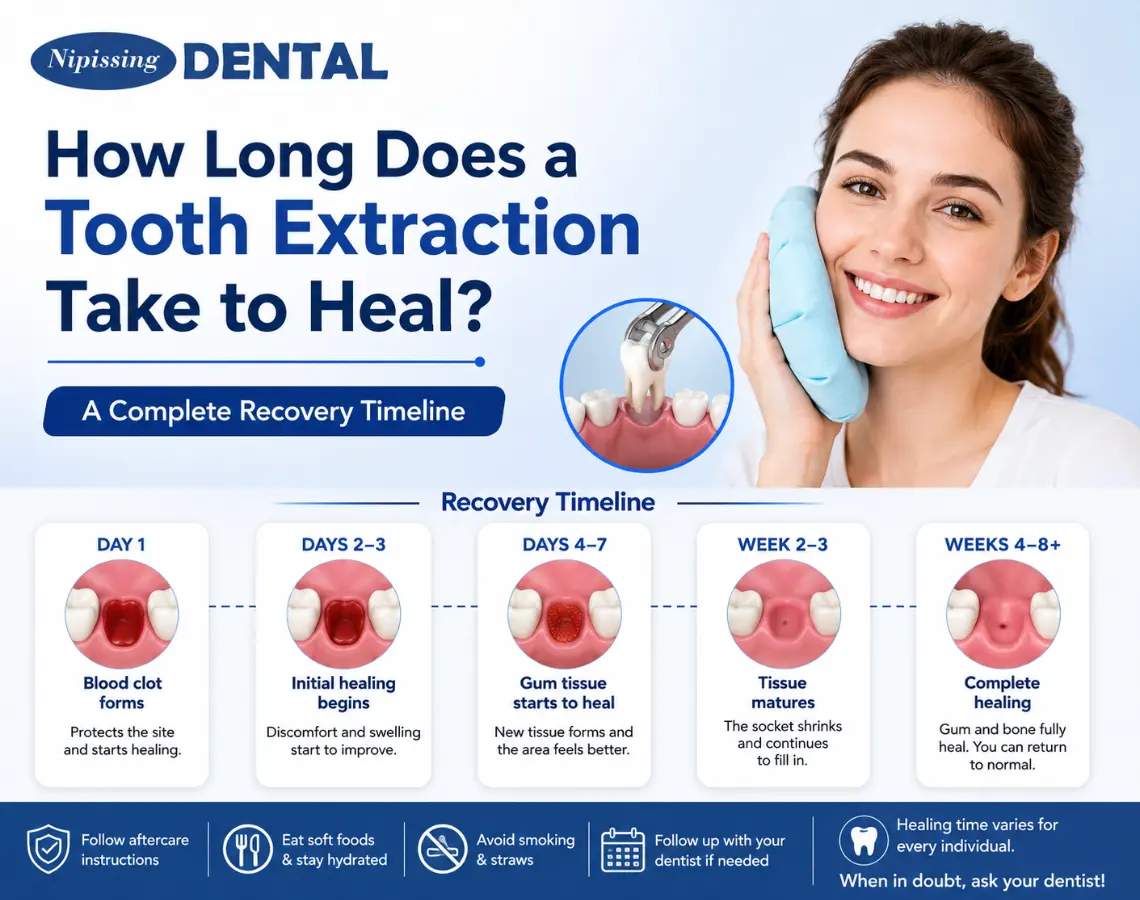
Patients often ask: teeth extraction how long to heal — and the answer depends on the type of extraction and your aftercare. After a tooth extraction, soft tissue typically heals in 7–14 days for simple extractions and 2–3 weeks for wisdom teeth. Complete bone healing takes 3–6 months regardless of extraction type. Most patients resume normal activities within 2–3 days, but full recovery requires proper post-care and patience. Your dentist in Milton will guide you through each healing stage and monitor for complications like dry socket or infection. At Nipissing Dental in Milton, Dr. Disha Hans and our team are committed to making your extraction experience comfortable and ensuring a smooth, complication-free recovery.
Key Takeaways: Teeth Extraction How Long to Heal
- Simple extraction: 7–10 days for soft tissue healing, 3–6 months for complete bone recovery
- Wisdom tooth extraction: 2–3 weeks for full recovery, 3–4 months for bone healing
- Pain level: Most patients report mild discomfort (3/10 on pain scale) manageable with over-the-counter medication
- Healing stages: Day 1–3 (blood clot forms), Day 4–7 (swelling peaks then decreases), Week 2–4 (soft tissue closes), Month 3–6 (bone fills socket)
- Critical warning: Avoid smoking, straws, and vigorous rinsing for 7 days to prevent dry socket (occurs in 2–5% of cases) [Source: American Dental Association, 2024]
Teeth Extraction How Long to Heal: Complete Healing Timeline
What does teeth extraction how long to heal mean for your recovery? When you have a tooth extraction, the healing process follows predictable stages. Soft tissue closes within 7–14 days for simple extractions, while wisdom teeth require 2–3 weeks. The underlying bone takes 3–6 months to fully regenerate. Most patients feel normal within 2–3 days, but complete healing requires patience and proper care. Dr. Disha Hans at Nipissing Dental in Milton has performed thousands of extractions and wisdom teeth removals and consistently sees patients heal fastest when they follow post-care instructions perfectly.
What Is Teeth Extracted and Why Is It Necessary?
What is teeth extracted and when do dentists recommend it? Tooth extraction means removing a tooth completely from its jawbone socket. This procedure is performed when a tooth cannot be saved through other treatments like root canal therapy, fillings, or crowns.
Common reasons for extraction include:
- Severe decay that fillings or crowns cannot repair
- Advanced gum disease causing significant bone loss
- Infected tooth not responding to antibiotics or root canal
- Wisdom teeth causing crowding, pain, or impaction
- Overcrowded teeth before orthodontic treatment (braces or Invisalign)
- Teeth fractured below the gum line
- Teeth that pose infection risk before surgery or organ transplant
At Nipissing Dental, we evaluate every tooth to determine if extraction is necessary or if extract tooth vs root canal alternatives might preserve your natural tooth. If extraction is unavoidable, patients naturally want to know: teeth extraction how long to heal — and we walk every patient through a personalised recovery plan. According to the Canadian Dental Association (CDA), preserving your natural tooth is always the preferred approach whenever clinically viable.
How Long Does Wisdom Tooth Extraction Take to Heal?
One of the most common searches is teeth extraction how long to heal specifically for wisdom teeth — and recovery follows a specific timeline different from simple extractions due to the complexity and location of third molars. After extracting wisdom teeth, recovery follows a specific timeline:
Wisdom tooth healing timeline:
- Day 1–3: Blood clot forms; swelling and discomfort peak
- Day 4–7: Swelling decreases; soft tissue begins closing
- Week 2–3: Most patients feel normal; socket mostly closed
- Month 1–2: Bone begins filling the socket
- Month 3–4: Complete bone healing for most patients
How long does wisdom tooth extraction take during the actual procedure? The extraction typically takes 30–60 minutes for all four wisdom teeth, or 15–20 minutes per tooth individually. Surgical extractions (when teeth are impacted) may take longer.
Most patients return to work or school within 2–3 days after extracting wisdom teeth, but should avoid strenuous exercise for 7 days. For a full breakdown of teeth extraction how long to heal after wisdom tooth removal, speak with our team at your consultation. If you have an urgent situation, contact our emergency dentist in Milton for same-day assessment.
Extraction Teeth Recovery: Stage-by-Stage Healing Timeline
Understanding each healing stage helps you know what’s normal and when to contact your dentist.
Stage 1: Blood Clot Formation (Day 1–3)
The first 72 hours are the most critical when considering teeth extraction how long to heal — your body forms a blood clot in the socket that protects the bone and nerve underneath. This is the foundation of the entire recovery process.
What to expect:
- Bleeding for 2–4 hours (spit gently, don’t swallow)
- Mild to moderate pain (manage with prescribed or OTC medication)
- Swelling begins around hour 12
Critical DO NOTs:
- Don’t use straws (suction can dislodge clot)
- Don’t smoke (reduces blood flow, increases dry socket risk 5x)
- Don’t rinse vigorously (can remove clot)
Stage 2: Swelling Peak and Tissue Repair (Day 4–7)
For patients tracking teeth extraction how long to heal, days 4–7 usually bring noticeable improvement. Swelling typically peaks around day 2–3, then gradually decreases as soft tissue begins closing over the socket.
What to expect:
- Swelling decreases by 50% each day after peak
- Pain becomes mild (2–3/10 on pain scale)
- Gum tissue starts sealing the socket
Care tips:
- Apply ice packs for 15 minutes on/off during first 24 hours
- Switch to warm compresses after day 2
- Begin gentle salt water rinses (½ tsp salt in warm water) after day 3
Stage 3: Soft Tissue Closure (Week 2–4)
By week 2–4, the answer to teeth extraction how long to heal becomes visible — the socket is mostly closed with pink gum tissue. You can eat normally but should avoid chewing directly on the extraction site for another 2 weeks.
What to expect:
- Socket appears smaller and pinker
- Minimal or no pain
- Normal eating resumes (avoid hard/crunchy foods near site)
Stage 4: Bone Filling (Month 1–6)
Understanding teeth extraction how long to heal at the bone level is important — bone gradually fills the socket from bottom up. This is invisible but critical for long-term stability, especially if you plan on future dental implants in Milton.
Timeline:
- Month 1: 25% bone fill
- Month 3: 75% bone fill
- Month 6: 100% bone fill (complete healing)
Does Getting Teeth Extracted Hurt? Pain Management Guide
Pain levels are one of the biggest concerns patients raise when asking teeth extraction how long to heal. Does getting teeth extracted hurt during the procedure? No — your dentist uses local anesthesia to numb the area completely. You may feel pressure but no sharp pain.
Does extracting teeth hurt after the procedure? Most patients report mild to moderate discomfort (3–4/10 on pain scale) lasting 2–4 days. Pain is manageable with:
Pain management options:
- Over-the-counter: Ibuprofen (Advil) 400–600mg every 6 hours or acetaminophen (Tylenol) 500mg every 6 hours
- Prescribed: Your dentist may prescribe stronger medication for surgical extractions or multiple teeth
- Natural: Cold compresses, rest, and avoiding hot/spicy foods
When pain is concerning:
- Severe pain (7+/10) after day 3
- Pain worsening instead of improving
- Throbbing pain not relieved by medication
- Pain with fever or foul taste
These may indicate dry socket (blood clot dislodged) or infection — contact Nipissing Dental immediately. The American Dental Association (ADA) recommends patients seek prompt care for any post-extraction pain that worsens beyond the third day.
Post Care Wisdom Teeth Extraction: Essential Do’s and Don’ts
Proper aftercare directly affects teeth extraction how long to heal — following these guidelines is critical for preventing complications and speeding recovery.
DO:
- Bite gently on gauze for 3–4 hours to control bleeding
- Take pain medication before numbness wears off (first dose at 2 hours)
- Rest with head elevated for 24–48 hours
- Eat soft foods (yogurt, mashed potatoes, smoothies without straws)
- Brush gently, avoiding the extraction site for 3 days
- Rinse with salt water after day 3 (½ tsp salt in 8 oz warm water)
- Use ice packs for first 24 hours (15 min on/off)
- Switch to warm compresses after day 2
DON’T:
- Use straws for 7 days (suction dislodges blood clot)
- Smoke or use tobacco for 7–10 days (increases dry socket risk 5x)
- Drink alcohol for 24 hours (interacts with medications)
- Rinse vigorously for 3 days
- Chew directly on extraction site for 2 weeks
- Exercise strenuously for 7 days
- Skip prescribed medications
Following these guidelines reduces dry socket risk from 5% to under 2%. Remember: your behaviour in the first 7 days is the single biggest factor in teeth extraction how long to heal. For personalised aftercare instructions, schedule a follow-up with our dental hygiene team in Milton.
Healthy Tooth Socket After Extraction: What Normal Healing Looks Like
Tracking your socket’s progress stage by stage helps answer the question: teeth extraction how long to heal — for my case specifically. A healthy tooth socket after extraction shows these signs:
Day 1–3:
- Dark red/blood clot visible in socket
- Mild swelling (1–2 cm)
- Slight bleeding when biting gauze
Day 4–7:
- Clot turns gray/white (normal healing tissue)
- Swelling decreases
- No active bleeding
Week 2–4:
- Pink gum tissue covers most of socket
- Socket size reduced by 50%
- No pain or discomfort
Month 1–3:
- Smooth pink gum line (socket invisible)
- Bone filling underneath (visible on X-ray)
- Normal function resumes
Signs of complications:
- Empty socket with visible bone (dry socket)
- Pus or foul odor (infection)
- Swelling increasing after day 3
- Fever over 100.4°F (38°C)
Contact Nipissing Dental immediately if you notice these signs. Health Canada advises patients to seek professional dental evaluation for any post-surgical symptoms including fever, persistent swelling, or unusual discharge.
Extract Tooth vs Root Canal: When to Choose Each
Before you can ask teeth extraction how long to heal, you first need to know whether extraction is even the right choice. Not every damaged tooth needs extraction — understanding extract tooth vs root canal helps you make an informed decision.
Choose root canal when:
- Tooth structure is mostly intact
- Decay hasn’t reached below the gum line
- Root is not fractured
- You want to preserve the natural tooth
- Cost is comparable ($****–**** for root canal + crown vs $***–$*** for extraction)
Choose extraction when:
- Tooth is fractured below the gum line
- Severe bone loss from gum disease
- Root is cracked or excessively curved
- Infection doesn’t respond to root canal
- Wisdom teeth causing crowding or impaction
- Tooth is non-restorable
At Nipissing Dental, we recommend saving teeth whenever possible. However, extraction is the better long-term choice when a tooth cannot be restored. Following an extraction, many patients explore dental implants or crowns and bridges to restore their smile. The Canadian Dental Association (CDA) consistently advocates for preserving natural teeth wherever clinically possible.
Expert Insight: From Practice
When patients ask Dr. Disha Hans directly — teeth extraction how long to heal in real cases — the answer consistently comes back to one thing: how well you follow aftercare instructions. Dr. Hans has observed consistent healing patterns across thousands of extractions at Nipissing Dental. The most common complication is dry socket, occurring in 2–5% of cases but jumping to 25% in patients who smoke or use straws within 7 days.
One patient Dr. Hans treated, a 28-year-old male from Milton, had all four wisdom teeth extracted surgically. He followed all post-care instructions perfectly — no straws, no smoking, gentle rinsing after day 3. By day 5, he returned to work with minimal discomfort. His sockets were fully closed at 3 weeks, and bone healing was complete at 4 months.
Contrast this with another patient who used a straw on day 2 and developed dry socket. Dr. Hans noted he experienced severe pain (8/10), needed an emergency visit, and his healing timeline extended by 2 weeks.
The lesson: Following post-care instructions is the single most important factor in your recovery speed — and in determining teeth extraction how long to heal for your specific case. If you experience complications, contact our emergency dental team at Nipissing Dental immediately.
Factors That Affect Teeth Extraction Healing Time
So, teeth extraction how long to heal — the exact answer varies by patient. Your healing speed depends on several individual factors:
Age
Age plays a major role in teeth extraction how long to heal:
- Teens/young adults: Heal fastest (2–3 weeks for soft tissue)
- Ages 30–50: Standard healing (7–14 days)
- Ages 50+: Slower healing (14–21 days) due to reduced blood flow
Overall Health
Systemic conditions can significantly extend teeth extraction how long to heal:
- Diabetes: Slows healing by 30–50% (target blood sugar under 200 mg/dL)
- Smoking: Increases healing time by 2–3 weeks and dry socket risk 5x
- Immune conditions: May extend recovery by 1–2 weeks
Health Canada recommends disclosing all systemic health conditions to your dental provider before any oral surgery procedure, as they can significantly affect healing outcomes.
Extraction Type
The type of extraction is the most direct answer to teeth extraction how long to heal:
- Simple extraction: 7–10 days
- Surgical extraction: 10–14 days
- Multiple teeth: 14–21 days
- Wisdom teeth: 2–3 weeks
Bone Quality
Bone density also affects teeth extraction how long to heal at the deepest level:
- Dense jawbone: Slower initial healing but better long-term stability
- Soft jawbone: Faster initial healing but may need bone grafting
[Source: American Dental Association (ADA), 2024]
When to Call Your Dentist: Complications and Red Flags
Knowing teeth extraction how long to heal normally helps you spot when something is wrong. Most extractions heal without issues, but watch for these warning signs:
Call immediately (within 24 hours):
- Bleeding that doesn’t stop after 4–6 hours
- Severe pain (7+/10) not relieved by medication
- Fever over 100.4°F (38°C)
- Pus or foul taste in mouth
- Swelling increasing after day 3
- Numbness lasting beyond 8 hours
These indicate:
- Dry socket: Blood clot dislodged, exposing bone
- Infection: Bacteria entered the socket
- Excessive bleeding: Clot didn’t form properly
What Nipissing Dental will do:
- Dry socket: Clean socket, place medicated dressing, prescribe pain medication
- Infection: Antibiotics, possibly clean socket
- Bleeding: Apply pressure, place additional gauze, monitor
Most complications resolve within 3–5 days with proper treatment. Complications are also the #1 reason teeth extraction how long to heal extends beyond the expected timeline — so act fast and do not delay. Contact Nipissing Dental right away for any urgent post-extraction concerns.
Conclusion: Patience and Proper Care Lead to Full Recovery
Understanding teeth extraction how long to heal helps you prepare mentally and physically for a smooth recovery. If you are asking teeth extraction how long to heal, the short answer is: 2–3 weeks for soft tissue and 3–6 months for complete bone healing.
The key to fast, complication-free recovery — and to reducing teeth extraction how long to heal to the minimum possible time — is:
- Avoid straws and smoking for 7 days
- Take pain medication as prescribed
- Eat soft foods and rest for 2–3 days
- Rinse gently after day 3
- Contact your dentist immediately if complications arise
At Nipissing Dental in Milton, we’re committed to making your extraction experience comfortable and guiding you through every healing stage. With proper care, you’ll return to normal activities quickly and enjoy a healthy, pain-free smile.
Still Asking Teeth Extraction How Long to Heal? Book at Nipissing Dental, Milton ON
Don’t let a painful, infected, or impacted tooth affect your daily life. If you are asking teeth extraction how long to heal after your procedure or before scheduling one, our team has the answers and the aftercare plan you need. At Nipissing Dental, our dedicated team — led by Dr. Disha Hans — provides comprehensive, comfortable, and highly effective extraction and aftercare right here in Milton. We serve patients in English, Hindi, Urdu, and Punjabi.
FAQ Section: Teeth Extraction How Long to Heal — Your Questions Answered
Explore Our Related Services
- Extractions and Wisdom Teeth Removal in Milton — Expert tooth extractions including surgical and impacted wisdom teeth removal
- Dental Implants in Milton — Permanent tooth replacement after extraction to restore full smile function
- Crowns and Bridges in Milton — Restore adjacent teeth and replace missing teeth after extraction
- Root Canals in Milton — Save an infected tooth before extraction becomes necessary
- Emergency Dentist in Milton — Urgent care for post-extraction complications including dry socket and infection
- Dental Fillings in Milton — Conservative cavity treatment before damage requires extraction
- Dental Cleanings in Milton — Preventive care and hygiene support before and after extraction
- Invisalign Clear Aligners in Milton — Orthodontic alignment after extraction for overcrowding cases
- Cosmetic Dentistry in Milton — Enhance your smile after full extraction healing
- Teeth Whitening in Milton — Brighten your smile once your extraction site has fully healed
- Family Dentistry in Milton — Complete oral care for every family member, from children to adults
- Children’s Dentist in Milton — Early preventive care to reduce future extraction needs
- Night Guards and Sports Guards in Milton — Protect your remaining teeth and restorations from grinding and impact
References & Trusted Sources
This article was developed using expert dental knowledge and validated against the following trusted health and dental authorities:
- American Dental Association (ADA) — Clinical guidelines on tooth extraction, post-operative care, dry socket prevention, and patient recovery standards
- Canadian Dental Association (CDA) — Canadian clinical standards for oral surgery, extraction procedures, and natural tooth preservation
- Health Canada — Oral health guidance, post-extraction care recommendations for Canadians, and systemic health connections to oral surgery outcomes