When you need to fix a damaged or missing tooth, you might hear two terms that sound similar but mean completely different things: a dental cap crown and a dental implant. Many patients assume they’re interchangeable options, but the truth could save you time, stress, and weeks of treatment. At Nipissing Dental in Milton, we help you understand whether you need a crown to restore your existing tooth or an implant to replace it entirely — because that is the single most important decision in your restorative journey.
Key Takeaways
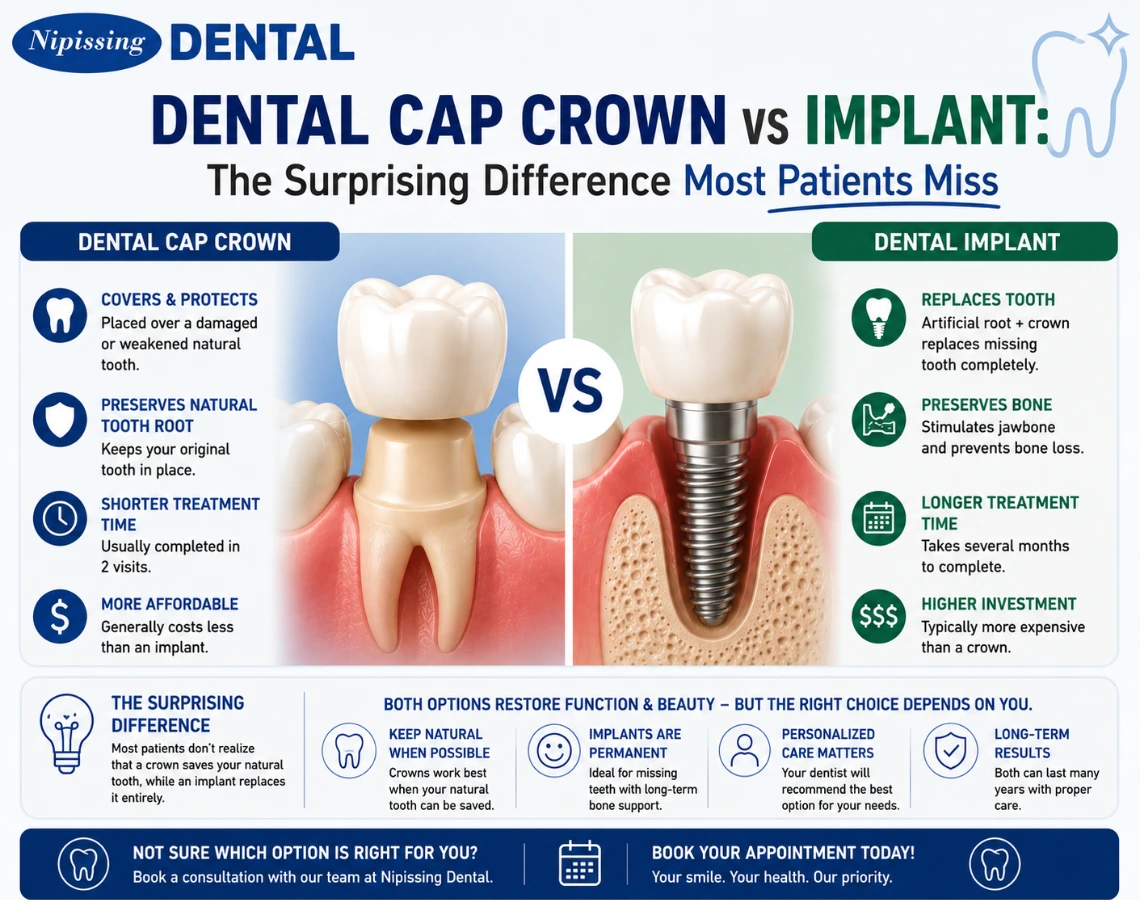
- A dental cap crown restores a damaged tooth that still has healthy structure underneath, while an implant replaces the entire tooth including the root
- Crown treatment is the better choice when your tooth root is salvageable; implants work best when the tooth is non-restorable or missing entirely
- The crown procedure typically takes 1–2 visits over 2–3 weeks, whereas implants require 3–9 months for full healing and integration
- Both options last 10+ years with proper care, but implants offer superior bone preservation since they mimic a natural tooth root
- Your dentist will evaluate tooth structure, gum health, bone quantity, and your overall health to recommend the right path forward
What Is a Dental Cap Crown, Really?
A dental cap crown — most dentists simply call it a crown — is a custom-made covering that fits over your existing tooth. Think of it like placing a protective helmet on a damaged structure that still has a solid base. This restoration restores the tooth’s shape, strength, and appearance while preserving the natural root underneath.
Dentists at Nipissing Dental recommend crown treatment when a tooth has:
- Extensive decay that fillings can’t fix
- Large cracks or fractures
- Significant wear from grinding
- A post-root canal tooth that needs protection
- A broken or weakened tooth structure
The restoration covers everything above your gum line, creating a new, functional surface for biting and chewing. According to the American Dental Association (ADA), crowns are one of the most reliable and widely performed restorative procedures in modern dentistry.
What Is a Dental Implant?
A dental implant is a titanium post that replaces your tooth root entirely. After the implant fuses with your jawbone over several months, a dentist attaches a crown on top of it. So an implant treatment actually includes two parts: the implant itself (the root replacement) and the crown (the visible tooth).
Our dental implants in Milton are considered the gold standard for replacing missing teeth because they:
- Preserve jawbone health by mimicking natural root function
- Don’t require grinding down adjacent teeth
- Offer superior long-term stability
- Feel and function like natural teeth
The Critical Difference: Save vs Replace
Here’s where most patients get confused, and it’s absolutely crucial to understand:
A dental cap crown saves your tooth. An implant replaces it.
If your tooth root is healthy and you have enough structure to support a crown restoration, your dentist will almost always recommend saving it. Why? Because your natural tooth, even when damaged, has advantages no implant can fully replicate — including natural nerve feedback and periodontal ligaments that cushion your bite.
But if your tooth is fractured below the gum line, has severe bone loss, or the decay is too extensive to restore, extraction followed by an implant becomes the better option.
From clinical experience, we’ve seen patients rush toward implants thinking they’re “more modern,” only to discover their tooth was perfectly salvageable with a tooth crown. Conversely, we’ve also watched patients cling to damaged teeth for years, avoiding extraction, which leads to infection, pain, and eventually more complex treatment. The Canadian Dental Association (CDA) consistently advocates for preserving natural teeth wherever clinically possible.
Inlay vs Onlay vs Crown: Understanding Conservative Options
Before you jump to a full crown placement, your dentist might suggest a more conservative approach. Here’s how these restorative options differ:
| Treatment | What It Covers | When It’s Used |
|---|---|---|
| Inlay | Inside the cusps (between tooth bumps) | Small to moderate cavities when cusps are intact |
| Onlay | One or more cusps plus the inside | Moderate damage when a full crown would be too aggressive |
| Crown | Entire visible tooth above gum line | Extensive damage, cracks, or after root canal |
The rule of thumb: choose the least invasive option that still protects your tooth long-term. If only half your tooth is damaged, an onlay might work. But if most of it is gone, a full crown restoration provides the protection you need.
Dental Crown Before and After: What Results Look Like
Patients often ask what they’ll actually see and feel after getting a dental cap crown. Here’s the typical transformation:
Before: A cracked, discolored, or decayed tooth that’s painful to bite on, sensitive to temperature, or visibly broken.
After: A smooth, natural-looking tooth that matches your smile, functions normally for chewing, and eliminates sensitivity. Most patients report feeling like they have their “original tooth” back.
The restoration’s color, shape, and texture are customized to blend seamlessly with your surrounding teeth. Modern materials like zirconia or lithium disilicate offer exceptional realism — even dental professionals can’t easily spot them. To explore what’s possible for your smile, book a cosmetic dentistry consultation at Nipissing Dental.
Crown Dental Implants: When They Work Together
The term “crown dental implants” refers to the crown that sits on top of an implant. So when you get an implant, you’re actually getting an implant and a crown. The implant is the titanium root; the crown is the visible tooth.
This is different from a traditional tooth crown, which sits on your natural root. The implant crown attaches to an abutment (a connector piece) that screws into the implant itself. Our team provides comprehensive crowns and bridges for both natural teeth and implant restorations.
Dental Implants vs Crowns: A Side-by-Side Comparison
Let’s break down the practical differences that matter most to patients:
| Factor | Dental Cap Crown | Dental Implant |
|---|---|---|
| Best for | Damaged but salvageable tooth | Missing or non-restorable tooth |
| Procedure time | 1–2 visits, 2–3 weeks total | Surgery + 3–9 months healing + crown placement |
| Number of appointments | 2–3 | 3–5+ |
| Tooth preservation | Keeps natural root | Removes tooth, replaces root |
| Bone preservation | Maintains existing bone around root | Prevents bone loss by mimicking root |
| Immediate results | Temporary crown same day; permanent in 2 weeks | Temporary options available, but full healing takes months |
| Longevity | 10–15+ years | 15–25+ years (implant itself can last decades) |
| Adjacent teeth | Unaffected | Unaffected |
| Surgery required | No (unless core buildup needed) | Yes (implant placement) |
Zirconia Crowns: The Material That’s Changing Dentistry
When choosing a crown material, zirconia has become the top choice for most patients. Here’s why:
- Strength: Zirconia is incredibly durable, making it ideal for back teeth and implant crowns
- Aesthetics: Modern layered zirconia looks natural, with translucency that mimics real teeth
- Biocompatibility: It’s gentle on gums and doesn’t trigger allergic reactions
- Stain resistance: Zirconia resists discoloration better than porcelain
For front teeth where aesthetics are paramount, some dentists still prefer lithium disilicate (like E-max) for its superior translucency. But for most cases, zirconia offers the best balance of strength and beauty. Our crowns and bridges team in Milton will guide you through the best material for your specific case.
Orthodontics and Crowns: How They Fit Into Your Overall Treatment
If you’re considering orthodontics (like Invisalign clear aligners in Milton) alongside restorative work, timing matters. Your dentist will typically:
- Complete orthodontic treatment first to position your teeth properly
- Then place the crown or implant on teeth that need them
Why? Because moving teeth after crown placement can damage the restoration or create gaps. Getting the foundation right first ensures your restoration fits perfectly and lasts longer. At Nipissing Dental in Milton, we are an Invisalign provider and coordinate restorative and orthodontic care seamlessly.
The Decision Process: How Your Dentist Chooses
Your dentist won’t just guess whether you need a crown or implant. They’ll evaluate several factors:
1. Tooth Structure
How much healthy tooth remains above and below the gum line? If you have enough to support a crown restoration, saving the natural tooth is usually best.
2. Root Health
Is the root fractured, infected, or weakened? A healthy root favors a crown; a damaged root often means implant. Our root canal team in Milton can assess and treat root infections before a crown is placed.
3. Bone Quality
Do you have enough jawbone to support an implant? If bone loss is severe, you might need a bone graft first — or a crown restoration might be the only option.
4. Gum Health
Active gum disease can complicate both treatments. Your dentist may treat gum disease first — starting with a professional dental cleaning in Milton — before proceeding.
5. Your Overall Health
Conditions like uncontrolled diabetes, smoking, or certain medications can affect implant success. Crown treatments don’t have these limitations. According to Health Canada, systemic health conditions should always be disclosed to your dental provider before any restorative procedure.
6. Your Preferences
Some patients want the fastest solution (a crown restoration), while others prioritize long-term bone health (an implant).
Expert Insight: From Practice
In years of treating restorative cases, our team has noticed a consistent pattern: patients who understand the difference between a dental cap crown and an implant make faster decisions and feel more confident afterward. The key is remembering that your natural tooth is always the first choice if it’s salvageable.
One patient we treated had a cracked lower molar with a large old filling. She was convinced she needed an implant because “it’s more modern.” But after evaluation, we found the root was healthy and there was enough structure for a crown. We placed a zirconia restoration via same-day CAD/CAM milling — she’s had it for four years with zero issues. Proof that the right decision isn’t always the most expensive or “advanced” option.
If you suspect you may need emergency care, don’t wait. Contact our emergency dentist in Milton for fast evaluation.
Maintenance: Keeping Your Crown or Implant Healthy
Both options require similar care:
- Brush twice daily with a soft toothbrush
- Floss daily (use a floss threader or water flosser for implants)
- Avoid chewing hard objects like ice or pen caps
- Wear a custom nightguard in Milton if you grind your teeth
- See your dentist for regular dental cleanings and checkups
With proper care, both restorations last many years. Implants often have a slight edge in longevity because there’s no risk of decay beneath them. The Canadian Dental Association (CDA) recommends twice-yearly checkups to extend the life of all restorations.
When Timing Matters: Urgent vs Planned Treatment
Sometimes you need a crown urgently — a cracked tooth that’s painful or a broken tooth exposing decay. A dental cap crown is often the fastest way to save the tooth and stop pain in these situations.
Implants take months, so they’re not an option for emergency tooth-saving. If you have an urgent issue, the sequence is usually:
- Save the tooth with a crown (or extract if non-restorable)
- Address pain and infection
- Later, if extraction was needed, plan for a dental implant
Dental Care for the Whole Family in Milton
Whether you need a crown, an implant, or simply routine preventive care, family dentistry in Milton at Nipissing Dental covers every member of your household. We also offer children’s dental care to help young patients build healthy habits early — long before restorative treatments are ever needed. After any restorative work is complete, many patients also explore teeth whitening in Milton to complete their smile transformation.
Ready to Explore Your Options?
If you’re in Milton, Ontario and wondering whether you need a dental cap crown or implant, the best step is a consultation. Your dentist will examine your tooth, take necessary images, and walk you through both options with clarity.
At Nipissing Dental, we offer comprehensive evaluations for crown treatments, implants, Invisalign, and all restorative needs. We accept the Canadian Dental Care Plan (CDCP) and are committed to personalized care that puts your comfort and long-term health first.
Your natural tooth is worth saving if it’s possible. But when it’s not, an implant gives you a solution that feels and functions like the real thing. Either path, when chosen correctly, leads to a healthier, more confident smile.
Book Your Dental Cap Crown Consultation at Nipissing Dental, Milton ON
Don’t let a cracked, painful, or damaged tooth affect your daily life. At Nipissing Dental, our dedicated team — led by Dr. Disha Hans — provides comprehensive, comfortable, and highly effective crown and implant treatment right here in Milton. We serve patients in English, Hindi, Urdu, and Punjabi.
FAQ Section: Dental Cap Crown vs Implant
Explore Our Related Services
- Crowns and Bridges in Milton — Custom dental cap crown and bridge restorations to protect and restore damaged teeth
- Dental Implants in Milton — Permanent tooth replacement when a crown is no longer sufficient
- Root Canals in Milton — Saving infected teeth before placing a protective crown
- Dental Fillings in Milton — Conservative cavity treatment before damage requires a full crown
- Emergency Dentist in Milton — Urgent crown treatment for cracked, broken, or painful teeth
- Extractions and Wisdom Teeth Removal in Milton — When a crown cannot save the tooth
- Dental Cleanings in Milton — Preventive care to extend the life of your crown
- Invisalign Clear Aligners in Milton — Align your teeth before final crown placement
- Cosmetic Dentistry in Milton — Enhance your smile’s appearance after crown restoration
- Teeth Whitening in Milton — Brighten surrounding teeth to match your new crown
- Family Dentistry in Milton — Complete oral care for every family member, from children to adults
- Children’s Dentist in Milton — Early preventive care to reduce future restorative needs
- Night Guards and Sports Guards in Milton — Protect your crown from grinding and impact damage
References & Trusted Sources
This article was developed using expert dental knowledge and validated against the following trusted health and dental authorities:
- American Dental Association (ADA) — Clinical guidelines on crown restorations, implant therapy, restorative materials, and patient care standards
- Canadian Dental Association (CDA) — Canadian clinical standards for restorative dentistry, crown placement, and natural tooth preservation
- Health Canada — Oral health guidance, dental care recommendations for Canadians, and systemic health connections to restorative dentistry