You spent months — maybe even years — wearing braces or aligners, and now your smile is exactly where you wanted it. But then your orthodontist hands you a retainer and says, “Wear this every night.” And you think: is this really that important?
The honest answer is yes — absolutely yes. As someone who works closely with patients through every stage of their orthodontic journey, I’ve seen firsthand what happens when retainer wear gets skipped. Teeth shift. Alignment is lost. And undoing that movement is far harder the second time around.
Whether you’re searching for information about a dental orthodontic retainer for the first time, comparing dental retainer types, or trying to understand why your retainer teeth have started shifting again — this guide covers everything you need to know about the best retainer after braces and how to protect your smile long-term.
At Nipissing Dental in Milton, ON, our team provides personalized orthodontic care — including Invisalign clear aligners in Milton and complete post-treatment retention solutions — designed around your specific needs and smile goals.
What Is a Dental Orthodontic Retainer — and Why Do You Need One?
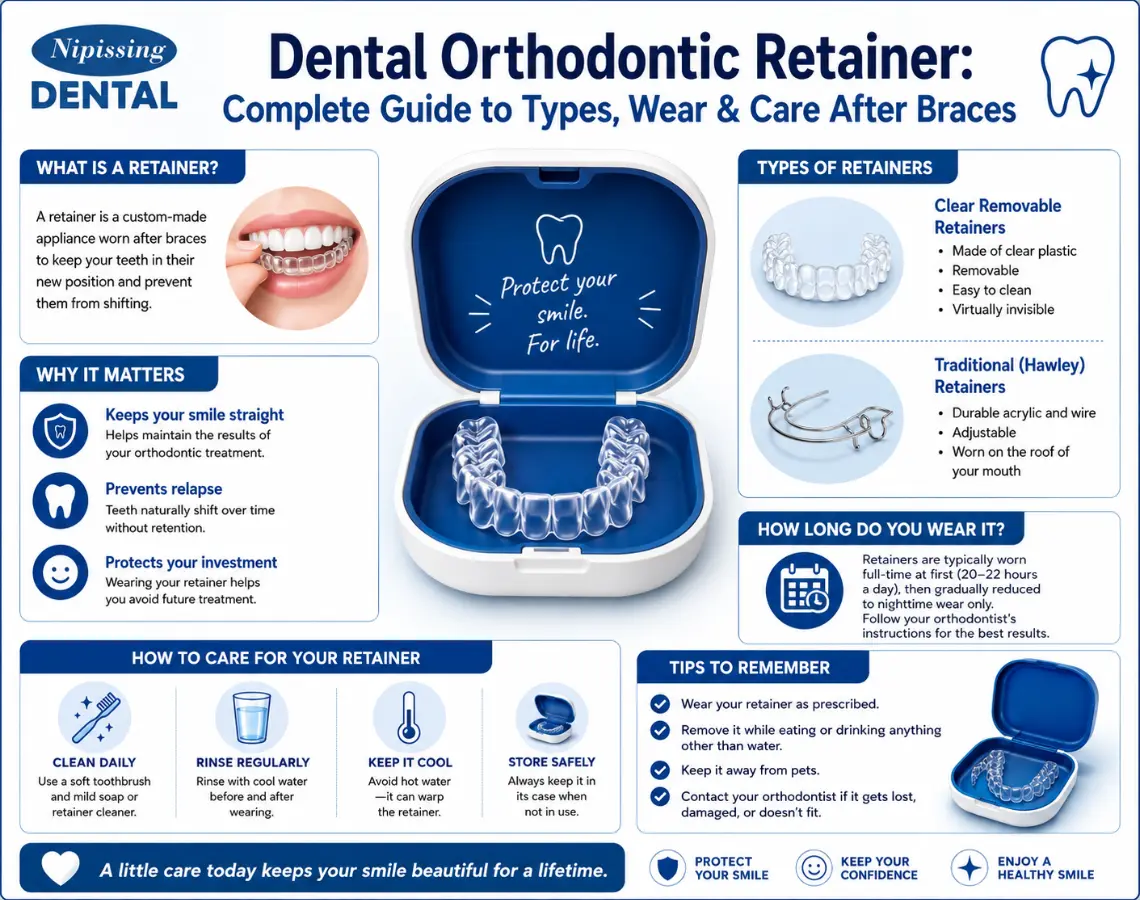
A dental retainer is a custom-fit oral appliance designed to hold your teeth in their corrected positions after orthodontic treatment. When your braces come off or you complete your final Invisalign tray, your teeth are in the right place — but the bone and connective tissues surrounding them haven’t fully stabilized yet.
This stabilization process takes time. Without a dental orthodontic retainer, those tissues naturally pull the teeth back toward their original positions — a phenomenon known as orthodontic relapse. It’s not a flaw in your treatment; it’s simply biology.
The American Dental Association (ADA) confirms that retainer wear following active orthodontic treatment is essential for preserving alignment. The Canadian Dental Association (CDA) equally endorses retainers as the standard of care after braces or aligners, noting that patients who skip this phase risk losing their results entirely.
Think of your teeth retainer as insurance for the investment you made in braces or aligners. Your dental retainer after braces is not optional — it is the phase that makes all of that time, effort, and cost permanent. If you’re unsure whether braces were right for you or your child to begin with, our comprehensive dental exams in Milton are always a great starting point.
Types of Retainers After Braces: Which One Is Right for You?
Understanding your options is half the battle. There are several types of retainers after braces, and each of the different kinds of retainer has distinct advantages depending on your lifestyle, treatment history, and compliance habits. Here’s a clear overview of all the major dental retainer types:
| Retainer Type | Description | Best For | Approx. Cost (per arch) |
|---|---|---|---|
| Essix Retainer | Clear plastic tray (similar to aligners) | Discreet, everyday use | $***-*** |
| Bonded Retainer | Fixed wire cemented to the back of teeth | Patients prone to forgetting | $***-*** |
| Permanent Retainer | Long-term fixed wire behind front teeth | Maximum retention security | $***-*** |
Hawley Retainer
The classic Hawley retainer features a metal wire that runs across the front of the teeth, anchored by an acrylic plate that rests against the roof of the mouth or the tongue-side of lower teeth. It’s one of the most durable removable retainers available, and it can even be adjusted slightly if minor tooth movement occurs. Many patients consider the Hawley the best retainer after braces for long-term durability.
Essix Retainer
If discretion matters to you, the Essix retainer — a clear, thin tray that fits snugly over your teeth — might be your preference. These clear retainers for teeth are practically invisible and are especially popular with adults and teens as brace retainers after braces. They’re also the go-to post braces retainer for Invisalign patients, since the transition from aligners to a clear retainer feels completely natural. If you’re currently in the Invisalign process, our Invisalign clear aligners team in Milton can walk you through what to expect at the retention stage.
Bonded and Permanent Retainers
A bonded retainer (also called a fixed wire retainer) is cemented directly to the inside surfaces of your teeth. You won’t need to remember to put it in, because it’s always there. These permanent orthodontic retainers are ideal for patients who struggled with compliance during treatment or who had significant spacing or crowding corrected.
The trade-off? Flossing requires a bit more effort with a fixed retainer, and professional monitoring is essential to ensure the wire stays intact. If a bonded retainer wire breaks and goes unnoticed, teeth can shift quite quickly — which is why regular dental cleaning appointments in Milton are so valuable for patients wearing fixed retainers.
At Nipissing Dental in Milton, ON, we help patients assess which option fits their unique oral health profile and lifestyle — because the best dental orthodontic retainer is the one you’ll actually use.
Do Retainers Move Teeth Back? What You Should Realistically Expect
This is one of the most common questions I hear, and it deserves a clear, honest answer.
Can retainers move teeth back? In very minor cases — if you’ve only stopped wearing your orthodontic retainer teeth for a short period and the movement is minimal — yes, wearing your retainer consistently again can help guide teeth back into alignment. However, the longer you wait and the more movement occurs, the less effective this approach becomes.
Do retainers move teeth back after significant shifting? Generally, no. Once teeth have moved substantially, active orthodontic intervention — new aligners or braces — is required to correct the relapse. A dental orthodontic retainer is designed for retention, not correction. If your teeth have already shifted and you’re concerned about the extent of movement, our team can assess whether Invisalign clear aligners in Milton might be appropriate for re-treatment.
This is why orthodontic relapse prevention starts the moment treatment ends. Wearing your retainer as directed is far simpler — and far less expensive — than repeating treatment.
Wearing Your Retainer: A Practical Schedule That Works
One of the most common points of confusion I encounter is around how long and how often to wear a dental orthodontic retainer. Here’s the general wear schedule we recommend for most patients:
Phase 1 — First 6 to 12 Months Post-Treatment
- Wear your retainer full-time (20–22 hours per day) unless eating or brushing
- This phase is critical — bone consolidation is most active right now
- Your dental retainer after braces works hardest during this window
Phase 2 — Beyond the First Year
- Transition to nighttime-only wear
- Continue nightly for long-term straight teeth maintenance
Phase 3 — Long-Term Retention
- Most orthodontists, including those aligned with CDA guidelines, recommend nightly retainer wear indefinitely
- Your teeth will continue to shift naturally throughout life — a nighttime retainer is your best long-term defence
Retainer Care: How to Keep It Clean and Long-Lasting
Caring for your dental orthodontic retainer is just as important as wearing it. Neglecting hygiene can lead to bacterial buildup, bad odors, and even faster wear. Here are the most effective retainer maintenance tips:
For Removable Retainers (Hawley & Essix)
- Rinse with cool water every time you remove it
- Brush gently with a soft toothbrush — no toothpaste, as it can scratch clear plastic
- Soak in a retainer-cleaning solution or diluted white vinegar weekly
- Store in its case when not in use — never in a napkin or pocket
For Fixed / Bonded Retainers
- Use floss threaders or interdental brushes to clean beneath the wire
- Attend regular dental checkups so your dentist can inspect the bonding — our dental cleanings team in Milton checks fixed retainers at every visit
- Avoid biting directly into hard or sticky foods
How long do retainers last? Removable retainers typically last 2 to 5 years with proper care. Fixed retainers can last much longer but require professional maintenance. If yours is wearing out, contact your retainer dentist near me — a fresh replacement is a small cost to protect your orthodontic results.
What Happens If You Stop Wearing Your Retainer?
I’ve had patients come back after a gap of several months with noticeable shifting — and the frustration is always real. Here’s what typically happens when retainer teeth wear stops:
- First few weeks: Subtle movement begins, especially in the front teeth
- 1–3 months: Gaps may reappear; crowding can return
- 6+ months: Significant relapse may require retreatment
- Years without wear: Alignment can revert close to the pre-treatment state
The front teeth are especially vulnerable because they’re supported by thinner bone and have less surface area. This is why preventing teeth from moving after braces requires consistent, ongoing effort. If shifting has already occurred and enamel has been damaged, our dental fillings team in Milton or our crowns and bridges service can address any structural damage before it worsens.
Replacing or Repairing a Lost or Broken Retainer
Life happens. Retainers get lost, stepped on, or accidentally thrown out with a napkin at a restaurant. If you find yourself with a broken retainer or a missing one, don’t wait.
The longer you go without wearing your dental orthodontic retainer, the more your teeth can shift. Even a week or two without it — especially early in the retention phase — can make the retainer fit noticeably tighter or impossible to seat properly.
If you need emergency retainer repair or replacing lost retainers, contact your dental provider as soon as possible. At Nipissing Dental in Milton, we can take new impressions and create a replacement quickly so your progress isn’t lost. In the meantime, if something feels wrong with your teeth or bite, our emergency dentist in Milton is available to assess the situation promptly.
How Much Does a Dental Orthodontic Retainer Cost in Milton, ON?
One of the most common questions patients ask their retainer dentist near me is about cost. Here’s a realistic overview for Milton, ON patients:
- Hawley retainer: $***–$*** per arch — durable, adjustable, long-lasting
- Essix (clear) retainer: $***–$*** per arch — most popular as a clear orthodontic retainer
- Bonded retainer: $***–$*** per arch — includes bonding appointment and professional fitting
- Retainer replacement: Similar to original cost; budget for replacements every 2–5 years
Does insurance cover retainers? Many Canadian dental insurance plans include orthodontic benefits that partially cover dental retainer costs — especially if you’re replacing one after active treatment. Check with your provider, and our team can provide the necessary documentation for your claim. Given that the cost of full orthodontic retreatment can run $****–$****, a dental orthodontic retainer at a fraction of that price is one of the most cost-effective investments in dentistry.
Retainers for Children and Teens: What Parents Should Know
Orthodontic braces for children are increasingly common, and many kids complete treatment while their jaws and teeth are still developing. That makes the retention phase slightly different — and often more important.
Children and teenagers may be tempted to skip retainer wear, especially during school hours. As a parent, it helps to frame the dental orthodontic retainer as non-negotiable from day one. The earlier good habits are established, the less likely relapse becomes.
Health Canada supports early dental intervention and supervised retainer use for children when recommended by a dental professional. For younger patients, a bonded retainer may offer better outcomes since there’s no compliance factor. For teens committed to removable retainers, a consistent morning-and-night routine works best.
Our children’s dentist in Milton works closely with families to find the right fit for children’s orthodontic care — because catching issues early always leads to a simpler, more affordable outcome.
References & Trusted Sources
This article was developed using expert dental knowledge and validated against the following trusted health and dental authorities:
- American Dental Association (ADA) — Guidelines on orthodontic retention and retainer use
- Canadian Dental Association (CDA) — Canadian clinical standards for orthodontic aftercare
- Health Canada — Guidance on oral health and dental appliances for children and adults
- Mayo Clinic — Patient education on orthodontic treatment and teeth shifting
- National Institutes of Health (NIH) — Peer-reviewed research on orthodontic relapse and retention
Frequently Asked Questions About Dental Orthodontic Retainers
Most orthodontists recommend full-time wear for the first 6 to 12 months, then nightly for life. Teeth naturally shift throughout adulthood — a consistent retainer wear schedule is the most reliable protection. The Canadian Dental Association (CDA) endorses lifelong nighttime retainer use as the standard of post-treatment care.
Absolutely. Adults benefit from a dental orthodontic retainer just as much as younger patients. In fact, adult teeth can be more susceptible to relapse because bone density changes with age. Many adults also use clear orthodontic retainers for subtle, discreet protection. Our family dentistry team in Milton provides retainer consultations and fittings for patients of all ages.
For most patients, yes — when worn consistently. Clear Essix-style retainers provide excellent retention and are more comfortable for many people. Wire (Hawley) retainers may be preferable when some minor adjustment is still needed, as they can be fine-tuned by your orthodontist. The key difference lies in how aggressively you grind or clench — if you do, a harder-material retainer may last longer. Our team can help you decide during your dental exam in Milton.
Some mild pressure or tightness is normal — especially after a break in wear. If your dental retainer feels significantly painful or no longer seats properly, see your dentist. Forcing a poorly fitting retainer can cause more harm than good. If you’ve experienced chipping or sensitivity due to extended retainer neglect, our dental fillings team in Milton can evaluate and treat any affected teeth.
Your teeth will begin shifting fairly quickly — the first few weeks are when movement is most pronounced. Contact your dental office immediately for a replacement to protect your smile. If you’re in Milton, reach out to Nipissing Dental and we’ll get you a new dental orthodontic retainer as quickly as possible so your alignment is preserved.
The best retainer after braces depends on your individual needs. Clear Essix retainers are the most popular for discreet, comfortable wear. Hawley retainers are best for durability. Bonded retainers are best for patients who struggle with compliance. Your retainer dentist near you will assess your bite, treatment history, and lifestyle before recommending the right dental orthodontic retainer. At Nipissing Dental in Milton, we’ll walk you through all your options at your retainer consultation.
Protect Your Smile with a Custom Dental Orthodontic Retainer — Book in Milton Today
A dental orthodontic retainer is one of the simplest, most effective tools available to protect your smile after braces or Invisalign. The key is choosing the right dental retainer type and getting a proper fit from a qualified dental professional who understands your bite, your history, and your goals.
If you’re in Milton, ON, and you’ve recently completed orthodontic treatment — or if you suspect your retainer teeth have started shifting after a period without wear — the team at Nipissing Dental is ready to help. We’ll assess your alignment, discuss your options, and recommend the right retention solution tailored specifically to you.
Don’t let your hard-earned results slip away. Your smile is worth protecting — starting tonight.

Team at Nipissing Dental
Milton, Ontario — Modern, Patient-Centred Dental Care
The Team at Nipissing Dental is dedicated to providing compassionate, high-quality dental care for individuals and families in Milton, Ontario. Our experienced dental professionals share educational content to help patients better understand oral health, preventive dentistry, cosmetic treatments, restorative procedures, orthodontics, and modern dental solutions for healthy, confident smiles.
“From first contact at Nipissing Dental, Dr. Hans and her staff are committed to your individual attention and personalised oral health care tailored for your unique dental needs and goals.”
Serving Milton, Ontario and surrounding communities
Book a Consultation →