If you’ve been told you need a molar removed, I want to walk you through everything clearly and honestly. Molars are your largest back teeth, built for heavy chewing, so removing one is a more involved process than pulling a smaller front tooth. But with the right preparation and a skilled dental team, it’s a manageable procedure that most patients handle better than they expect.
To understand your full oral health picture before any extraction, it helps to start with a comprehensive dental exam at Nipissing Dental — where our team reviews your X-rays, discusses your symptoms, and maps out the safest treatment path.
How Long Does It Take to Extract a Molar?
The most common question I hear is: how long does it take to extract a molar?
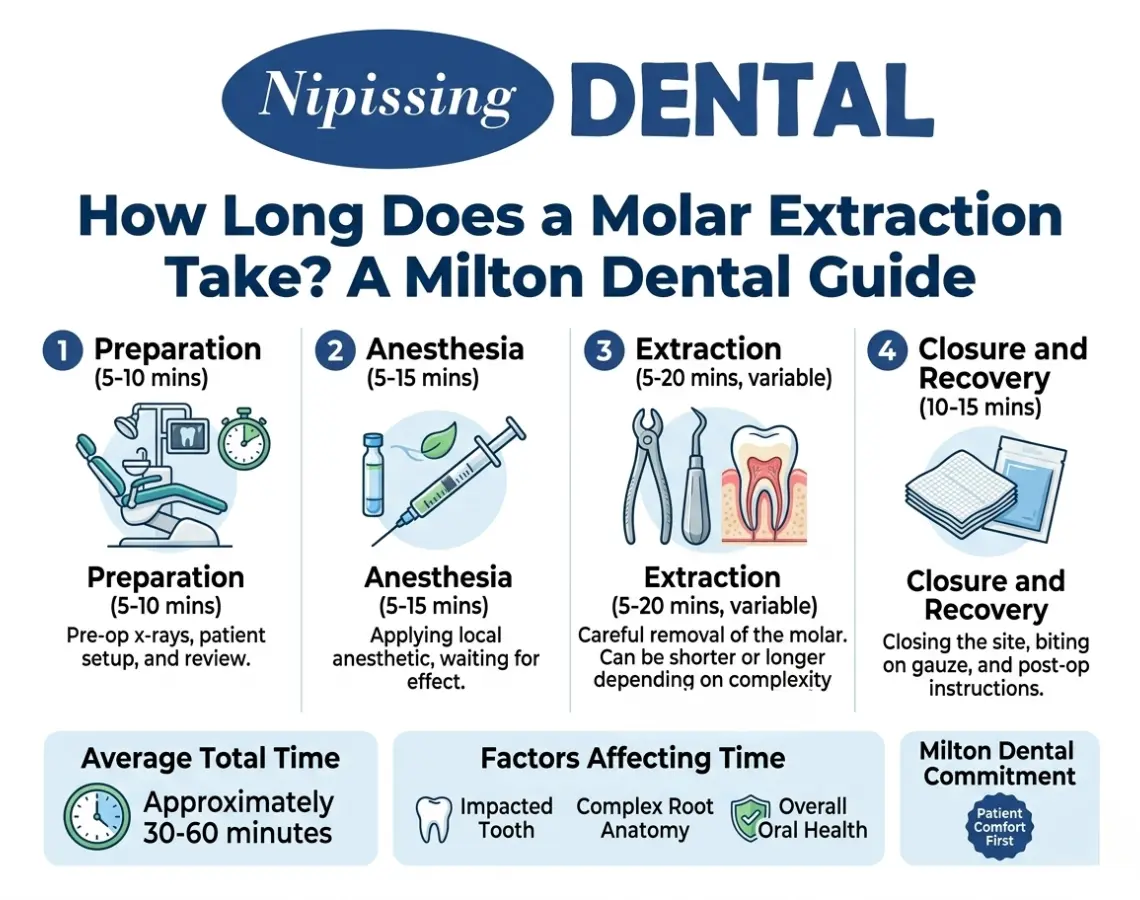
The honest answer is — it depends. A straightforward molar extraction on a fully erupted tooth with good root position typically takes 20 to 40 minutes from the moment the dentist starts the procedure. However, the full appointment — including pre-extraction assessment, anaesthesia administration, the extraction itself, and post-procedure instructions — usually runs 45 to 90 minutes.
Surgical extractions, which involve molars that are impacted, partially erupted, or have curved roots, can take longer — sometimes 60 to 120 minutes, particularly for lower wisdom molars.
Several factors influence that timeline:
- Root anatomy — molars have two to three roots. Curved or fused roots add complexity.
- Bone density — denser bone requires more careful sectioning.
- Degree of decay or infection — a severely broken-down tooth may need to be removed in sections.
- Impaction level — partially or fully impacted molars require surgical access.
- Patient cooperation and medical history — certain conditions affect anaesthesia and healing.
If you’re wondering how long does it take to extract a tooth in general, simple single-root teeth (like incisors) can be removed in under 15 minutes, while molars always require more time due to their size and root structure. Learn more about our tooth extraction services and what to expect on the day.
Simple vs. Surgical Molar Extraction: What’s the Difference?
Simple (Non-Surgical) Extraction
A simple extraction is performed when the molar is fully visible above the gumline and structurally intact enough to be loosened and removed in one piece. I use an instrument called an elevator to gently loosen the tooth from its socket, then lift it out with extraction forceps. Local anaesthesia keeps you comfortable throughout.
Typical time: 20–40 minutes for the procedure itself.
Surgical Extraction
When a molar is impacted, broken below the gumline, or has complex root anatomy, a surgical approach is necessary. This may involve making a small incision in the gum tissue, removing a small amount of surrounding bone, and sectioning the tooth into pieces for easier removal.
At Nipissing Dental, our team assesses every case with digital X-rays before deciding on the appropriate extraction approach. This ensures no surprises mid-procedure.
Patients who are anxious about surgical extractions often benefit from discussing sedation dentistry options beforehand — a conversation I encourage anyone with dental anxiety to have with our team.
Typical time: 45–120 minutes depending on complexity.
Dental Root Canal vs. Extraction: Which Should You Choose?
One of the most common conversations I have with patients is around dental root canal vs. extraction. If a molar is infected or severely decayed, both options may be on the table — and the right choice depends on several clinical and personal factors.
A root canal removes infected tissue from inside the tooth, preserving the natural root and crown structure. It’s generally the preferred option when the tooth can be saved, because keeping your natural tooth maintains jawbone density and bite alignment.
An extraction is recommended when:
- The tooth is too damaged to restore
- Infection has spread significantly and cannot be resolved
- There is insufficient bone support
- The tooth is causing overcrowding or orthodontic issues
- Cost or time constraints make root canal therapy impractical
According to the Canadian Dental Association (CDA), preserving natural teeth is always the first priority when clinically appropriate. However, a well-executed extraction followed by a dental implant or bridge is a fully viable long-term solution.
I always present both options clearly so patients can make an informed choice. There’s no one-size-fits-all answer.
Does Having a Tooth Pulled Hurt?
Let’s address this directly: does having a tooth pulled hurt?
During the procedure — no, it should not hurt. Modern local anaesthesia is extremely effective. You will feel pressure, movement, and sometimes a brief sensation when the tooth is rocked loose, but sharp pain during an extraction is a signal to your dentist to pause and re-anaesthetize.
What many patients describe after the anaesthesia wears off (typically 2–4 hours post-procedure) is a dull, achy soreness in the jaw and surrounding gum tissue. This is entirely normal and expected.
For most simple molar extractions, over-the-counter pain relievers such as ibuprofen or acetaminophen manage discomfort well. Your dentist may prescribe stronger pain relief for surgical extractions or cases involving pre-existing infection.
If you experience severe throbbing pain 3–4 days after the extraction, this may indicate a condition called dry socket (alveolar osteitis), where the protective blood clot is lost prematurely. Dry socket is more common with lower molar extractions and in smokers. Contact your dental team promptly — it’s easily treated.
Learn more about our tooth extraction services to understand what to expect on the day of your procedure.
What to Do After Tooth Extraction
Knowing what to do after tooth extraction is just as important as the procedure itself. Proper aftercare significantly reduces the risk of complications and speeds healing.
Immediately After the Procedure
- Bite firmly on the gauze pad your dentist places over the socket — keep pressure for 30–45 minutes to control post dental extraction bleeding
- Avoid rinsing, spitting forcefully, or using a straw for the first 24 hours — these actions can dislodge the blood clot
- Apply an ice pack to your cheek in 20-minute intervals during the first 24 hours to reduce swelling
- Keep your head elevated — even while sleeping — for the first night
- Avoid smoking or using tobacco products for at least 72 hours (ideally longer)
Managing Post Dental Extraction Bleeding
Some oozing and mild bleeding for the first few hours is completely normal. To manage post dental extraction bleeding:
- Replace gauze as needed and maintain firm biting pressure
- Dampen a plain black tea bag and bite down on it — the tannic acid in tea supports clot formation
- Avoid hot drinks, alcohol, and physical activity for 24 hours
- If heavy bleeding continues beyond 1–2 hours, contact your dental team immediately
At Nipissing Dental, written aftercare instructions are provided after every extraction. Our team is always available to answer questions during your recovery — never hesitate to call if something doesn’t feel right.
Days 2–7: Healing Phase
- Rinse gently with warm salt water starting 24 hours after surgery (½ tsp salt in 8 oz of warm water)
- Take all prescribed medications as directed
- Keep the area clean but avoid brushing directly on the extraction socket
- Watch for signs of infection: increasing pain, fever, foul taste, or pus
What to Eat After a Tooth Extraction
Choosing the right foods during recovery makes a real difference in comfort and healing speed.
| Foods to Eat | Foods to Avoid |
|---|---|
| Yogurt, smoothies (no straw), soft-serve ice cream | Crunchy, hard, or sharp foods — chips, nuts, raw vegetables |
| Scrambled eggs, mashed potatoes, mashed sweet potato | Sticky or chewy foods — caramel, gummies, tough meats |
| Oatmeal, cream of wheat, soft-cooked rice | Spicy or acidic foods that may irritate the socket |
| Applesauce, bananas, ripe avocado | Hot beverages and alcohol during the first 48 hours |
| Soft-cooked fish, tofu, well-mashed legumes | Small seeds and grains that can lodge in the extraction site |
| Broth-based soups (cooled to a comfortable temperature) |
Most patients return to a near-normal diet within 7–10 days for simple extractions and approximately 2 weeks for surgical cases. Staying well-nourished supports immune function and tissue repair throughout.
When Should You Call Your Dentist After an Extraction?
Contact your dental team if you experience any of the following:
- Severe or worsening pain after day 3 (possible dry socket)
- Fever above 38°C (100.4°F)
- Persistent or heavy bleeding beyond the first few hours
- Swelling that worsens after day 2
- Numbness that hasn’t resolved after 24 hours
- Signs of allergic reaction to prescribed medication
What Happens to the Gap After Molar Extraction?
This is an important question that often gets overlooked. Once a molar is extracted, the adjacent and opposing teeth gradually shift toward the gap. Over time, this can cause bite misalignment, jaw soreness, and bone loss in the area.
Tooth replacement options to discuss with your dentist include:
- Dental implant — the gold standard for single-tooth replacement
- Fixed bridge — crowns on adjacent teeth with a pontic to fill the gap
- Partial denture — a removable option when implants aren’t suitable
Explore our dental implants page to learn how implants restore both function and aesthetics after a molar extraction — often the most recommended long-term solution.
The American Dental Association (ADA) recommends discussing replacement options ideally before the extraction, so you have a clear treatment plan in place. Health Canada’s oral health guidelines similarly reinforce the importance of full-mouth planning after any tooth loss.
Conclusion
A molar extraction is a common, well-understood dental procedure. Yes, it takes longer than pulling a smaller tooth — but with proper anaesthesia, a skilled dentist, and attentive aftercare, most patients are surprised by how manageable the experience truly is.
If you’re facing a molar extraction and have questions about the procedure, timing, pain management, or recovery, the team at Nipissing Dental is here to guide you through every step with care and expertise. Book your appointment today.
References & Trusted Sources
Frequently Asked Questions
How long is the recovery time after a tooth extraction?
Recovery after a tooth extraction typically takes 3–7 days for initial healing. Most patients feel normal within a week, but full recovery can vary depending on the complexity of the extraction and aftercare.
What can I eat after getting a tooth pulled?
After a tooth extraction, stick to soft foods like yogurt, mashed potatoes, smoothies, soup, and scrambled eggs. Avoid hard, spicy, or crunchy foods for a few days to prevent irritation and promote faster healing.
How do I know if my tooth needs an emergency extraction?
You may need an emergency tooth extraction if you have severe pain, swelling, infection, abscess, or a badly broken tooth. Difficulty chewing or signs of spreading infection (fever, pus) also require immediate dental care.
How long does it take for the gums to fully heal after an extraction?
Gum healing usually takes about 1–2 weeks, while complete bone healing can take several weeks to a few months depending on the case and oral hygiene.
Is tooth extraction painful with local anesthesia?
Tooth extraction is not painful with local anesthesia, as the area is fully numbed. You may feel pressure during the procedure, but pain is minimal. Mild discomfort afterward is normal and manageable with medication.
Ready to Feel at Ease at the Dentist?
Our team at Nipissing Dental is here to make every visit as comfortable and stress-free as possible. Take the first step toward better oral health today.