The titanium implant root is designed to last a lifetime and fuses permanently with your jawbone. The crown on top typically needs replacement after 10–25 years. With consistent oral hygiene and regular dental check-ups, most patients in Milton can expect their dental implants to outlast virtually every other tooth replacement option available.
What Is a Dental Implant and How Does It Work?
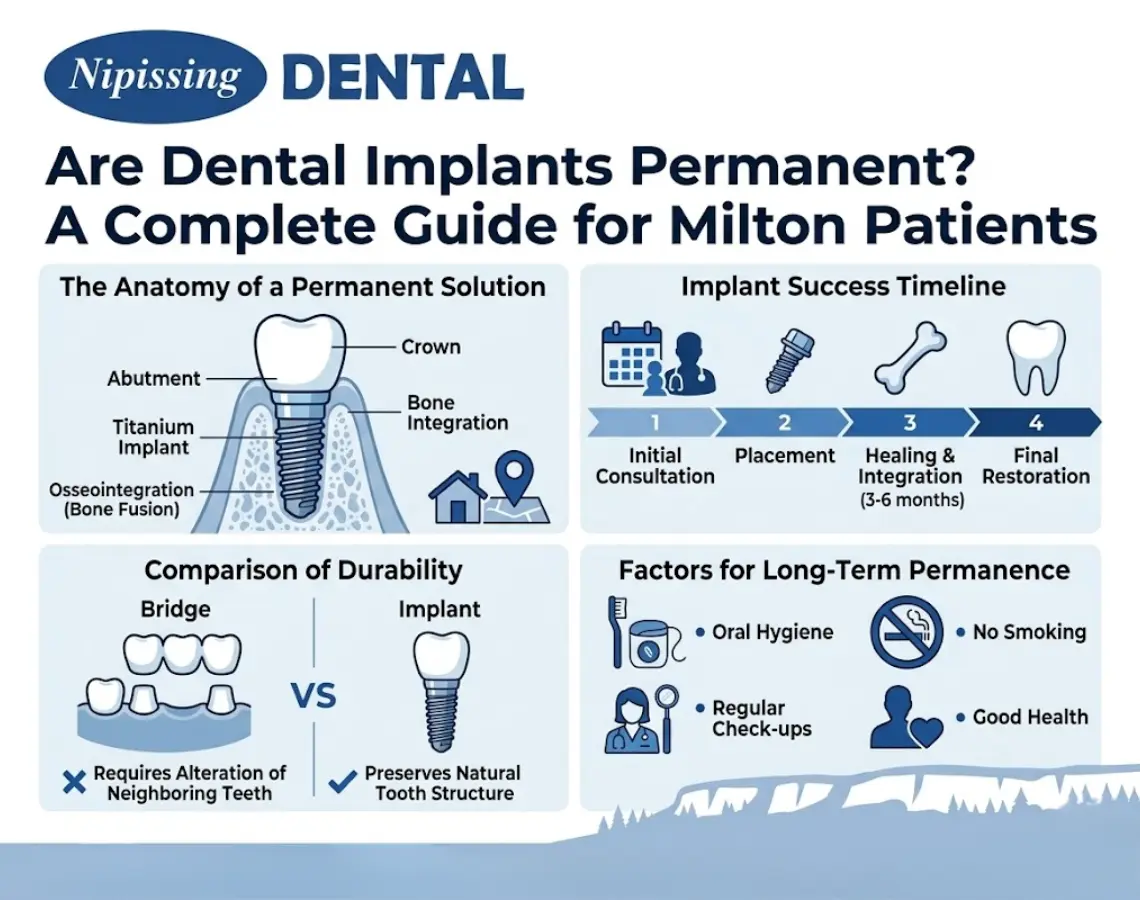
A dental implant is a small titanium post surgically placed into the jawbone to replace a missing tooth root. Over the following weeks and months, the post integrates with surrounding bone through a biological process called osseointegration — the same mechanism that allows bone to fuse with titanium in hip and knee replacements.
Once the implant is fully integrated, a connector piece (abutment) is attached, and a custom crown is secured on top. The result is a restoration that looks, bites, and feels like a natural tooth. Unlike dentures, it does not move. Unlike a dental bridge in Milton, it does not require grinding down neighbouring healthy teeth.
Here are the three components and their typical lifespans:
| Component | What It Does | Expected Lifespan |
|---|---|---|
| Titanium post (root) | Anchors in jawbone permanently | Lifetime (20–30+ years) |
| Abutment (connector) | Joins post to crown | 10–20+ years |
| Crown (visible tooth) | Restores bite and appearance | 10–25 years |
Are Dental Implants a Permanent Solution for Missing Teeth?
The implant post itself is designed to be a permanent solution. Clinical evidence, including long-term studies referenced by the ADA and ITI (International Team for Implantology), consistently demonstrates implant survival rates above 95% over a 10-year period when patients maintain adequate oral hygiene and attend regular professional cleanings.
The crown, however, is subject to the same wear forces as any natural tooth. Diet, grinding habits (bruxism), and oral hygiene all affect how long the crown lasts. Replacing the crown does not mean the implant has failed — the root remains integrated and functional.
The honest answer: dental implants are the most permanent tooth replacement option available in modern dentistry. No other solution — not dentures, not bridges — offers the same combination of longevity, bone preservation, and natural function.
Are Dental Implants Painful During the Procedure?
The procedure itself is performed under local anaesthesia, which means you will feel pressure and vibration but not sharp pain. For patients with significant dental anxiety, our team at Nipissing Dental discusses sedation options before any surgery is scheduled.
What Happens During the Procedure
- The surgical site is fully numbed before any incision is made
- You may feel movement and light pressure — this is normal
- The implant placement itself typically takes 1–2 hours per tooth
- You will feel nothing sharp during a properly anaesthetised procedure
Post-Procedure Discomfort: A Realistic Timeline
Post-operative soreness is expected and temporary. Here is what most patients experience:
- Days 1–3: Mild to moderate soreness, swelling, and possible bruising — all expected
- Days 4–7: Discomfort noticeably decreases; most patients manage with ibuprofen or acetaminophen
- Week 2: Tenderness largely resolves; soft diet continues
- Week 3+: Most patients report little to no ongoing discomfort
Understanding Pain by Location
Where you feel discomfort after surgery can tell us something useful:
| Location | What It May Indicate |
|---|---|
| At the implant site | Normal post-surgical healing — expected |
| Jaw stiffness | Muscle tension from keeping mouth open — resolves within days |
| Persistent gum soreness | Possible early peri-implantitis — mention at your follow-up |
| Pain radiating toward the ear | Possible nerve proximity — contact your dentist promptly |
| Sinus pressure (upper jaw) | Normal for upper arch implants due to sinus proximity |
Are Dental Implants More Painful Than a Tooth Extraction?
Most patients report after the fact that the procedure was nothing like what they imagined. Implant surgery is generally comparable to, or less uncomfortable than, a dental extraction in Milton — particularly when compared to surgical extractions for impacted teeth.
Both procedures use local anaesthesia. Both involve 3–7 days of post-operative soreness. The key difference is precision: implant surgery follows a planned surgical protocol specifically designed to minimize tissue disruption, which generally leads to a controlled, predictable recovery.
The Dental Implant Recovery Timeline
Understanding each stage of recovery helps you plan realistically and recognize what is normal at every step.
Stage 1: Surgery Day Through Week One
- Apply ice to the outside of your cheek in 20-minute intervals for the first 48 hours
- Eat soft foods — yogurt, soup, mashed potatoes, smoothies
- Avoid hot liquids, straws, and vigorous rinsing for the first 24 hours
- Rest and avoid strenuous activity for at least 48–72 hours
- Take pain relief as recommended
Stage 2: Weeks 2–4 (Soft Tissue Healing)
- Swelling and bruising resolve by the end of week 2 in most cases
- Most patients return to normal daily activities within a week
- Continue avoiding hard or crunchy foods near the implant site
- Attend your scheduled follow-up appointment
Stage 3: Months 2–6 (Osseointegration)
This is the most critical phase — the titanium post is fusing with your jawbone. You will not feel this happening, but premature pressure on the implant during this window can compromise integration. Your dentist monitors progress with X-rays and clinical checks.
Stage 4: Crown Placement (3–9 Months Post-Surgery)
Once your dentist confirms successful osseointegration, your permanent dental crown in Milton is placed. Your implant is now fully functional. Most patients complete the full implant process within 4 to 9 months. Cases requiring bone grafting or sinus lifts may take longer.
Can You Get Dental Implants with Gum Disease?
Active, untreated gum disease is a contraindication for dental implant surgery. Placing an implant into an infected oral environment significantly increases the risk of failure and a condition called peri-implantitis — bacterial infection around the implant post.
However, gum disease does not permanently disqualify you. Once periodontitis is treated, bone loss is stabilized, and the gum environment is healthy, implant candidacy can be reassessed. Mild gingivitis is often managed in the weeks leading up to implant planning. Advanced periodontitis with significant bone loss requires a more comprehensive treatment sequence before implants are considered.
The Canadian Dental Association and Health Canada both emphasize that periodontal health is the foundation of any implant treatment plan.
Can You Get Dental Implants If You Have Significant Bone Loss?
Adequate bone density and volume are necessary to anchor the implant post securely. Bone loss — which commonly follows tooth loss, gum disease, or long-term denture wear — can complicate placement, but it is rarely an absolute barrier. When significant bone loss is present, these preparatory procedures may be recommended:
- Bone grafting — rebuilding jaw volume using bone material before implant surgery
- Sinus lift — elevating the sinus membrane to create space for upper jaw implants
- Zygomatic implants — a specialized solution for severe upper jaw bone deficiency
Dental Implants vs Bridges: Which Is Better for Milton Patients?
The right answer genuinely depends on your specific clinical picture, not a general rule. Here is an honest comparison:
| Feature | Dental Implants | Dental Bridge |
|---|---|---|
| Adjacent teeth affected | No | Yes — must be prepared (filed) |
| Jawbone preservation | Yes — stimulates bone | No — bone loss continues |
| Longevity (root component) | 20–30+ years | 10–15 years average |
| Daily maintenance | Brush and floss normally | Requires floss threaders |
| Upfront cost | Higher initial investment | Lower initial cost |
| Surgery required | Yes | No |
| Best suited for | Long-term single or multiple gaps | Avoiding surgery; lower upfront budget |
For most Milton patients with good bone health and no significant medical contraindications, dental implants offer a superior long-term outcome — particularly because they preserve the jawbone and do not stress neighbouring teeth. That said, a dental bridge remains a clinically valid choice and may be the right decision for certain health or financial situations.
How Long Do Dental Implants Last on Average?
Based on peer-reviewed data and the clinical guidelines of the ITI and ADA, here is what the research shows:
- The titanium implant post has documented survival rates above 95% at 10 years and strong outcomes beyond 20 years in well-maintained patients
- The crown requires replacement every 10–25 years depending on wear, bite forces, and hygiene
- Smoking is among the strongest modifiable risk factors for implant failure — it significantly impairs healing and bone integration
- Patients with well-controlled type 2 diabetes can achieve implant success rates comparable to non-diabetic patients with appropriate treatment planning (supported by ITI Consensus Statements)
The most accurate predictor of implant longevity is consistent, diligent maintenance — both at home and professionally.
How to Clean and Maintain Dental Implants
Implants are not real teeth, but they require real maintenance. Peri-implantitis — a bacterial infection affecting the tissue and bone around the implant — is the leading preventable cause of implant failure. Your daily routine is your best defence.
Daily Home Care
- Brush twice daily with a soft-bristled toothbrush
- Use a low-abrasive toothpaste (avoid harsh whitening pastes)
- Floss daily using implant-specific floss or an interdental brush
- A water flosser is highly effective for cleaning around the implant base
- Use an antibacterial, alcohol-free mouthwash to reduce bacterial load
Professional Maintenance
- Hygiene appointments every 3 to 6 months, depending on your risk profile
- Ask your hygienist to use non-metal instruments around implants to avoid surface scratching
- Periodic X-rays to monitor bone levels at the implant site
- If you grind your teeth, ask about a custom night guard to protect the crown
Urgent Signs: When to Call Your Dentist Immediately
If you are in the post-operative period or have existing dental implants and are experiencing any of the following, do not wait for your next scheduled appointment — contact us today:
- Pain that is worsening after day 3, rather than improving
- Fever above 38°C (100.4°F) at any point post-surgery
- Swelling that is expanding, not receding
- Pus or unusual discharge from the implant site
- A loose or wobbly implant at any stage
- Numbness or tingling that persists beyond the first day
- Inability to close your mouth normally
- Heavy or uncontrollable bleeding beyond the first 24 hours
What to Do and What NOT to Do After Implant Surgery
Do:
- Follow your dentist’s post-operative instructions precisely
- Keep the site clean using prescribed rinse or warm salt water gently (after 24 hours)
- Sleep with your head slightly elevated for the first few nights
- Eat soft, nutritious foods and stay well hydrated
- Take all recommended or prescribed medications on schedule
- Attend every follow-up appointment, even if you feel fine
Do NOT:
- Smoke or use tobacco — nicotine is one of the most significant risk factors for implant failure and dramatically impairs soft tissue and bone healing
- Consume alcohol during initial healing
- Poke or probe the implant site with your tongue or fingers
- Eat hard, crunchy, or sticky foods until cleared by your dentist
- Skip follow-up appointments — early complications caught at check-ups are far easier to manage
- Ignore pain that does not resolve on the expected timeline
Conclusion
Dental implants are the closest thing to a permanent tooth replacement that modern dentistry offers. With the right candidacy assessment, proper surgical technique, and diligent long-term maintenance, most patients in Milton can expect their implant to last decades — often a lifetime. The key is starting with a thorough consultation, addressing any underlying oral health issues, and committing to the ongoing care that protects your investment.
If you are considering dental implants in Milton, our team at Nipissing Dental is here to help — with digital imaging, honest cost information, and a treatment plan designed around your specific oral health needs. Book your implant consultation today.
References & Trusted Sources
- Canadian Dental Association (CDA) — cda-adc.ca
- American Dental Association (ADA) — ada.org
- Health Canada — canada.ca/en/health-canada
- International Team for Implantology (ITI) — iti.org
Frequently Asked Questions
Are dental implants painful during the procedure?
No. The procedure is performed under local anaesthesia so you should not feel sharp pain — only pressure and movement. Post-operative soreness is normal and manageable with over-the-counter medication. Patients with dental anxiety can discuss sedation options with our team before surgery.
How long do dental implants typically last?
The titanium implant post is designed to last a lifetime, with clinical studies showing survival rates above 95% at 10 years. The crown portion requires replacement after 10–25 years depending on wear. Longevity is strongly influenced by hygiene habits, smoking status, and regular professional care.
Are dental implants a permanent solution for missing teeth?
Dental implants are the closest thing to permanent tooth replacement that modern dentistry offers. The implant root fuses with the jawbone permanently. The visible crown will eventually need replacement, but the structural foundation is designed to last for decades.
Can you get dental implants if you have significant bone loss?
In many cases, yes. Bone grafting, sinus lifts, and other preparatory procedures can rebuild the foundation needed for successful implant placement. Your eligibility is assessed through clinical examination and digital X-rays.
Are dental implants more painful than a tooth extraction?
Most patients report that implant surgery is comparable to — or more comfortable than — a tooth extraction, particularly when compared to surgical extractions. Both are performed under local anaesthesia and involve a similar recovery period of 3–7 days of mild soreness.
Ready to Feel at Ease at the Dentist?
Our team at Nipissing Dental is here to make every visit as comfortable and stress-free as possible. Take the first step toward better oral health today.