A dental crown is a custom-made cap that covers a damaged or weakened tooth entirely, restoring its shape, strength, and function. In Milton, crowns are most commonly recommended after a root canal, for cracked or severely decayed teeth, or to complete a dental implant or dental bridge.
What Is a Dental Crown?
You’re sitting in the dental chair, and your dentist says: “You need a crown on that tooth.” Your first thought? How bad is it, really? Your second? What does this mean for my daily life?
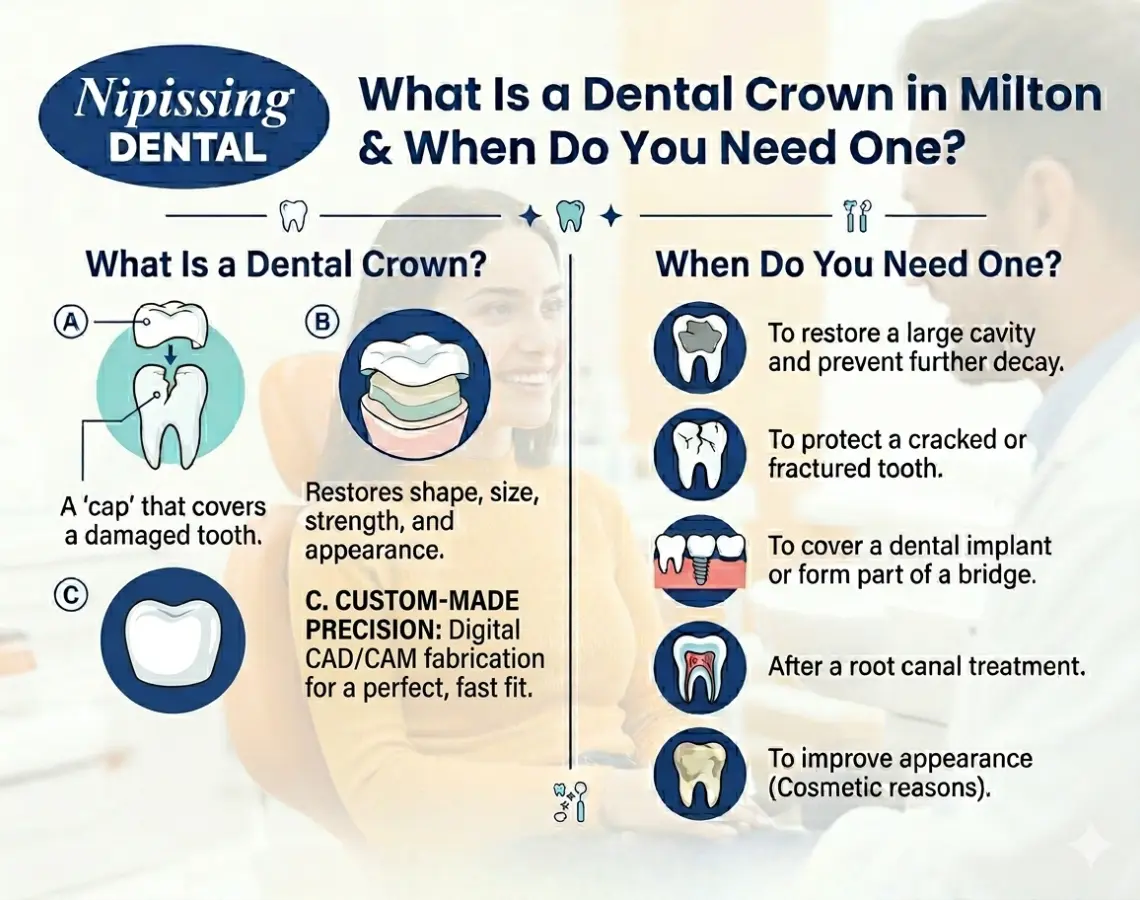
A dental crown is a tooth-shaped cap placed over a damaged, weakened, or cosmetically compromised tooth. It covers the entire visible portion of the tooth — from the gum line upward — restoring its shape, size, strength, and appearance.
Think of it like a fitted helmet for a tooth that’s been through a lot. Once cemented into place, a crown functions exactly like a natural tooth. You bite, chew, and smile without thinking twice about it.
At Nipissing Dental in Milton, our team places crowns regularly — and the most common thing patients tell us after the process is done? “I wish I hadn’t waited so long.” Crowns are one of the most versatile, long-lasting restorations in dentistry, built to solve problems that dental fillings simply cannot handle alone.
When Do You Actually Need a Dental Crown?
Not every damaged tooth requires a crown. But there are specific clinical situations where it’s the right — and often the only — long-term solution.
A large or failing filling
When a cavity takes up more than half the width of a tooth, or when an older filling has cracked or worn away, there isn’t enough healthy tooth structure left to support another dental filling. A crown covers what remains and distributes biting forces evenly across the whole tooth.
A cracked or fractured tooth
Cracks don’t always cause immediate pain — but they do spread. A crown acts like a splint, holding the tooth together and preventing the fracture from deepening toward the root, which would eventually require extraction. If you feel a sudden sharp pain when biting on one specific spot, that’s a classic crack symptom — and early crown placement can save the tooth entirely.
If the pain is severe or comes on suddenly, it may also qualify as a dental emergency. Don’t wait in those situations.
After a root canal treatment
Root canal treatment removes the nerve and pulp from inside an infected tooth, which leaves the remaining structure brittle and vulnerable to fracture. Without a crown, that tooth can split — sometimes in a way that cannot be repaired. A crown placed over a root-treated tooth protects it and significantly extends its functional life.
Severe or extensive decay
When decay is so widespread that a filling can’t rebuild structural integrity, a crown reconstructs the tooth from the ground up. It’s not a cosmetic choice — it’s a structural one.
A broken or heavily worn tooth
Teeth cracked by injury, worn flat from bruxism (teeth grinding), or chipped repeatedly often need a crown to restore proper bite function and aesthetics. A night guard can address the grinding going forward, but the existing damage requires restoration.
To anchor a dental bridge
Dental bridges and crowns work closely together. The crowns on either side of a gap — called abutment crowns — hold the bridge and the artificial tooth firmly in place. Without sound abutment teeth (or well-placed abutment crowns), a bridge isn’t possible.
To complete a dental implant
A crown for a dental implant is the visible, functional part of the restoration. The titanium post integrates with the jawbone; the implant crown sits on top, giving you a natural-looking tooth that functions, feels, and cleans just like the real thing.
Types of Dental Crowns Available in Milton
Crown materials have advanced significantly. Your dentist will recommend a material based on the tooth’s position, bite strength, your cosmetic preferences, and your budget.
| Crown Type | Best For | Lifespan | Aesthetics |
|---|---|---|---|
| All-Ceramic / Porcelain | Front teeth | 10–15 yrs | Excellent |
| Zirconia | Back teeth, implants | 15–25 yrs | Very Good |
| Porcelain-Fused-to-Metal (PFM) | Any tooth | 10–15 yrs | Good |
| Gold / Metal Alloy | Molars | 20+ yrs | Lower |
All-ceramic (porcelain) crowns offer the best cosmetic match, mimicking the translucency of natural enamel. They’re ideal for front teeth where appearance matters most.
Zirconia crowns have become the standard for back teeth and implants — exceptionally strong, highly biocompatible, and naturally aesthetic. The Canadian Dental Association (CDA) recognises zirconia restorations as demonstrating excellent long-term clinical performance in posterior teeth.
Porcelain-fused-to-metal (PFM) crowns combine a metal core for durability with a porcelain exterior for aesthetics — a reliable middle-ground option.
Gold and metal alloy crowns remain the most durable option available. They require minimal tooth removal and are gentle on opposing teeth — a sensible choice for back molars where appearance isn’t a priority.
Dental Crown vs. Filling — Which Is Better
This is one of the most common questions patients ask at our Milton practice. The honest answer: it depends entirely on the clinical situation.
A filling is appropriate for small to medium cavities where the surrounding tooth structure is mostly intact. It’s quicker, less invasive, and more affordable — often completed in a single appointment.
But when a tooth is significantly compromised — through a large cavity, cracking, or multiple repairs over the years — a filling can create additional problems by stressing thin walls of remaining structure. Those walls can fracture down the road, turning a manageable problem into a complex one.
A crown wraps and protects the entire tooth. It’s the better long-term investment when structural integrity is genuinely at risk.
Dental Bridges, Crowns & Implants — How Do They Work Together?
These three restorations are often mentioned together, and understanding how they relate helps patients make more informed decisions.
A dental bridge replaces a missing tooth by spanning the gap between two neighbouring teeth. Those teeth receive crowns — called abutment crowns — that anchor the bridge. A standard three-unit bridge involves two crowns and one artificial tooth in the middle, all fused together.
A dental implant replaces a missing tooth from root to tip. A titanium post fuses with the jawbone over several months (osseointegration), and a crown for a dental implant is then attached on top. Implants are widely considered the gold standard for tooth replacement because they preserve jawbone density and don’t rely on neighbouring teeth.
The right option depends on the health of adjacent teeth, bone density, overall health, timeline, and budget. Both are available at Nipissing Dental, and a thorough consultation — including digital X-rays — helps determine the best path forward.
How Long Do Dental Crowns Last in Milton?
With proper care and regular dental check-ups, most crowns last between 10 and 15 years. Many well-maintained crowns — particularly gold and zirconia — last 20 years or longer.
Key factors that affect crown lifespan:
- Material choice: Zirconia and gold have the best long-term clinical track record
- Location in the mouth: Back molars face significantly more biting force than front teeth
- Oral hygiene: Decay can develop at the margin where the crown meets the tooth — brushing twice daily and flossing carefully around the crown edge is essential
- Bruxism (grinding): Night grinding shortens the lifespan of any crown material. A custom night guard is a wise investment if this applies to you
- Diet and habits: Chewing ice, hard candies, or using your teeth as tools accelerates wear
Regular professional cleanings and check-ups in Milton allow your dentist to monitor crown margins, check for looseness, and catch small issues before they become large ones.
What Does the Dental Crown Procedure Feel Like?
The process typically involves two appointments, though same-day crowns using CAD/CAM digital milling are increasingly available.
Appointment 1 (60–90 minutes): Your dentist numbs the area with local anaesthetic, gently reshapes the tooth to create space for the crown, takes a digital scan or impression, and fits a temporary crown. The permanent crown is typically ready within 1–2 weeks.
Appointment 2 (30–60 minutes): The temporary crown is removed. The permanent crown is checked for fit, bite, and colour match — then cemented in place. Minor bite adjustments are common and take only a few minutes.
Does it hurt? The procedure itself is not painful. Local anaesthetic fully numbs the area before any work begins. Most patients describe it as similar to getting a filling. Mild sensitivity or gum soreness for 2–3 days afterward is normal and manageable with over-the-counter pain relief.
If you experience significant or persistent pain after the crown is placed, contact your Milton dental office promptly. A bite adjustment or further assessment may be needed.
Benefits of Dental Crowns for Damaged Teeth in Milton
Beyond the clinical reasons, patients consistently notice meaningful real-world improvements after a crown:
- Restored chewing comfort on both sides of the mouth
- Elimination of sensitivity caused by cracked or exposed tooth structure
- Improved appearance — ceramic and zirconia crowns look indistinguishable from natural teeth
- Protection from further damage — crowns stop cracks from spreading and seal out decay
- Confidence to smile — particularly where front teeth are involved
- Long-term cost savings by avoiding extraction and more complex replacement procedures
- Peace of mind — once a vulnerable tooth is fully protected, it stops being something you worry about every time you eat
Conclusion
A dental crown in Milton isn’t something to fear — it’s one of the most reliable, well-tested restorations in modern dentistry. Whether you need one to protect a cracked tooth, complete a root canal treatment, anchor a dental bridge, or top a dental implant, a crown is built to restore your tooth fully and keep it functioning for well over a decade.
If your dentist has recommended a crown, act promptly. Delaying treatment rarely makes things simpler — a tooth that could have been crowned often ends up needing extraction if a fracture extends too far.
Frequently Asked Questions
What is a dental crown and when is it needed?
A dental crown is a custom-made cap that fits over a damaged, weakened, or cosmetically compromised tooth, covering it entirely from the gum line up. It’s needed when a tooth is too damaged for a filling to provide adequate protection — typically after a root canal, for a severely cracked or decayed tooth, to support a dental bridge, or to restore a dental implant. Your Milton dentist assesses how much healthy tooth structure remains to determine whether a crown is the right restoration.
How long does a dental crown procedure take in Milton?
The standard dental crown process in Milton involves two appointments. The first visit — tooth preparation, digital scanning, and temporary crown fitting — takes 60–90 minutes. The second visit for permanently cementing the crown runs 30–60 minutes. Some Milton dental offices now offer CAD/CAM same-day crowns, completing the entire process in a single extended appointment of 2–3 hours.
How long do dental crowns last on average?
With proper oral hygiene and regular dental check-ups, most dental crowns last between 10 and 15 years. Zirconia and gold crowns often exceed 20 years. The key factors are material type, oral hygiene habits, whether you grind your teeth, and professional monitoring. The Canadian Dental Association supports six-monthly dental visits as the baseline for maintaining restorations and long-term oral health.
Are dental crowns painful to get?
The procedure itself is not painful — local anaesthetic fully numbs the tooth and surrounding area before any preparation begins. Most patients describe it as comparable to getting a filling. Mild sensitivity for 1–3 days afterward is normal and manageable with over-the-counter pain relief. If you experience significant or prolonged pain after the crown is placed, contact your dentist — bite adjustments or further assessment may be needed.
Does getting a dental crown hurt?
No — not during the procedure. The area is fully frozen with local anaesthetic before the dentist begins any work. You may feel pressure or vibration, but not pain. Post-procedure sensitivity to temperature or biting pressure for a few days is common as gum tissue settles.
Ready to Feel at Ease at the Dentist?
Our team at Nipissing Dental is here to make every visit as comfortable and stress-free as possible. Take the first step toward better oral health today.