If you’ve been putting off your dental cleaning because you’re not sure what to expect — or simply unsure how long to block off in your schedule — you’re in good company. Most Milton patients want to walk in knowing exactly what’s going to happen, how much time to set aside, and whether it’s going to hurt. This guide answers all of that, clearly and honestly, so your next teeth cleaning appointment in Milton is one less thing to worry about.
What Is a Professional Teeth Cleaning?
A professional teeth cleaning — clinically called a dental prophylaxis — is a preventive procedure performed by a registered dental hygienist. It does far more than your toothbrush ever could. The hygienist removes plaque and hardened tartar (calculus) from above and below the gumline, polishes the tooth surfaces, and checks for early warning signs of decay or gum disease.
According to the Canadian Dental Association (CDA), routine professional cleanings are among the most effective tools available for preventing periodontal disease and maintaining long-term oral health. This isn’t cosmetic care — it’s a genuine pillar of your overall well-being.
Teeth Cleaning: How Long Does It Take?
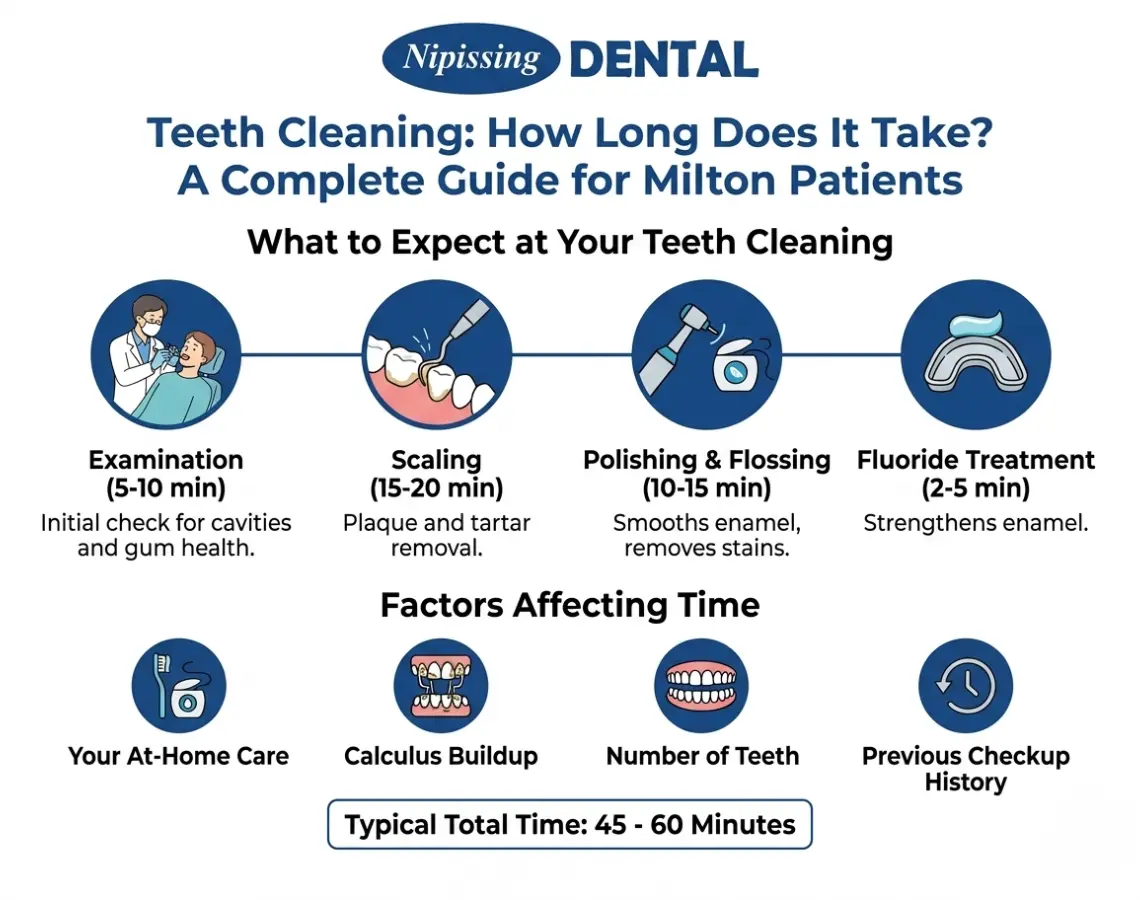
For most adults in Milton, a standard routine cleaning takes between 45 minutes and 1 hour. If it’s your first visit to a new dentist, or if it’s been more than a year since your last appointment, plan for closer to 90 minutes — the hygienist will also complete a thorough oral health assessment.
Here’s how a typical appointment at a Milton dental office breaks down:
| Step | What Happens | Estimated Time |
|---|---|---|
| 1. Health history review | Medications, conditions, changes since last visit | 5–10 min |
| 2. Oral exam & X-rays | Gum pockets, bone levels, bite assessment | 10–15 min |
| 3. Scaling | Plaque and tartar removal above and below gumline | 15–25 min |
| 4. Polishing | Removes surface stains, smooths enamel | 5–10 min |
| 5. Flossing & fluoride | Interproximal cleaning, fluoride application | 5–10 min |
| 6. Dentist exam & plan | Final check, treatment discussion, next steps | 10–15 min |
The time varies based on how much tartar has accumulated, your current gum health, and whether digital X-rays are needed that day. Children’s cleanings typically run shorter — around 30 to 45 minutes.
Before and After Dental Cleaning: What to Expect
Before Your Appointment
No special preparation is needed for a routine cleaning. Brush and floss as normal. If you experience dental anxiety — which is far more common than most people admit — let the team know when you book. Many practices offer comfort options including numbing gels, music, and adjusted technique.
Immediately After Your Cleaning
Your teeth may feel more sensitive along the gumline for a few hours post-cleaning. That’s completely normal and resolves on its own. Your gums may look slightly pink or feel tender if tartar buildup was significant. Many patients are also pleasantly surprised to notice their teeth look noticeably brighter — not from whitening, but simply from the removal of staining and tartar that had accumulated over time.
How Long After Teeth Cleaning Can You Eat?
For a standard cleaning without fluoride, you can eat right away. If your hygienist applied a fluoride varnish, the standard recommendation from the American Dental Association (ADA) is to wait at least 30 minutes before eating, drinking, or rinsing — this allows the fluoride to absorb fully into the enamel.
What Not to Eat After Teeth Cleaning
For the first few hours, especially if your teeth feel sensitive, be mindful of what you consume:
Avoid for 2–4 hours:
- Very hot or cold beverages
- Citrus fruits and acidic juices
- Sticky or chewy candies
- Carbonated soft drinks
- Deeply pigmented foods (berries, tomato sauce, soy sauce)
- Alcohol-based mouthwash (if fluoride was applied)
Safe to eat right away:
- Lukewarm water
- Soft cooked vegetables or pasta
- Eggs (scrambled or soft-boiled)
- Yogurt or cottage cheese
- Bananas and other soft fruits
- Mild soups (not too hot)
Does Teeth Cleaning Remove Black Stains?
This is one of the most frequently asked questions at Milton dental offices — and the answer depends on what’s causing those stains.
Professional scaling and polishing can remove:
- Coffee, tea, and red wine surface stains
- Tobacco staining
- Black or brown tartar (calculus) deposits along the gumline
- General food-related discolouration
Professional cleaning cannot remove:
- Internal (intrinsic) stains from medications like tetracycline
- Staining caused by dental fluorosis
- Discolouration from trauma to a tooth
If visible black or dark deposits remain after a cleaning, your dentist can discuss whitening treatments, microabrasion, or veneers depending on the cause. If you’re noticing dark lines along your gumline that you haven’t addressed, book an appointment — this can be calculus, but it may also indicate early decay that needs professional attention.
How to Clean Stained Teeth at Home Between Appointments
Professional cleanings are irreplaceable — but your at-home routine is what protects the results between visits. A few practical habits that genuinely make a difference:
Brush twice daily using a fluoride toothpaste and a soft-bristled brush. Electric toothbrushes have strong evidence for superior plaque removal over manual brushing.
Floss at least once a day. This reaches the 35% of tooth surfaces your brush simply cannot access. Water flossers are a good complement but not a full substitute.
Rinse after staining drinks. Coffee, tea, and red wine leave residue quickly. A simple water rinse immediately after reduces their staining impact significantly.
Use a whitening toothpaste carefully. Some whitening toothpastes are abrasive enough to wear enamel with daily long-term use. Ask your hygienist which product is appropriate for your enamel strength.
Avoid DIY scraping or acidic home remedies. Scraping teeth with sharp tools, or rubbing with lemon and baking soda, can cause irreversible enamel and gum damage. Always consult your dental hygienist before trying any at-home whitening method.
How Often Should You Have Your Teeth Cleaned?
Every 6 months is the standard recommendation — and it’s one the Canadian Dental Association supports as a general baseline for most healthy adults. That said, the right frequency for you personally depends on your gum health, cavity risk, saliva composition, and overall home care routine.
Patients with active or treated periodontal disease often benefit from maintenance cleanings every 3 to 4 months. These are sometimes called periodontal maintenance appointments, and they differ slightly from a standard cleaning in focus and technique.
Children and teenagers are typically seen every 6 months, though your dentist will adjust based on cavity risk and orthodontic factors.
Here’s a straightforward way to think about it: the cost of two cleanings per year is a fraction of what a single cavity, crown, or extraction costs. Preventing the problem will always be more affordable — and more comfortable — than treating it.
Is It Painful to Get Your Teeth Cleaned?
Most routine cleanings cause minimal to no pain. You’ll feel pressure and the scraping sensation of the scaler, particularly around sensitive gum areas, but sharp pain shouldn’t be part of the experience.
If you have inflamed gums, significant tartar buildup, exposed root surfaces, or dental sensitivity, the process can be more uncomfortable. That’s exactly the kind of thing worth mentioning before the hygienist begins — not after.
For patients with dental anxiety or sensitivity, asking for a topical numbing gel at the gumline makes a real difference. Deep cleanings are done with local anaesthetic as standard.
The most reliable way to have a comfortable cleaning experience is straightforward: keep your appointments regular. When cleanings happen every 6 months, there’s simply less to remove, and the procedure is faster and more comfortable every time.
Conclusion
A routine teeth cleaning in Milton takes around 45 minutes to an hour — a small commitment that delivers lasting returns for your oral and overall health. Whether you’re overdue for a standard cleaning, dealing with stubborn staining, or wondering if you might need a deep clean, the right next step is booking an appointment and having an honest conversation with your dental team.
At Nipissing Dental, every visit is built around making you comfortable, informed, and confident about your oral health. Regular professional cleanings — backed by a solid home care routine — remain the single most effective thing most people can do to protect their teeth for life.
References & Trusted Sources
- Canadian Dental Association — Oral Health Resources — Guidelines on periodontal health, brushing, and preventive care
- American Dental Association — Topical Fluoride — Fluoride application clinical recommendations
Frequently Asked Questions
How long does deep teeth cleaning take?
A full deep cleaning (scaling and root planing) takes 2 to 4 hours total, usually divided into two appointments treating one side of the mouth at a time. Each session runs approximately 1 to 2 hours with local anaesthetic.
How often do I need to clean my teeth professionally?
Every 6 months is the standard guideline from the Canadian Dental Association for most adults. Patients with gum disease history or high tartar buildup benefit from cleanings every 3 to 4 months.
What should you not eat after teeth cleaning?
Avoid very hot or cold drinks, citrus, sticky sweets, and dark-coloured foods for a few hours after cleaning. If fluoride was applied, wait 30 minutes before eating or rinsing anything.
How long to wait to eat after teeth cleaning?
You can eat immediately after a standard cleaning. If fluoride varnish was applied, wait at least 30 minutes to allow the fluoride to absorb fully into enamel.
Is it painful to get your teeth cleaned?
Routine cleanings are not typically painful — you’ll feel pressure and scraping. If your gums are inflamed or you have sensitivity, tell your hygienist beforehand so they can use numbing gel or adjust their approach.
Ready to Feel at Ease at the Dentist?
Our team at Nipissing Dental is here to make every visit as comfortable and stress-free as possible. Take the first step toward better oral health today.