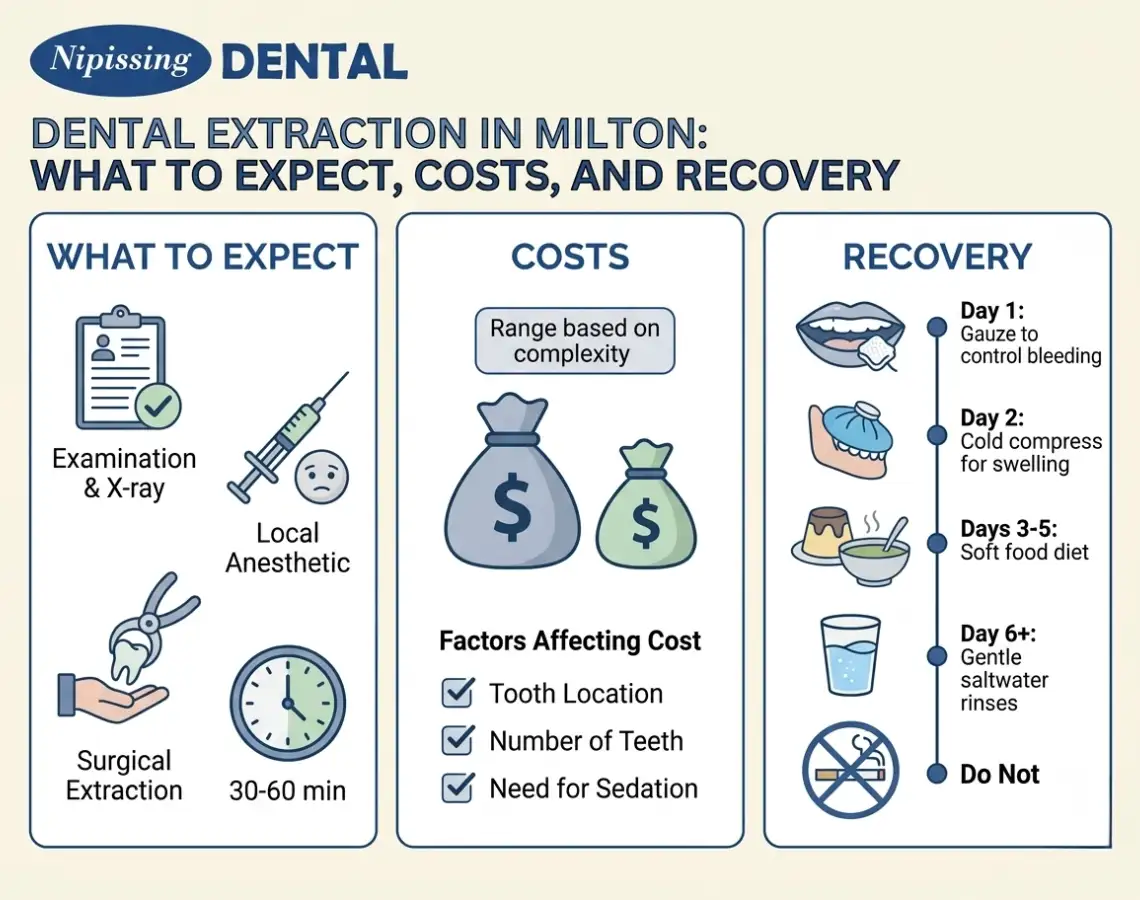
If you’ve been told you need a dental extraction, it’s natural to have questions — about the procedure itself, the cost, and how to recover. Whether you’re dealing with a painful wisdom tooth, a severe infection, or preparing for orthodontic treatment, understanding the process can make a significant difference in your comfort and outcome.
This guide walks you through everything you need to know about tooth extraction in Milton, Ontario — from when it’s recommended to what aftercare looks like. We’ve also answered the most common questions patients ask, so you can feel confident and informed before your appointment.
What Is a Dental Extraction?
A dental extraction is the clinical removal of a tooth from its socket in the jawbone. Also referred to as tooth removal or dental tooth extraction, it is one of the most common oral health procedures performed at dental offices in Canada.
There are two main types:
- Simple extraction — performed on teeth that are visible above the gum line, typically under local anaesthetic.
- Surgical extraction — required when a tooth is impacted, broken beneath the gum line, or has complex root anatomy.
In both cases, your dentist or oral surgeon will ensure you are fully comfortable before beginning the procedure.
When Is a Tooth Extraction Recommended?
Not every dental problem requires extraction. Your dentist will always explore options to preserve the natural tooth first. However, extraction becomes the appropriate course of action in situations such as:
- Severe tooth decay that cannot be treated with a filling or crown
- Dental extraction infection that has spread to the surrounding tissue or bone
- Overcrowding when preparing for braces or orthodontic alignment
- Impacted wisdom teeth causing pain, swelling, or crowding
- Emergency dental extraction due to trauma or irreparable fracture
- Preparing for dentures or implant-supported prosthetics
If you are experiencing acute dental pain, visible swelling, or signs of infection, it is important to seek emergency dental care promptly rather than waiting for a scheduled appointment.
How Much Does a Dental Extraction Cost in Milton?
One of the most frequently searched questions in our area is: How much is a dental extraction? The cost of tooth removal in Milton depends on several factors:
- The complexity of the extraction (simple vs. surgical)
- Whether sedation or general anaesthetic is required
- The tooth’s location and root structure
- Your dental insurance coverage and annual maximum
The cost of a dental extraction in Milton depends on several factors, including the complexity of the procedure, the condition of the tooth, and whether it requires a simple or surgical approach. Additional elements like X-rays, anesthesia, and follow-up care can also influence the overall cost. If you have dental insurance, a portion of the treatment is often covered. For the most accurate estimate, it’s best to consult your dentist and request a personalized treatment plan.
At Nipissing Dental, we believe in transparent pricing. We will provide you with a full treatment estimate and help you understand your dental benefits before proceeding with any procedure.
What to Expect During the Procedure
Many patients are surprised to find that tooth extraction is far more comfortable than they anticipated. Here is a general overview of what the procedure involves:
1. Consultation and Imaging
Before any extraction, your dentist will review your dental and medical history and take digital X-rays to assess root structure, bone density, and proximity to adjacent teeth or nerves.
2. Anaesthesia
A local anaesthetic is used to fully numb the treatment area. For patients with dental anxiety or those undergoing multiple extractions, sedation options may also be discussed.
3. The Extraction
For a simple extraction, the dentist loosens the tooth using a dental instrument called an elevator, then removes it with forceps. For surgical cases, a small incision may be made in the gum tissue to access the tooth or remove it in sections.
4. Post-Extraction Care
Gauze is placed over the socket to help a blood clot form. Your care team will provide detailed aftercare instructions before you leave the office.
Same Day Tooth Extraction and Dental Implant Options
A growing number of patients in Milton are asking about same-day tooth extraction and dental implant placement. In select cases — where bone density is adequate, and infection is absent — it may be possible to place an implant immediately following extraction. This approach, often called immediate implant placement, can reduce overall treatment time and the number of surgical appointments required.
Dental implants placed on the same day as extraction are not suitable for every patient. Your dentist will evaluate your bone structure, oral health, and overall health history to determine whether this option is appropriate for you.
Recovery After a Dental Extraction: What You Need to Know
Proper aftercare following a tooth removal significantly affects healing time and comfort. Most patients recover within 3 to 7 days for a simple extraction, while surgical cases may take 1 to 2 weeks for initial healing.
Key Aftercare Guidelines
- Bite gently on the gauze pad for 30 to 45 minutes to help the clot form
- Avoid rinsing, spitting forcefully, or using a straw for the first 24 hours
- Apply an ice pack to the outside of your cheek to reduce swelling
- Take prescribed or over-the-counter pain medication as directed
- Eat soft foods such as yogurt, soup, and mashed potatoes for the first few days
- Keep your head elevated when resting to reduce bleeding
If you are taking blood thinners such as Xarelto or Zometa, it is essential to speak with your dentist and your prescribing physician before the procedure. Patients often ask how long to hold Zometa after dental extraction or when to resume Xarelto after dental extraction — these decisions must be made in consultation with your healthcare providers, as protocols vary based on the medication and individual risk factors.
Potential Complications and When to Call Your Dentist
While dental extractions are routine procedures with high success rates, it is important to be aware of signs that may require follow-up care:
- Dry socket — when the blood clot is dislodged before healing is complete, causing significant pain
- Dental extraction infection — signs include increasing pain after 48 hours, swelling, fever, or discharge
- Dental extraction pain that worsens rather than improves after 72 hours
- Excessive bleeding that does not subside with gentle pressure
If you experience any of these symptoms, contact your dental office promptly. Early intervention prevents complications from progressing.
Why Choose a Local Dentist in Milton for Your Extraction?
Choosing a local dental provider for your tooth extraction means you have easy access to follow-up care and a team that knows your oral health history. At Nipissing Dental, our experienced team is committed to making every visit as comfortable as possible — from your initial consultation through to full recovery.
We treat every patient as an individual. We understand that dental anxiety is real, and we take the time to explain each step of the process, answer your questions, and ensure you feel supported throughout your care.
Frequently Asked Questions
How much is a dental extraction in Milton?
Dental extraction costs in Milton can vary depending on the complexity of the procedure. Simple extractions are generally more affordable, while surgical or wisdom tooth removals may be higher due to the additional care required. Many dental insurance plans cover part of the cost, so it’s best to consult your dentist for a personalized estimate
How much does dental extraction cost with insurance?
With dental insurance, the cost of a dental extraction is often partially covered, depending on your plan. Most insurance policies cover a percentage of basic or major procedures, which can significantly reduce your out-of-pocket expense. It’s best to check with your provider and dentist for an accurate estimate based on your coverage.
What is a dental extraction, and when is it necessary?
A dental extraction is the removal of a tooth from its socket in the jawbone. It is recommended when a tooth is severely decayed, infected, impacted, or when space is needed for orthodontic treatment. Your dentist will always consider tooth-preserving alternatives first.
How long does dental extraction pain last?
Mild soreness and tenderness after a simple extraction typically resolve within 3 to 5 days. Surgical extractions may involve discomfort for up to 7 to 10 days. If pain worsens after 48 hours, contact your dentist as this may indicate dry socket or infection.
Can I get a dental implant the same day as an extraction?
In some cases, yes. Immediate implant placement — placing a dental implant the same day as an extraction — is possible when bone conditions are favourable and there is no active infection. Your dentist will assess your individual circumstances to determine whether same day extraction and implant placement is appropriate.
Ready to Feel at Ease at the Dentist?
Our team at Nipissing Dental is here to make every visit as comfortable and stress-free as possible. Take the first step toward better oral health today.